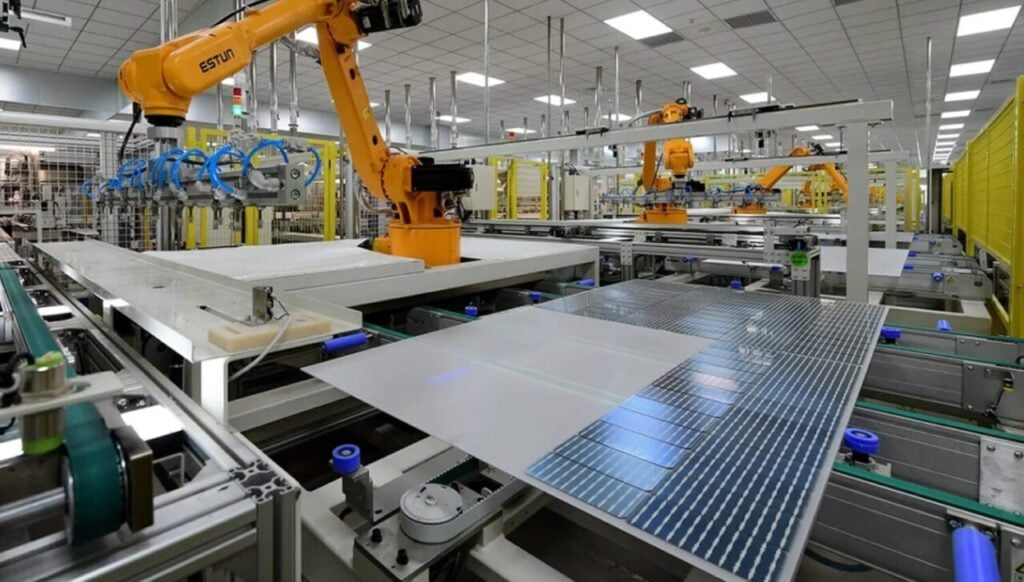
Virginia-based startup MSolar Manufacturing has announced plans to invest US$23.7 million into a new solar manufacturing facility that will produce solar glass, heterojunction technology (HJT) cells and modules.
The facility will be built in Shenandoah County, which sits on the border with West Virginia. The company did not provide an annual manufacturing capacity in megawatts for the facility, nor a prediction of when it would begin commercial operations, but said that it would aim to produce “more than half a million” HJT modules for both the residential and utility-scale sector.
Try Premium for just $1
- Full premium access for the first month at only $1
- Converts to an annual rate after 30 days unless cancelled
- Cancel anytime during the trial period
Premium Benefits
- Expert industry analysis and interviews
- Digital access to PV Tech Power journal
- Exclusive event discounts
Or get the full Premium subscription right away
Or continue reading this article for free
On its website, MSolar claims its panels will have a capacity of 560W and 720W, respectively, and producing exactly half a million of each type would give the facility an annual production capacity of 280MW or 360MW.
This would be a significant development for the Virginia solar manufacturing industry, which has no cell or module manufacturing footprint; according to the US Department of Energy, the state is currently home to one inverter manufacturing facility and one eBOS plant. Domestic module manufacturing is a crucial part of the discussion in the US solar sector at present, and will be discussed in great detail at this month’s PV ModuleTech Conference USA, to be held in California from 16-17 June. PV Tech readers can save 20% with the code PVT20.
“We’re building the foundation of a vertically integrated solar manufacturing platform here in Virginia,” said MSolar CEO Michael O’Connor. “This factory represents the first step in our long-term strategy to expand domestic solar production and deliver high-performance technology for energy projects.”
The emphasis on the manufacturing of upstream components is significant as the US has a major imbalance between cell and module production. Figures from PV Tech Market Research show that the US has just 11GW of domestic cell manufacturing capacity, compared to over 66GW of module capacity, in part due to the complexities of cell manufacturing.
“Cell manufacturing is a much more complex and expensive process than module manufacturing,” PV Tech Research market research analyst Joe Hennessy told PV Tech this morning.
“Another reason is that there were enough cells from abroad before the latest rounds of the anti-dumping and countervailing (AD/CVD) investigations and those tariffs have seemed to move the needle a bit in terms of announcements,” he continued, pointing to the ongoing AD/CVD investigations as an aspect of US policy that has made importing solar products from abroad challenging.
Indeed, the involvement of solar glass, in particular, could speak to MSolar’s interest in the broader “ecosystem of the supply chain,” according to PV Tech head of Market Research Moustafa Ramadan.
“The more interesting piece here is the glass part, which would indicate that MSolar is not just interested in the value chain but also in the ecosystem of the supply chain,” added Ramadan. “It will probably be the first of many solar companies trying to take an active part in other sections of the ecosystem.”
Virginian government stepping up
MSolar’s investment was also announced by Virginia governor Abigail Spanberger, who called building more electricity generation capacity “critical” in the US at present.
“Increasing energy generation is critical to addressing high energy costs and supporting greater economic growth,” said Spanberger. “I congratulate MSolar on this exciting investment and look forward to watching them grow in the Shenandoah Valley.”
The direct support from a state governor is significant in the current US policy landscape. Policies at the federal level, most notably the AD/CVD investigations and foreign entity of concern (FEOC) guidance, are the result of the Trump administration’s protectionist approach to renewable energy trade – building on the measures introduced by previous governments – and have generally been met with pessimism from the industry.
However, individual state government have stepped up to provide policy support for renewable energy that has been lacking from the federal government. Earlier this year, PV Tech Premium spoke to Vote Solar’s Sachu Constantine, who named Spanberger specifically as a newly-elected governor that has made supportive policies for renewable energy a priority.
Hennessy noted, however, that a plant of this size is unlikely to make a significant impact on the US, and Virginia’s, manufacturing sector, “at least immediately”.
“It won’t make a huge impact on the scale of the manufacturing in the country- at least immediately. It’s more about the symbolic value of a vertically-integrated facility and the ability to make cells in the country,” he said. “I would say the US is a very attractive place to manufacture, but it’s part of a growing trend where more companies are willing to manufacture in the US instead of importing cells or modules because of policy risk.”