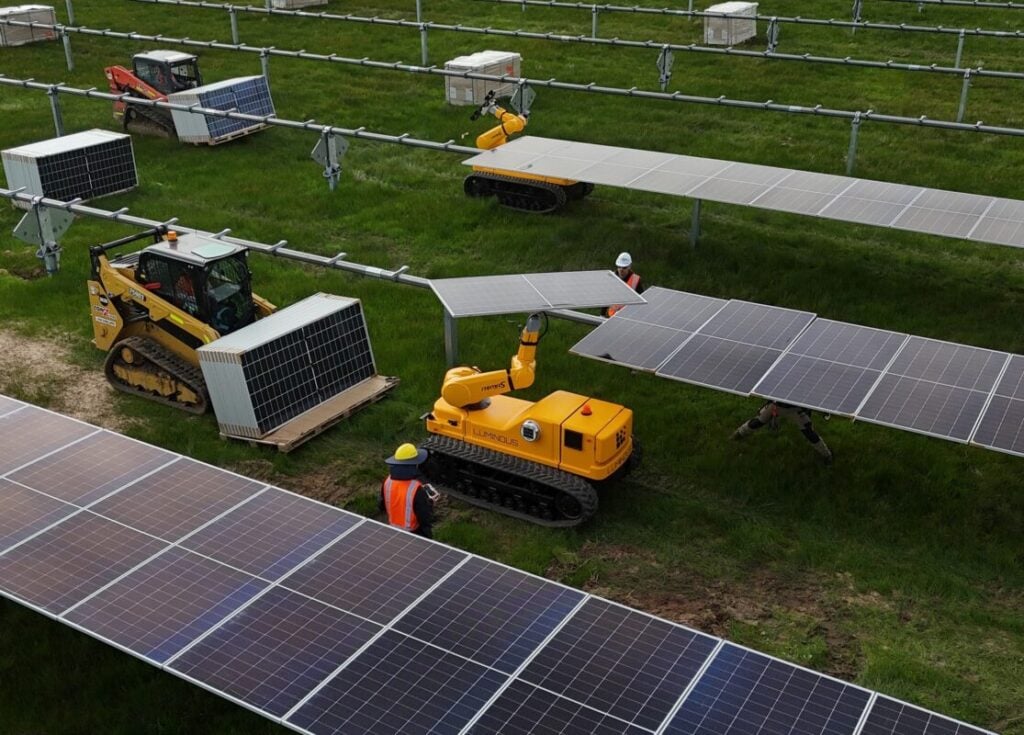
The Australian Renewable Energy Agency (ARENA) is providing up to AU$32.3 million (US$22.3 million) to set up factories in Melbourne and Brisbane for robots that install solar modules and drive foundation piles at utility-scale solar PV power plants.
The funding, which is being allocated to Luminous Robotics, comes from Round 2 of ARENA’s Solar Sunshot Program, an AU$850 million scheme announced by the Australian government in March 2024 to support innovation in solar PV manufacturing.
Try Premium for just $1
- Full premium access for the first month at only $1
- Converts to an annual rate after 30 days unless cancelled
- Cancel anytime during the trial period
Premium Benefits
- Expert industry analysis and interviews
- Digital access to PV Tech Power journal
- Exclusive event discounts
Or get the full Premium subscription right away
Or continue reading this article for free
ARENA is the federal government agency that funds early-stage and commercialising clean energy technology.
It said the projects aim to cut construction costs, speed up building and ease workforce shortages as large-scale solar deployment grows.
Installing foundations and placing modules are two of the most labour-intensive stages of building a solar PV power plant, and the two machines are designed to work on those steps in turn.
Luminous Robotics will receive up to AU$17.8 million to establish a Melbourne factory for its LUMI robots, which use artificial intelligence to place solar modules onto racking structures.
The facility is expected to support the manufacture and deployment of about 100 LUMIs by 2029.
Luminous came through ARENA’s 2024 Solar Challenge, a global call for ideas to reduce the cost of large-scale solar, and LUMI was demonstrated at solar PV power plants in Victoria and New South Wales under Australian construction and environmental conditions.
The new funding is intended to move the technology from field demonstration to production in Australia.
Tenzin Crouch, general manager of Luminous Robotics Australia, said: “Building a production line in Melbourne, delivering our first hundred robots, and then growing from there.”
Built Robotics Australia will receive up to AU$14.5 million for a manufacturing hub and operations centre in Brisbane.
The facility will build, integrate, test, and deploy 12 robotic piling systems to drive the foundation piles that support solar modules.
ARENA said the project builds on earlier deployments of the company’s autonomous piling technology in Australia.
Paul Kelly, vice president of business development at Built Robotics, said: “Australia has shown the world that construction robotics and physical AI work in the field. Now we’re going to build that technology here.”
ARENA CEO Darren Miller said: “Manufacturing these technologies in Australia will help to strengthen local supply chains, develop specialist skills and give solar projects better access to advanced construction equipment when and where it is needed.”
From site trials to local production
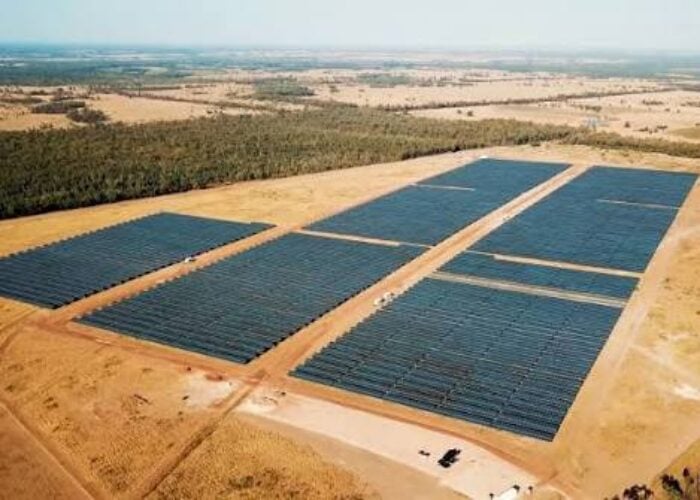
The announcement follows field trials of LUMI at Engie’s 250MW Goorambat East project near Benalla in Victoria.
Luminous, a US company, said its robots exceeded their target production rate there, marking the company’s first deployment outside the US.
Engie, the French energy group, evaluated three robotic systems at the site, including piling robots, and said construction progressed ahead of schedule with their help.
Jay Wong, Luminous’s CEO and founder, said at the time: “Our LUMI robots exceeded our target production rate.”
Luminous received AU$4.9 million in July 2025 from ARENA’s AU$100 million Solar ScaleUp Challenge, a separate scheme, to deploy a fleet of five LUMI robots at Goorambat East and Neoen’s 440MW Culcairn solar PV power plant in New South Wales.
The installation work at both sites was to be carried out with Equans, the engineering and construction company.
ARENA said at the time that LUMI could install modules up to 3.5 times faster than the current workforce and potentially lower plant costs by up to 6.2%. Those are ARENA’s figures from the earlier announcement and were not repeated in the latest one.
Luminous and ARENA also planned to release what they described as the largest solar construction robotics dataset as open source, which was expected within months of the Goorambat East results.
ARENA frames the work as part of its ultra-low-cost solar vision, which targets 30% module efficiency and an installed cost of 30 cents per watt by 2030. That would bring the levelised cost of electricity, the average cost of each unit of power over a plant’s life, below AU$20/MWh.