The Australian Renewable Energy Agency (ARENA) has committed AU$358 million (US$227.8 million) to new projects during the year from 1 July 2022 to 30 June 2023, while it has also assigned AU$41.5 million for ultra low cost solar, a new focus since last year.
In its latest annual report for 2022-2023, ARENA witnessed growth in multiple areas. A total of AU$544 million was approved for new projects for the year from 1 July 2021 to 30 June 2022. AU$358 was committed to new projects, increasing from AU$107 million or by 234.6% year-on-year.
Try Premium for just $1
- Full premium access for the first month at only $1
- Converts to an annual rate after 30 days unless cancelled
- Cancel anytime during the trial period
Premium Benefits
- Expert industry analysis and interviews
- Digital access to PV Tech Power journal
- Exclusive event discounts
Or get the full Premium subscription right away
Or continue reading this article for free
Australia has been ramping up its renewables development in recent years and the Australian government even committed AU$4 billion in new investment to the energy transition, and confirmed tenders for renewables and energy storage in its Federal Budget 2023-2024. ARENA, an Australian government statutory agency, started 35 new projects last year, up from 26 new projects in the previous year.
However, ARENA only completed 44 projects from 2022 to 2023 in total, decreasing from 79 during 2021 to 2022.
Regarding solar PV, ARENA stated in the report that Australia had already “made good progress in achieving the lower-cost renewable electricity”. As a result, ARENA’s focus had moved to achieve ultra low cost solar — the key to producing low cost green hydrogen, decarbonising heavy industries, and producing low emissions energy products.
ARENA added that projects selected for funding under last year’s ultra low cost solar PV research and development (R&D) funding round are now underway, striving to achieve its 30/30/30 vision — to improve solar module efficiency to 30% and reduce total construction costs of utility-scale solar farms to 30 cents per watt by 2030.
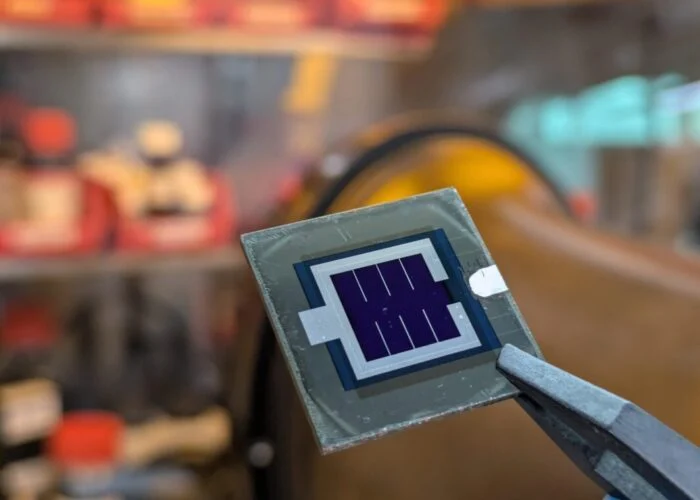
The report also highlighted some projects that ARENA assigned funds. It committed AU$4.3 million in funding support to the Australian National University this year to further develop its monolithic silicon-perovskite tandem (SPT) to the point of commercial production, with significant anticipated production capacity by the end of the project.
According to ARENA, the AU$19.01 million project aims to “develop high-performing, industrially viable polysilicon sub-cells as well as efficient, scalable and stable perovskite sub-cells for SPTs, before testing them on Jinko Solar’s pilot production line”.
PV Tech Premium reported that some of the world’s largest PV manufacturers are committing to perovskites, which could indicate the looming of commercialisation of perovskite-based solar technology.
Prior to this project, ARENA has committed AU$118.5 million in grant funding to 145 solar PV projects with 17 institutions since its inception in 2012. Additionally, ARENA has supported 230 solar PV projects during the same period.
Earlier this year, ARENA unveiled a new round of funding to develop and deploy microgrid technologies across regional and remote communities, with a majority of it allocated for microgrid projects in First Nations communities.
It allocated AU$125 million to the Regional Microgrids Programme, with AU$75 million being used to develop microgrid projects in First Nations communities, delivering cleaner, cheaper and more reliable energy and empowering First Nations communities to participate in their electricity supply arrangements and the development of energy infrastructure.