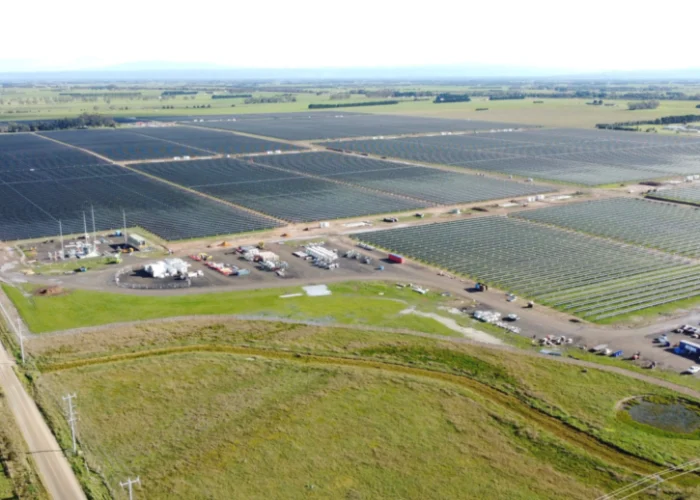
ARRAY Technologies has partnered with Aeeris subsidiary Early Warning Network (EWN) to bring automated hail protection to solar PV plants in Australia.
Under the agreement, ARRAY will use EWN as its hail intelligence provider in Australia, feeding the weather company’s detection and forecasting data into its SmarTrack Hail Alert Response software.
Try Premium for just $1
- Full premium access for the first month at only $1
- Converts to an annual rate after 30 days unless cancelled
- Cancel anytime during the trial period
Premium Benefits
- Expert industry analysis and interviews
- Digital access to PV Tech Power journal
- Exclusive event discounts
Or get the full Premium subscription right away
Or continue reading this article for free
The system then moves modules to their maximum protective tilt angle before a storm arrives, without requiring an operator to make the call.
Neither company has disclosed the financial terms of the deal, its duration or which Australian projects will be the first to use the service.
Sydney-based Aeeris is listed on the Australian Securities Exchange (ASX) and provides real-time severe-weather forecasting and alerts to customers in the energy, infrastructure, insurance, and government sectors.
EWN’s hail monitoring combines radar coverage across Australia, verification by its meteorologists and its own detection algorithms.
ARRAY, which is listed on Nasdaq, has supplied trackers in Australia since 2017, when it won contracts for six utility-scale projects in Queensland and Victoria. It launched Hail Alert Response in the US in March 2024 and added a 60-degree version of its DuraTrack tracker in July, aimed at hail-prone regions such as Texas.
The company says its trackers stow more reliably in bad weather because they use an AC grid-powered motor and wired communications, rather than on-board battery storage and wireless links that storms can disrupt.
Francesca Lucia Falcone, ARRAY’s business development director for the Asia-Pacific region, said the integration “greatly improves the bankability” of Australian solar projects.
Henrik Thorup, executive chairman of Aeeris, said it would help protect solar assets on the grid “from the rising risks of damaging hail”.
Hail risk and insurance
ARRAY said Australia’s utility-scale solar capacity has grown significantly in recent years. Much of that capacity sits in regions prone to severe convective storms, and the company said insurance underwriters have flagged hail as a growing risk.
The pattern is clearer in the US, where hail accounted for only 6% of solar loss incidents but 73% of financial losses in kWh Analytics’ 2025 data. The insurance analytics firm’s 2026 Solar Risk Assessment found that 52% of the contiguous US needs protection beyond standard 2mm glass-glass modules and argued that stowing at 70 degrees or more does more to cut losses than tougher modules alone.
Operators have reported results from automated stow in the field. At a project in Lubbock, Texas, trackers moved modules to 60 degrees ahead of a forecast storm and held them there for three hours, according to a paper in kWh Analytics’ Resilient Power Report 2026.
The site lost less than 0.018% of its modules and the operator filed no insurance claims for the array.
Other research has questioned the limits of stow. Researchers at kWh Analytics have argued that standard impact models may overstate the protection that high stow angles provide by nearly 50%, and recommend combining stow with thicker glass.
They also noted that some insurers now ask owners to document their hail protection measures, which ARRAY says the EWN data will help its customers to do.