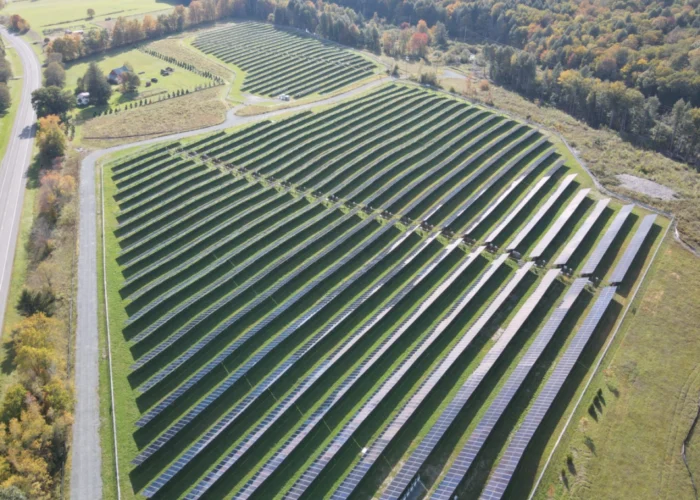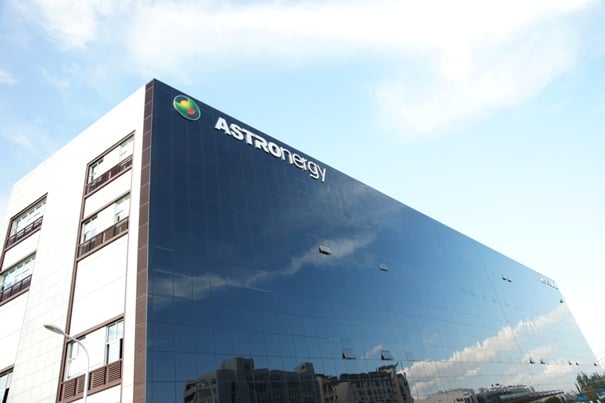
Chinese module manufacturer Astronergy has designed a solar PV, battery storage and building integrated photovoltaics (BIPV) micro-grid system for the Haining Zhengtai Industrial Park.
Located between the eastern Chinese cities of Hangzhou and Jiaxing, the park is home to high-end equipment manufacturing and advanced information technology companies.
Try Premium for just $1
- Full premium access for the first month at only $1
- Converts to an annual rate after 30 days unless cancelled
- Cancel anytime during the trial period
Premium Benefits
- Expert industry analysis and interviews
- Digital access to PV Tech Power journal
- Exclusive event discounts
Or get the full Premium subscription right away
Or continue reading this article for free
Astronergy said industrial parks’ demand for energy security is “booming” amid a climate of rising costs and needs.
Its solution has been to create a 5.9MW distributed solar power system built within the factory alongside a DC coupling micro-grid system. The micro-grid integrates an 8.83kW BIPV PV hut, a 50kW BIPV PV parking shed, a 4.5kW PV road and ribbon-shaped PV corridor, a 35kW PV lab and a 5kW vertical axis wind turbine.
Astronergy said developing low-carbon and zero-carbon buildings is important for energy conservation, emission reduction and environmental protection. “Every year, there are about 4 billion square meters of housing area being constructed, among which 5% uses BIPV,” the company claimed, adding the BIPV market will soon be worth RMB100 billion (US$14.6 billion).
The energy generation technologies are connected to the micro-grid through intelligent power electronic conversion equipment, Astronergy said. There is also a 50kW/100kWh energy storage system to support generation fluctuation smoothing, system load shifting and uninterrupted voltage support for sustained power supply to the companies within the park.
Established in 2006, Astronergy has manufacturing bases in the Chinese provinces of Zhejiang, Jiangsu and Gansu as well as Thailand. By the end of 2022, Astronergy said its solar cell production capacity will reach 13GW, while its module production capacity will reach 18GW.
In April, Astronergy announced its plans to launch its first TOPCon n-type modules under its ASTRO series that contains three new n-type products covering M10 and G12 cells, catering for different markets from residential to utility-scale and commercial & industrial (C&I).