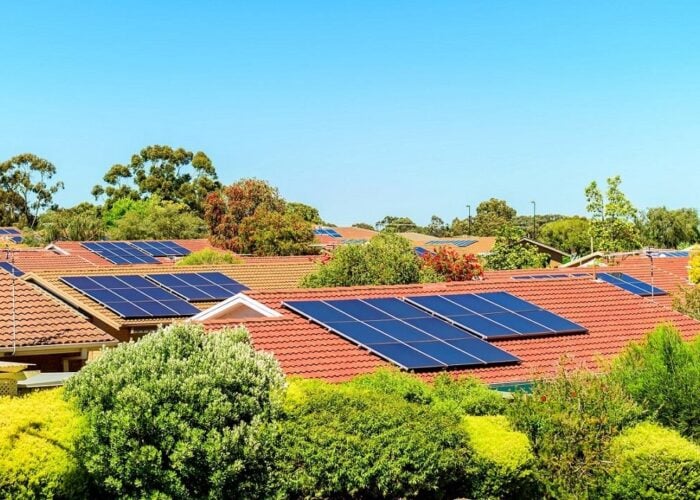
Australia has reached 26.8GW of installed rooftop solar at the end of the first half of 2025, according to a report from the Clean Energy Council (CIC).
In the bi-annual Rooftop Solar and Storage Report, the CEC expects that the country will exceed its 2030 target for rooftop solar set at 36GW, thanks to its year-on-year installation rate. The CIC forecasts 37.2GW of installed rooftop solar by June 2030, beating projections by 3.3%.
Try Premium for just $1
- Full premium access for the first month at only $1
- Converts to an annual rate after 30 days unless cancelled
- Cancel anytime during the trial period
Premium Benefits
- Expert industry analysis and interviews
- Digital access to PV Tech Power journal
- Exclusive event discounts
Or get the full Premium subscription right away
Or continue reading this article for free
During H1 2025, rooftop solar provided 12.8% of Australia’s electricity generation.
Between January and June 2025, 1.1GW of rooftop solar was installed in Australia, a 15% decrease from the 1.3GW of installed rooftop PV in the same period in 2024.
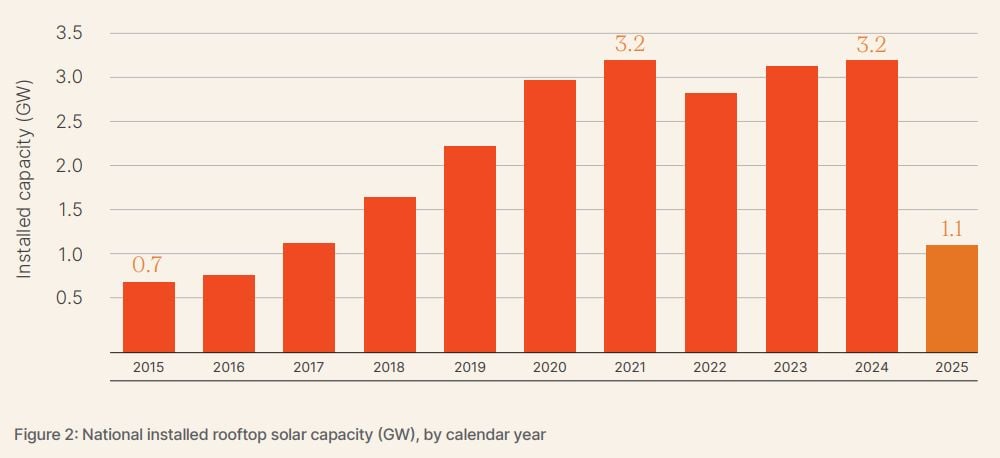
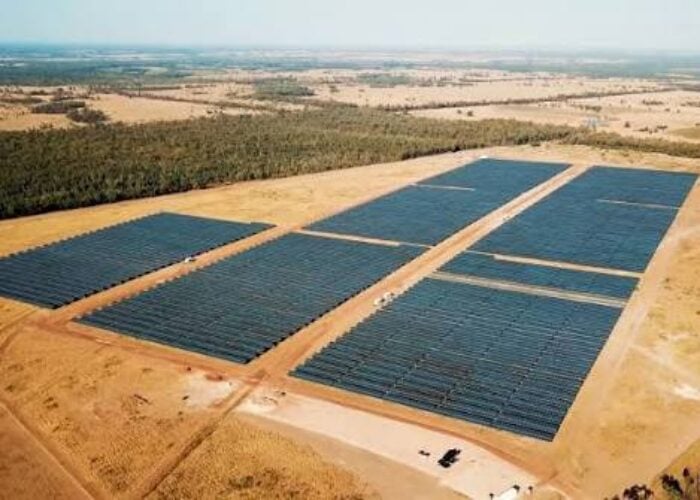
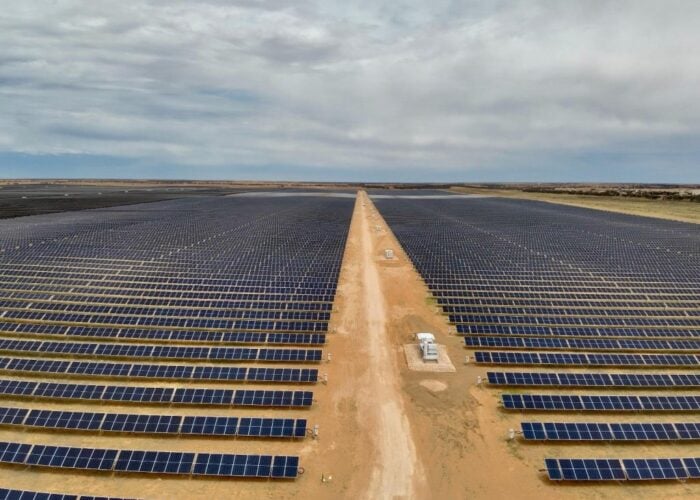
Despite the slower pace on a yearly basis, the rooftop solar numbers for H1 2025 are almost on par with the large-scale solar capacity commissioned (1GW) during the same period.
Home batteries, on the other hand, are growing rapidly, with 85,000 new units sold in H1 2025. This is a 191% increase from the same period last year. Cumulative installed batteries have doubled year-on-year to 271,000 across the country.
According to the CIC, installing a rooftop solar system can lead to AU$1,500 (US$999) yearly savings on the energy bill for a household, which can nearly double by adding a battery.
“Just as Australians have long understood the value of solar in lowering household energy bills, we are now seeing a surge in battery adoption, which allows households to store their own clean energy and maximise savings,” said Con Hristodoulidis, General Manager – Distributed Energy at CIC.
Moreover, the other positive aspect is that the average system size keeps increasing, with a six-month rolling average of 10.2kW per system. This represents a 4.1% increase when compared to the same period a year ago.
Region-wise, Queensland added the most rooftop solar with 326MW, followed by New South Wales with 321MW and Victoria with 230MW. In terms of cumulative installed capacity, the order changes slightly. New South Wales leads the country with 7.5GW of installed rooftop solar, closely followed by Queensland with 7.2GW, while Victoria closes the podium with 5.4GW.