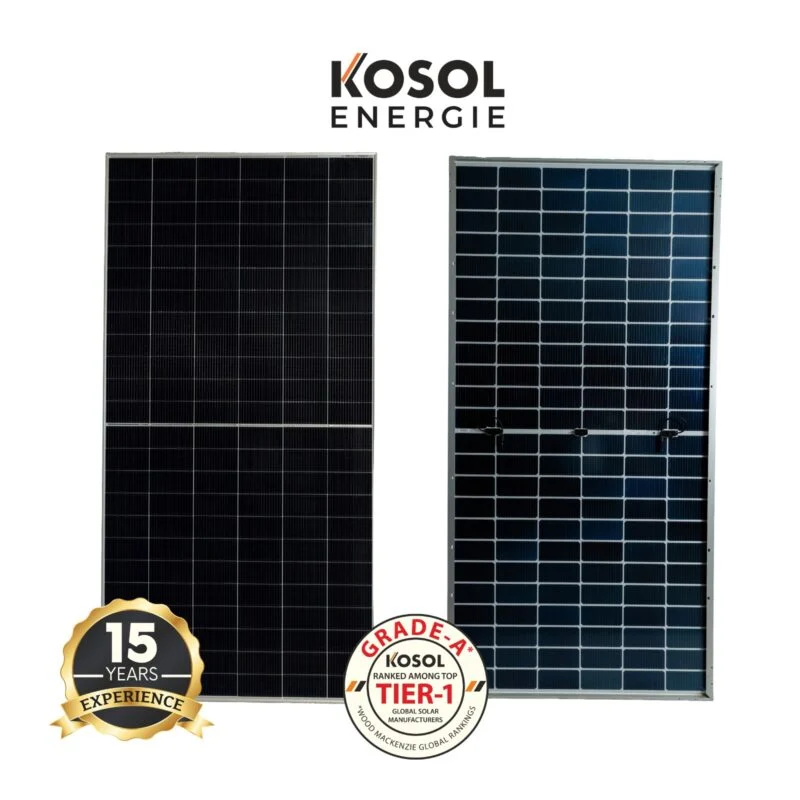
Indian solar module manufacturer Kosol Energie has launched a new n-type glass-glass hail-resistant module.
The new hail-resistant modules are qualified for 35mm hail impact testing, and the company said the modules have undergone successful testing at a National Accreditation Board for Testing and Calibration Laboratories (NABL)-approved International Electrochemical Commission (IEC) laboratory, demonstrating enhanced resistance to glass damage and microcracks caused by hail impacts.
Try Premium for just $1
- Full premium access for the first month at only $1
- Converts to an annual rate after 30 days unless cancelled
- Cancel anytime during the trial period
Premium Benefits
- Expert industry analysis and interviews
- Digital access to PV Tech Power journal
- Exclusive event discounts
Or get the full Premium subscription right away
Or continue reading this article for free
Kosol added that the modules are manufactured using thermally tempered high-strength solar glass that provides improved mechanical strength and impact resistance. It has also used a higher gram per square metre of Polyolefin Elastomer (POE) encapsulation to further strengthen the durability and offer a bigger cushioning to solar cells during transportation, vibration, thermal cycling and hail impact.
On top of that, the modules also feature high-transmission Anti-Reflective Coated (ARC) glass, which enables greater light absorption and improved energy generation, while maintaining high conversion efficiency under diverse climatic conditions.
The newly introduced modules are available in 600Wp, 620Wp, and 630Wp variants and are fully compliant with IEC 61215:2021 standards. They are also available in Bureau of India Standards (BIS)-certified domestic content requirement (DCR) configurations, including G12R and G12 models, supporting the growing demand for domestically manufactured solar modules in India.
Kalpesh Kalthia, chairman and managing director at Kosol Energie, said: “The future of solar energy depends not only on higher efficiency but also on long-term reliability under increasingly challenging weather conditions. Our enhanced n-Type glass-to-glass modules are engineered to deliver exceptional durability, helping customers maximise energy generation while reducing long-term operational risks.”
In the past few months, several solar module manufacturers have launched hail-resistant models that have been developed to withstand hailstorms. At this year’s Intersolar Europe event, Chinese solar PV manufacturer LONGi unveiled the Hi-Mo 9 Ice-Shield module intended for hail-prone environments, while in May Thornova Solar launched its own module engineered to withstand extreme hail conditions.
Hail was also a key topic of conversation during PV ModuleTech USA (subscription required) in June of this year both as a continued concern and also from manufacturers with many offering hail-resistant PV modules.
Hailstorms have been highlighted as one of the biggest challenges for solar PV project performance in the US. US-based climate insurance provider kWh Analytics published a report in May 2026 mentioning the need for better hail projections in solar PV projects built in the US.
A year before, kWh Analytics had released a report that showed the financial impact of severe hail on solar installations, with hail accounting for 73% of financial losses for US solar PV projects despite representing only 6% of the total number of incidents.
Canadian Solar receives FM Approvals recognition for TOPCon, HJT hail-resilient modules
In similar news, last week (30 July) solar PV manufacturer Canadian Solar received recognition from FM Approvals—a third-party testing and certification agency—under its FM 4478 and FM 4480 component certifications for its US-manufactured TOPCon and heterojunction Low Carbon hail-resilient modules.
According to the manufacturer, its modules are the first FM Approvals PV modules listed as identified components for severe hail zones.
In order to achieve the FM listing, the modules passed a series of tests designed to evaluate their ability to withstand the demanding environmental and mechanical stresses encountered by utility-scale solar PV projects. These include:
- Hail Damage Resistance Testing per ANSI/FM Approvals Standard for Ground-Mounted or Elevated Photovoltaic Module System, Class 4480.
- Design Qualification and Type Approval Testing in accordance with the IEC/EN 61215 series standards.
- Safety Qualification Testing in accordance with IEC/EN 61730-2 and ANSI/UL 61730 requirements.
“As extreme weather events become more frequent, resilience is increasingly critical to solar project success,” added Canadian Solar chairman Shawn Qu.