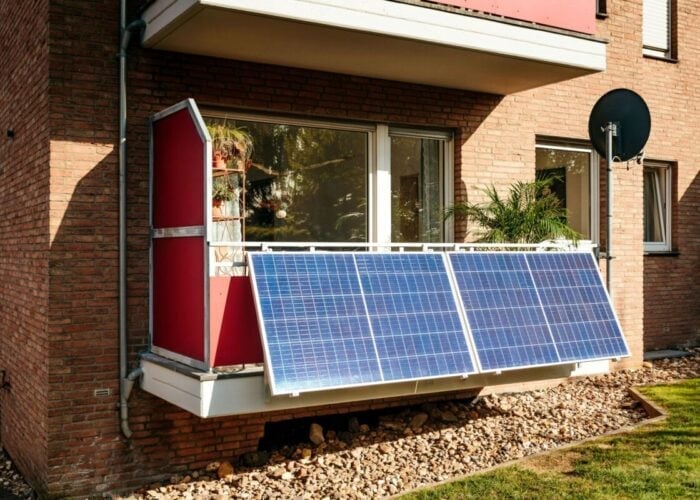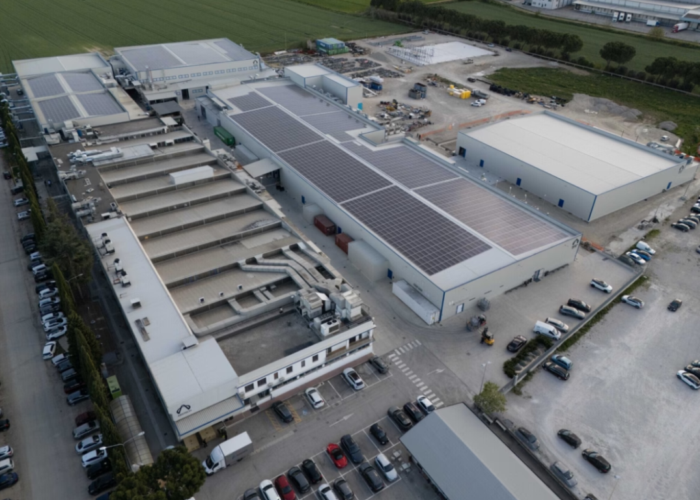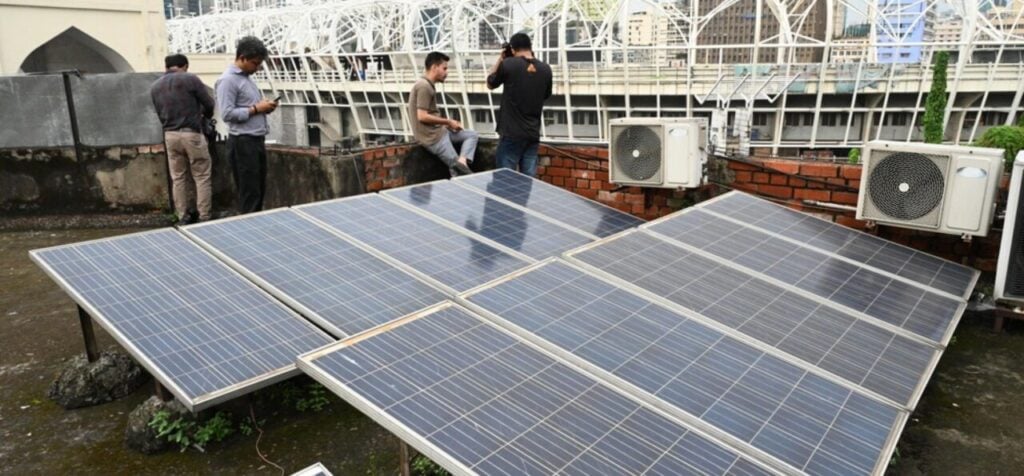
More widespread deployment of rooftop solar PV projects in Bangladesh could save consumers up to US$0.061/kWh, compared to buying power from the grid.
This is according to figures published by the Institute for Energy Economics and Financial Analysis (IEEFA), released last week. According to IEEFA, the levelised cost of electricity (LCOE) for rooftop solar in Bangladesh is around BDT3.5-4/kWh (US$0.028-0.032/kWh), which compares favourably to the US$0.094/kWh tariff set for industries with a load of up to 5MW.
Try Premium for just $1
- Full premium access for the first month at only $1
- Converts to an annual rate after 30 days unless cancelled
- Cancel anytime during the trial period
Premium Benefits
- Expert industry analysis and interviews
- Digital access to PV Tech Power journal
- Exclusive event discounts
Or get the full Premium subscription right away
Or continue reading this article for free
The LCOE of rooftop solar is also notably lower than the evening peak tariff of US$0.13/kWh, which IEEFA notes “will make rooftop solar with battery storage viable” during the evenings.
“The sector is expected to grow further, with engineering, procurement and construction (EPC) companies holding a project pipeline of more than 500MW,” said IEEFA lead energy analyst for Bangladesh Shafiqul Alam, who is also a co-author of a report into the distributed solar sector of Bangladesh, India and Australia, which was published today by IEEFA.
According to this report, government figures for operational rooftop solar capacity—418.1MW—could be underestimating the size of the sector, with IEEFA estimating that there is 667MW of capacity currently in operation. If the definition of rooftop solar is expanded to include projects of less than 0.15MW, the total operational rooftop solar capacity “might” already be around 1GW.
The potential for cost savings associated with rooftop solar is particularly significant in Bangladesh, where the government has repeatedly increased electricity tariffs to reduce the burden of subsidising access to electricity, which has been a key feature of the country’s energy system.
The country’s six major electricity distribution entities serve more than 50 million customers, including around 18 million low-income customers who receive subsidised electricity under government schemes, but financing these subsidies has proven challenging; IEEFA figures show a gap of around US$0.041/kWh between the cost of generating and selling electricity, which the government has sought to plug through frequent increases in tariffs.
The Bangladesh Energy Regulatory Commission (BERC) raised bulk electricity tariffs four times between 2015 and 2023, by as much as 10% in 2023, and earlier this year raised tariffs by 19.85%.
As a result, on-site generation projects, such as rooftop solar, could be an effective way of sidestepping rising costs for using solar power connected to main grid infrastructure. Looking ahead, Alam notes that the government is aiming to deploy more than 10GW of new renewable energy capacity by the end of the decade, of which more than half will be rooftop solar. He estimates that “a full duty waiver to all rooftop solar projects” could be a necessary removal of financial obstacles to facilitate this scale of rooftop solar deployment.
Indian rooftop solar sector has ‘vast potential’
Meanwhile, the IEEFA report described the Indian rooftop solar sector as one of “vast potential,” rather than vast deployments. The institute notes that India’s operational solar PV capacity has jumped from 1.8GW in the 2018 financial year to 31.5GW in the 2026 financial year, but that the share of rooftop solar in the country’s total energy mix has remained at the same level—21-22%—as utility-scale solar has grown at a similar rate.
IEEFA notes that government support schemes have been crucial to facilitating this growth in rooftop solar, highlighting the “flagship” PM Surya Ghar Muft Bijli Yojana and Pradhan Mantri Kisan Urja Suraksha evam Utthaan Mahabhiyan schemes in particular.
However, with the government’s own figures suggesting that India has a maximum technical potential of 637GW of rooftop solar—more than 20 times the current operational capacity—continued policy support may be essential to meet this potential.
“Backed by diverse business models, including capital expenditure (capex), renewable energy service company (RESCO)/operating expenditure (opex) and utility-led implementation models, these schemes have broadened market participation and accelerated distributed energy resource deployment across urban and rural areas,” said IEEFA lead analyst for sustainable finance in South Asia Gaurav Upadhyay, another co-author of today’s report.
Last week, the government approved a INR50.7 billion (US$531.7 million) scheme to deploy 5GW of floating solar PV with battery energy storage systems (BESS) as the state looks to invest in a number of different solar technologies. Other organisations have also invested in India’s distributed solar sector, such as the Asian Development Bank (ADB), which committed a US$850 million loan for residential rooftop solar, in particular, last month.
Australia retains lead in distributed energy deployment
Perhaps unsurprisingly, the IEEFA report describes Australia as a “global leader” in distributed energy deployment, pointing to the fact that solar panels are now installed on around 40% of homes in Australia. The latest figures from Australia’s National Electricity Market (NEM) show that this growth has continued into this summer, with rooftop solar generation increasing 41.7% between June and July this year, and up 17.1% between July 2025 and July 2026.
As is the case in India, supportive policy has supported this depth of deployment. The IEEFA attributes the scale of Australia’s rooftop solar sector to “early feed-in tariffs and government rebates”, and this policy support has continued in more recent years.
Last November, the government obligated energy retailers to provide free solar electricity to households during peak daytime generation periods, and last month the government introduced plans that will require large-scale data centres to become net exporters of renewable energy, although individual jurisdictions have announced opposition to the scheme.
“Rooftop solar has reshaped Australia’s grid, cutting deep into coal’s share of generation,” said IEEFA energy finance analyst for Australia, Jay Gordon, who is another of the report’s co-authors. “Now residential batteries are emerging as the next frontier, with the uptake seen since the launch of the Cheaper Home Batteries Program in July 2025 far exceeding what most forecasts expected.”