CIGS-perovskite tandem cell hits record 24.6% efficiency

Facebook
Twitter
LinkedIn
Reddit
Email
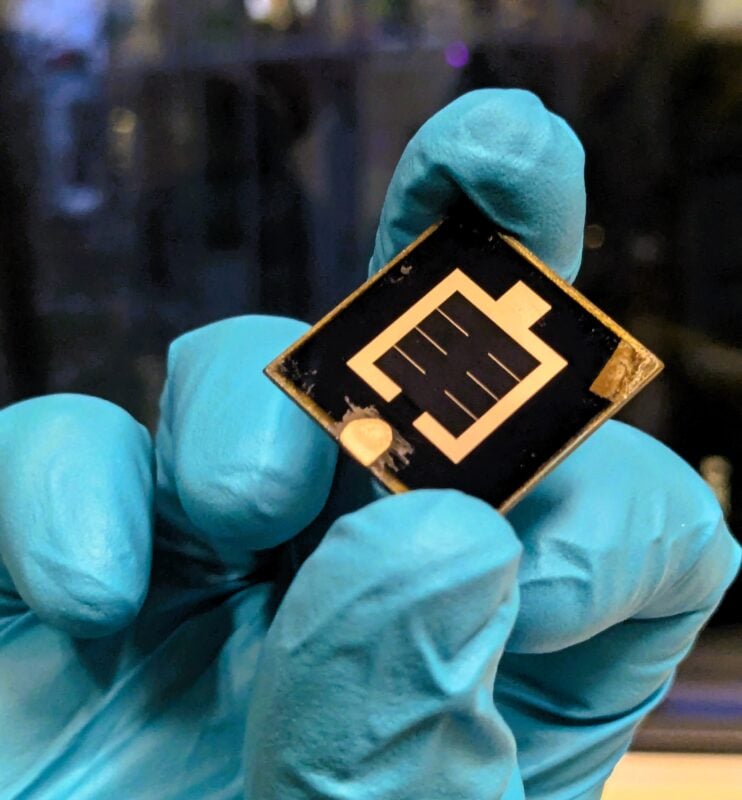
Improved contact layers helped boost the efficiency of the experimental CIGS-perovskite tandem cell to 24.6%. Image: HZB

Researchers from the Helmholtz-Zentrum Berlin (HZB) and Humboldt University Berlin have achieved an efficiency of 24.6% with a copper indium gallium selenide (CIGS) and perovskite tandem solar cell.

The result has been certified by the Fraunhofer Institute for Solar Energy Systems and is a world record conversion efficiency for a CIGS-perovskite cell, according to HZB.

This article requires Premium SubscriptionBasic (FREE) Subscription

Try Premium for just $1

  • Full premium access for the first month at only $1
  • Converts to an annual rate after 30 days unless cancelled
  • Cancel anytime during the trial period

Premium Benefits

  • Expert industry analysis and interviews
  • Digital access to PV Tech Power journal
  • Exclusive event discounts

Or get the full Premium subscription right away

Or continue reading this article for free

The tandem cell combines a bottom cell made of CIGS with a top cell based on perovskite. By improving the contact layers between the top and bottom cells, the researchers were able to increase the efficiency from their previous record of 24.16% to 24.6%.

“At HZB, we have highly specialised laboratories and experts who are top performers in their fields. With this world record tandem cell, they have once again shown how fruitfully they work together,” said Professor Rutger Schlatmann, spokesman for the Solar Energy Department at HZB.

Schlatmann said even higher efficiencies would be possible using the CIGS-perovskite tandem combination. “We are confident that CIGS-perovskite tandem cells can achieve much higher efficiencies, probably more than 30%,” he added.

The challenge for researchers is translating the higher efficiencies of perovskite-based PV technologies into commercially viable products, due to their relative instability in many operating environments.

The latest edition of our quarterly journal, PV Tech Power, explores the road to perovskite commercialisation in more depth. Click here to read more (subscription required).


13 October 2026
San Francisco Bay Area, USA
PV Tech has been running an annual PV CellTech Conference since 2016. PV CellTech USA, on 13-14 October 2026 is our fourth PV CellTech conference dedicated to solar manufacturing in the USA. From polysilicon, wafers, ingots, cells and modules, to critical component suppliers including glass and frames, the event connects every stage of the value chain under one roof. PV CellTech USA also brings together investors, innovators, manufacturers and industry stakeholders to collaborate and strengthen domestic solar manufacturing across the United States.

Read Next

July 1, 2026
Researchers from HZB and Humboldt-Universität in Berlin have achieved a record 25.5% conversion efficiency in a CIGS-perovskite tandem PV cell.
June 18, 2026
Oxford PV and Fraunhofer ISE have unveiled a module prototype that combines tandem perovskite-silicon and matrix shingle interconnection.
June 10, 2026
Solar manufacturer Trinasolar has reached a record peak power output of 907W and a full-area efficiency of 29.2% for a perovskite/crystalline silicon tandem module.
May 6, 2026
Germany's Fraunhofer ISE has opened a new lab to support the commercialisation of perovskite-silicon PV technology.
April 21, 2026
Two US solar companies have made advances in perovskite-silicon solar module production this week, with claims that they mark a step towards making the long-discussed technology commercially viable.
Premium
April 21, 2026
PV Tech Premium spoke with the CEOs of Caelux and Solx about bringing US perovskite technology to the market at large.

Upcoming Events

Solar Media Events
October 13, 2026
San Francisco Bay Area, USA
Solar Media Events
November 3, 2026
Málaga, Spain
Solar Media Events
November 24, 2026
Warsaw, Poland
Solar Media Events
April 20, 2027
Istanbul, Türkiye