Endeas highlights I-V curve measurement issues with high-efficiency PV modules

Facebook
Twitter
LinkedIn
Reddit
Email
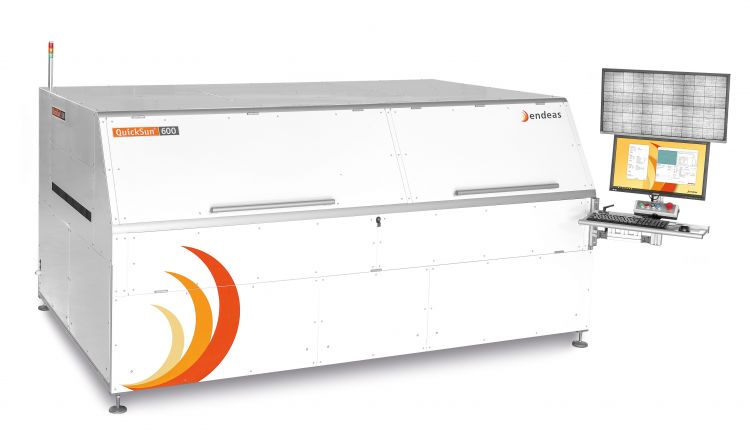
Endeas said it had developed a new method to counter the issues. Its Capacitance Compensation (CAC) technique is said to measure the steady-state I-V curve and maximum power of any PV cell or module based on a single flash pulse of only 40 ms. The method is included in its QuickSun 600 system, an all-in-one module testing station. Image: Endeas Oy

PV module equipment measurement specialist Endeas Oy has developed a new method to measure the steady-state I-V curves in PV modules using high-efficiency solar cells such as PERC, and especially HJT or IBC as solar simulators currently in production applications have limited accuracy, according to the company.

Endeas noted that when measuring I-V curves and maximum power of high-efficiency PV modules, inaccuracies can be discovered, due to the charging of the cells, which leads to a significant underestimation of the maximum power by typical flash testers. 

This article requires Premium SubscriptionBasic (FREE) Subscription

Try Premium for just $1

  • Full premium access for the first month at only $1
  • Converts to an annual rate after 30 days unless cancelled
  • Cancel anytime during the trial period

Premium Benefits

  • Expert industry analysis and interviews
  • Digital access to PV Tech Power journal
  • Exclusive event discounts

Or get the full Premium subscription right away

Or continue reading this article for free

The company noted that increasing the flash pulse length to overcome the issue becomes expensive and comes with additional problems, such as heating of the module during measurement.

Endeas said it had developed a new method to counter the issues. Its Capacitance Compensation (CAC) technique is said to measure the steady-state I-V curve and maximum power of any PV cell or module based on a single flash pulse of only 40 ms. The method is included in its QuickSun 600 system, an all-in-one module testing station.

The Capacitance Compensation method will be presented at the EU PVSEC conference in Brussels on 24 September 2018 by Dr. Henri Vahlman, a scientist at Endeas.

“PV manufacturers are understandably requesting longer and longer flash pulses. They are aware that the maximum power of their high-efficiency products may be underestimated by their current solar simulators, leading them to sell their products at a lower price than necessary”, said Jaakko Hyvärinen, managing director of Endeas. “The new CAC method is perfectly suited for power measurements in PV manufacturing, as measurement results comparable to steady-state solar simulators can be provided for any PV technology with compact and proven flash testers that are straightforward to integrate into a manufacturing line.”

Endeas said that the CAC method was based on measuring the capacitance (ability to store electric charge) of the tested device during the flash pulse. The measured capacitance was taken into account in processing the measurement data, resulting in more accurate steady-state I-V curves and maximum power measurements, according to the company.
16 June 2026
Napa, USA
PV Tech has been running PV ModuleTech Conferences since 2017. PV ModuleTech USA, on 16-17 June 2026, will be our fifth PV ModulelTech conference dedicated to the U.S. utility scale solar sector. The event will gather the key stakeholders from solar developers, solar asset owners and investors, PV manufacturing, policy-making and and all interested downstream channels and third-party entities. The goal is simple: to map out the PV module supply channels to the U.S. out to 2028 and beyond.
13 October 2026
San Francisco Bay Area, USA
PV Tech has been running an annual PV CellTech Conference since 2016. PV CellTech USA, on 13-14 October 2026 is our fourth PV CellTech conference dedicated to solar manufacturing in the USA. From polysilicon, wafers, ingots, cells and modules, to critical component suppliers including glass and frames, the event connects every stage of the value chain under one roof. PV CellTech USA also brings together investors, innovators, manufacturers and industry stakeholders to collaborate and strengthen domestic solar manufacturing across the United States.

Read Next

Premium
May 29, 2026
PV Talk: Kiwa PVEL's Tristan Erion-Lorico discusses highlights in the 2026 Module Reliability Scorecard, including UVID and delamination.
Premium
May 22, 2026
As trade dynamics shift, could the EU become the next big market for Indian solar suppliers? PV Tech Premium explores the outlook with Wood Mackenzie’s Yana Hryshko and IEEFA’s Charith Konda.
May 21, 2026
US solar glass producer Stewart Glass is expanding its facility in Ohio with a new production line expected in 2027.
May 20, 2026
GameChange Solar has partnered with First Solar to support the deployment of domestically manufactured thin-film solar modules in India. 
May 19, 2026
JinkoSolar has partnered with PM Green to supply 200MW of modules, as part of a broader collaboration covering up to 1GW of capacity. 
May 19, 2026
Alex Barrows and Molly Morgan of CRU lay out their predictions for the biggest themes at this year's Intersolar Munich and SNEC conferences.

Upcoming Events

Media Partners, Solar Media Events
June 2, 2026
Johannesburg, South Africa
Media Partners, Solar Media Events
June 3, 2026
National Exhibition and Convention Center (Shanghai)
Solar Media Events
June 16, 2026
Napa, USA
Media Partners, Solar Media Events
June 30, 2026
Sacramento, California
Media Partners, Solar Media Events
August 25, 2026
São Paulo, Brazil