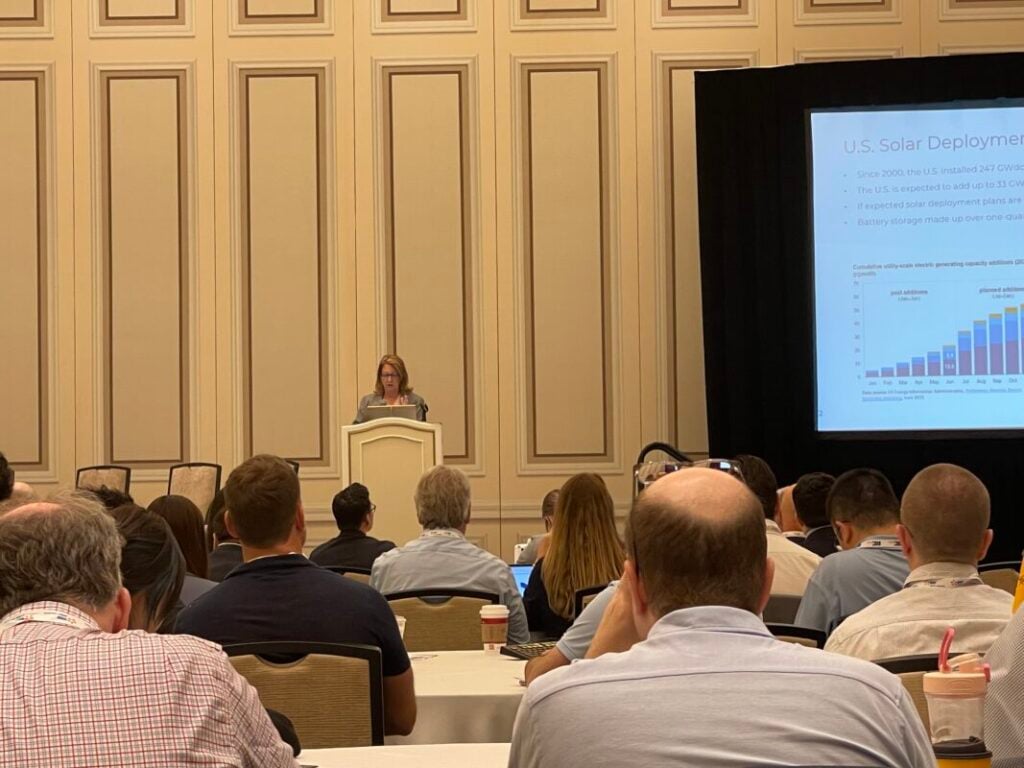
Leading solar industry professionals discussed the importance of US solar PV manufacturing during the Solar—Made in America session at the RE+ trade show in Las Vegas, US.
The session was hosted by TaiyangNews and EUPD Research. It featured presentations from Stacy J. Ettinger, senior vice president of supply chain and trade at the Solar Energy Industries Association (SEIA); John Smirnow, principal at Smirnow Law; and Elissa Pierce, solar module supply chain analyst at Wood Mackenzie.
Try Premium for just $1
- Full premium access for the first month at only $1
- Converts to an annual rate after 30 days unless cancelled
- Cancel anytime during the trial period
Premium Benefits
- Expert industry analysis and interviews
- Digital access to PV Tech Power journal
- Exclusive event discounts
Or get the full Premium subscription right away
Or continue reading this article for free
The presentations focused on solar manufacturing, tariffs and changes to tax credits under the ‘One Big, Beautiful Bill’ (OBBB) Act, compared to the policy framework under the Inflation Reduction Act (IRA), introduced in 2022.
Ettinger started by emphasising the growth of the US solar manufacturing industry, noting that so far this year, the US has added 8.7GW of solar module capacity, bringing the total to over 58GW of production.
In 2024 and 2025, the US increased its solar cell manufacturing capacity by 2GW. If all scheduled factories become operational in 2025, the total capacity could grow to 12.5GW.
Since the federal manufacturing tax credits were passed, mounting infrastructure production sites have grown by 50%.
Solar to grow ‘out of necessity’
However, the passage of the OBBB Act has undermined this growth. The act has shortened the eligibility timelines for several clean energy projects to receive Inflation Reduction Act (IRA) support. Combined with stricter “start of construction” rules, this is expected to result in the loss of tens of gigawatts of planned solar capacity.
According to the new budget rules, solar projects need to start construction by 4 July 2026, or be operational by the end of 2027, to qualify for the 45E Investment Tax Credit (ITC) or 45Y Production Tax Credit (PTC) under safe harbour provisions. These incentives have played a significant role in boosting solar deployment and demand in the US.
Smirnow’s presentation began with a sobering message: “Lobbying 101—solar energy’s hot streak comes to an end, natural gas won this round.”
While Ettinger was one of several speakers to make the point that “the industry will continue to grow out of necessity,” Smirnow noted that there would likely be increased competition from natural gas in the coming years.
An imbalanced supply chain
Pierce, meanwhile, noted that upstream component manufacturing has not kept pace with module manufacturing. Module manufacturers mostly rely on imported components, which makes them susceptible to tariffs.
New antidumping and countervailing duties (AD/CVD) are forcing manufacturers in China, Malaysia, Thailand and Vietnam to close or relocate. In turn, India, Laos, Indonesia and the Philippines are seeing growing solar manufacturing capacity.
However, the US International Trade Commission (ITC) recently voted to continue its investigation into imported solar cells from India, Indonesia, and Laos.
According to Pierce’s presentation, the alleged dumping margins for India are 123%, for Indonesia 94%, and for Laos between 123% and 190%.
Pierce concluded her presentation by highlighting that the solar manufacturing industry will continue to be vulnerable to tariff hikes and policy shifts until the US develops a self-sufficient module supply chain, which will take years.
Currently, the US has increasing capacity that is unlikely to become operational, with several projects in wafer, cell, and module manufacturing either cancelled or paused over the next two years. Meanwhile, the forecasted capacity growth is not keeping up with demand.
‘A national security imperative’
However, Pierce’s presentation highlighted that the IRA has led to more than a sixfold increase in US module manufacturing capacity, now surpassing annual installation figures. While this suggests growth may decelerate in 2026, the rate of manufacturing growth in the last three years has been a positive development.
Looking ahead, Smirnow presented potential pathways to success in the US solar industry beyond the OBBB and the IRA. Smirnow emphasised presenting US solar manufacturing as a “national security imperative,” much like has been done with battery energy storage system (BESS) technology.
Furthermore, Smirnow stated that every part of the supply chain must be “healthy,” and that market protection will grow more important as IRA incentives decrease.