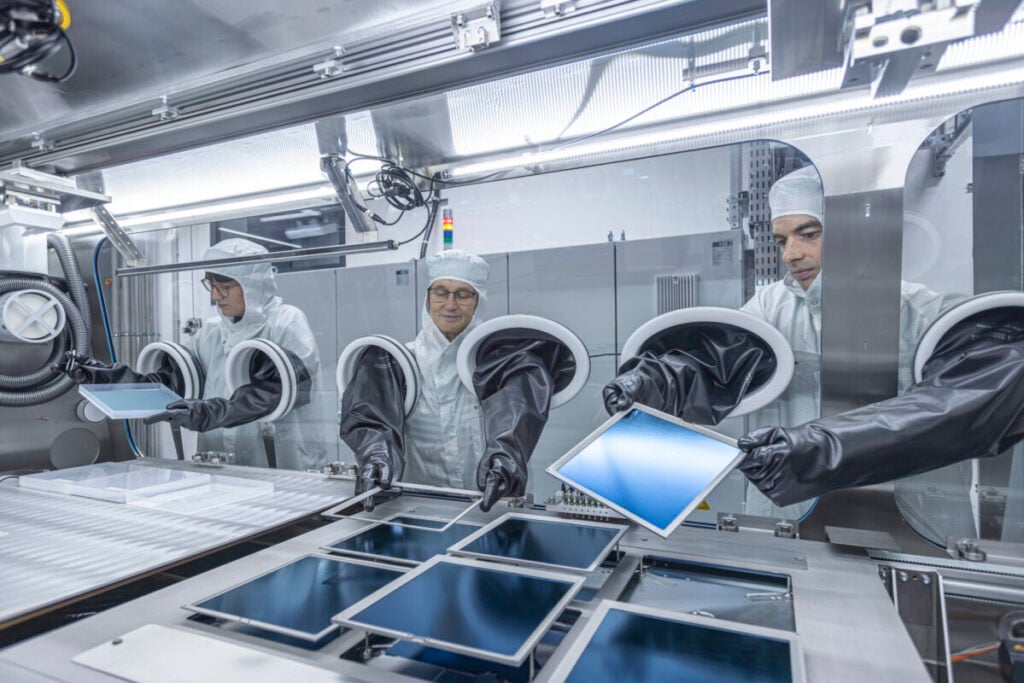
German research body the Fraunhofer Institute for Solar Energy Systems (ISE) has opened a new lab to support the commercialisation of tandem perovskite-silicon PV technology.
The new lab, dubbed “Pero-Si-SCALE”, will provide research and development (R&D) facilities for companies in the German and wider European PV industry. Its goal is to bring industrial tandem PV products to market faster and reduce technological and economic risks.
Try Premium for just $1
- Full premium access for the first month at only $1
- Converts to an annual rate after 30 days unless cancelled
- Cancel anytime during the trial period
Premium Benefits
- Expert industry analysis and interviews
- Digital access to PV Tech Power journal
- Exclusive event discounts
Or get the full Premium subscription right away
Or continue reading this article for free
Fraunhofer ISE said the lab would offer solar cell and module manufacturers with industry-standard manufacturing processes to scale up new tandem cell designs to large cell formats, analyse them and integrate them into modules.
At the facility’s opening, Fraunhofer ISE highlighted the opportunities presented by combining silicon and perovskite technologies, with a perovskite cell just 500 nanometers thick layered onto a conventional silicon solar cell boosting the cell’s theoretical efficiency limit from 29.4 to 43.3%.
“Photovoltaics is far from being ‘fully researched,’” said Stefan Glunz, head of the photovoltaics division at Fraunhofer ISE. “On the contrary, there is still a great deal to be gained here, and tandem solar cells are the key to achieving even greater efficiency. This means more solar energy in a smaller area and with less material usage.”
Fraunhofer said the new Pero-Si-SCALE builds on developments from the laboratory and transfers the innovative cell designs to industrial cell formats—up to a wafer size of 210 by 210 square millimetres—using scalable, high-throughput manufacturing processes. In addition to technologies for manufacturing perovskite-silicon PV cells and modules, the Pero-Si-SCALE also provides a comprehensive characterisation and analysis environment.
Fraunhofer ISE said its approach focuses on the so-called “hybrid route”, which combines vacuum and wet chemical processes for the manufacturing process of perovskite-silicon tandem solar cells. Using this technology, the institute said it had already achieved peak efficiencies of over 33% on a laboratory scale.
An advantage of this process is that “standard”, textured silicon solar cells from the industry can still be used, allowing for direct integration with current solar cell standards and achieving a higher energy yield from the tandem modules.
The opening of the lab comes at a critical time for Europe’s PV manufacturing industry, which has been steadily losing market share to China, despite efforts to revive it.
“Perovskite-silicon tandem solar cells offer an opportunity for a (re)entry into European industrial PV manufacturing,” said Andreas Bett, institute director of Fraunhofer ISE.
Fraunhofer has already notched up some notable milestones in developing perovskite-silicon tandem technologies. In 2024, it revealed details of a full-sized tandem module developed with perovskite specialist Oxford PV with a record efficiency of 25%.