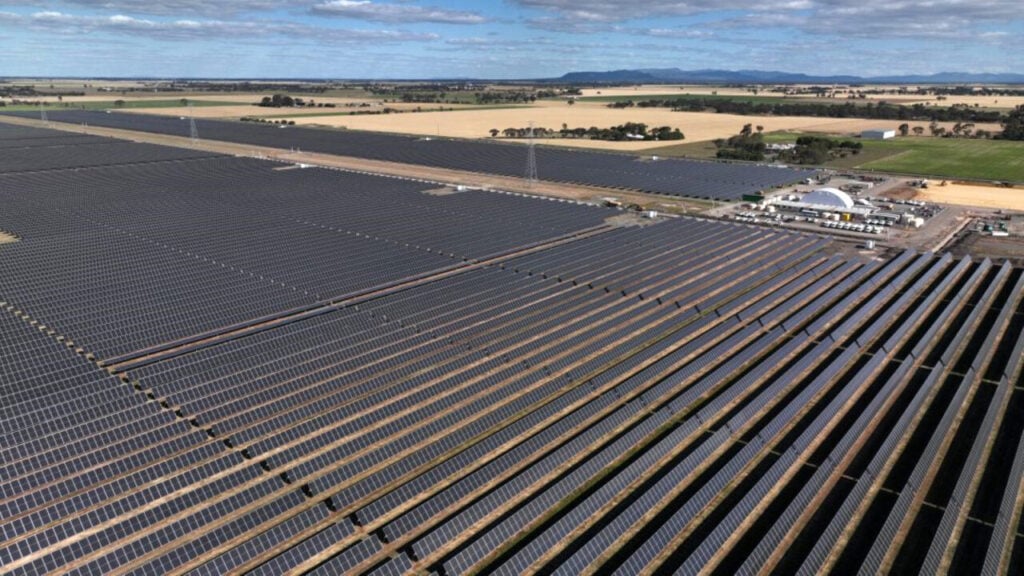
As Australia’s renewable energy sector matures, the coupling of solar and storage is emerging as the dominant paradigm for large-scale projects. George Heynes reports on the transition from standalone solar to hybrid configurations.
Australia’s National Electricity Market (NEM) stands at a pivotal juncture as utility-scale solar developments undergo a fundamental transformation. The convergence of technological advancement, policy innovation and market dynamics is reshaping how developers approach large-scale renewable energy projects, with hybrid solar-plus-storage configurations emerging as the dominant paradigm for new developments.
Try Premium for just $1
- Full premium access for the first month at only $1
- Converts to an annual rate after 30 days unless cancelled
- Cancel anytime during the trial period
Premium Benefits
- Expert industry analysis and interviews
- Digital access to PV Tech Power journal
- Exclusive event discounts
Or get the full Premium subscription right away
Or continue reading this article for free
The shift represents more than a technological evolution; it signals a maturation of Australia’s renewable energy sector as it grapples with grid constraints, volatile pricing and the imperative to replace retiring coal-fired generation.
With over 50GW of solar PV already installed across the continent, the industry is entering a new phase where storage integration, sophisticated revenue optimisation and strategic policy frameworks will determine the success of future deployments.
Hybrid technical and commercial drivers
The transition from standalone solar to hybrid configurations reflects a confluence of technical and economic pressures that have fundamentally altered project economics across the NEM. Grid constraints have emerged as a primary catalyst, forcing developers to reconsider traditional approaches to utility-scale development.
“We’re seeing many large-scale solar projects in the NEM transitioning to hybrid solar-plus-storage configurations due to grid constraints,” explains Sahand Karimi, CEO of OptiGrid, an Australian battery optimisation and trading intelligence platform.
“Each of the drivers outlined contributes to a preference towards hybrid developments to varying degrees; taken together, they can materially improve a project’s business case. These drivers include reducing curtailment, having a wider variety of route-to-market solutions, supportive policy environment and lower costs.”
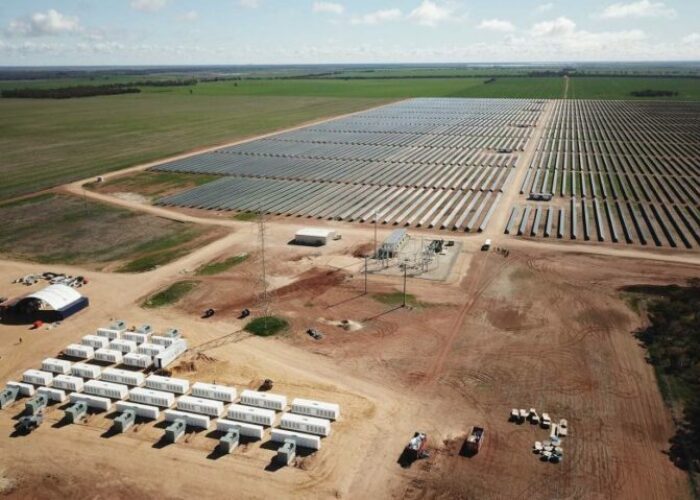
Co-location offers multiple technical advantages that extend beyond simple grid integration. Neha Sinha, product manager for energy storage systems at Wärtsilä, emphasises the efficiency gains achievable through DC-coupled configurations: “The primary benefit of a DC-coupled solution is your round trip efficiency (RTE) benefit,” Sinha says.
“Your efficiency losses that come with converting from the solar field through an inverter to the batteries back through an inverter are significantly reduced if you can directly couple the solar to the battery storage.”
These efficiency improvements translate directly into enhanced project economics. Curtailment reduction represents perhaps the most immediate benefit, as developers can capture otherwise-lost generation during periods of grid congestion or negative pricing.
“In Australia in particular, with the negative pricing that we’ve seen out of solar plants, there are a lot of solar plants that aren’t co-located with storage, and don’t have anything that they can do with the excess solar that they’re producing at those negative prices,” Sinha notes.
Dramatic cost reductions in battery storage technology have further strengthened the economic case for hybridisation. As Karimi highlights, “Battery storage costs have reduced substantially in the past 12-18 months, reducing the cost burden of adding storage to the design.
“Hybridisation also enables shared infrastructure, particularly in DC-coupled designs, costs and improving overall project economics.”
Revenue diversification through storage integration
The integration of battery storage fundamentally transforms the revenue potential for utility-scale solar developers, opening access to multiple income streams that were previously unavailable to standalone solar projects. This diversification represents a paradigm shift in how developers approach project financing and risk management.
Traditional solar projects in the NEM have historically required a majority of contracted revenue to achieve financial close, typically leaving only 20% of the project exposed to merchant risk.
The addition of storage changes this dynamic entirely, enabling developers to maintain larger merchant positions while accessing premium revenue streams.
“Adding battery storage opens up a plethora of additional revenue streams,” Karimi explains, outlining the expanded commercial opportunities available to hybrid projects.
These include hybrid power purchase agreements (PPAs), where buyers receive operational control of the combined asset, firmed or ‘shaped’ PPAs that deliver power according to specified profiles and virtual tolling agreements (VTA) that provide buyers with access to virtual battery capacity.
The sophistication of these revenue streams reflects the evolving maturity of the Australian energy market. Cap contracts protect buyers against spot price volatility above agreed-upon thresholds. At the same time, network support services provide additional income from distribution and transmission operators that are increasingly reliant on battery resources for grid stability.
However, this revenue diversification comes with increased complexity and risk. “While there is a much larger variety of options for hybrid projects, many come with increased risk,” Karimi warns. “Failing to manage a VTA or a cap contract effectively will not just see lower returns—it can create large losses due to the exposure to spot prices they create.”
The technical complexity of optimising hybrid operations requires sophisticated control systems and market forecasting capabilities. “Operating a battery energy storage system (BESS) is fundamentally different to operating solar and wind assets,” Karimi notes.
“A BESS is energy-limited, typically storing one to four hours of energy, and it must purchase its ‘fuel’ from the market. Because of this, returns are susceptible to both the accuracy of market forecasts and the quality of the trading optimisation.”
Regional deployment patterns and strategic location analysis
The scale of Australia’s utility-scale solar opportunity remains substantial despite market maturation. David Dixon, senior vice president and head of Australia renewables & power research at Rystad Energy,
forecasts steady growth across the NEM.
“The market size for utility solar deployment across the NEM is expected to be approximately 2-3GWdc per year to 2030,” he says.
The geographic distribution of hybrid developments across the NEM reflects a complex interplay of technical, economic and regulatory factors that vary significantly between regions. Understanding these regional dynamics is crucial for developers seeking to optimise project locations and maximise revenue potential.
New South Wales (NSW) has emerged as particularly attractive for hybrid developments, driven by the anticipated retirement of large coal-fired power stations and resulting price volatility. “NSW is one of the more attractive regions for batteries and hybrids as large coal plants are expected to close within the next few years,” Karimi observes.
The technical characteristics that make locations suitable for hybrid development extend beyond simple resource availability. Sites with higher levels of technical curtailment, where the addition of battery storage could materially influence the situation, represent prime opportunities.
Similarly, locations with poor marginal loss factors for solar generation can benefit significantly from the time-shifting capabilities of co-located storage.
Marginal loss factors are a mechanism used in electricity markets to account for energy lost as heat during the transmission of electricity through the power network.
They are a ratio that adjusts a generator’s revenue based on the network losses between its location and a regional reference node, influencing generator revenue and serving as an economic signal for efficient market operation.
A higher marginal loss factor rewards generators for being in a location that reduces losses, while a lower marginal loss factor penalises them.
“Locations with poor marginal loss factors for solar can make hybrid business cases more attractive as the time shifting of the plant generation improves the loss factor,” Karimi explains.
This technical consideration underscores the complex analysis necessary to identify optimal development sites in the current market environment.
Policy frameworks driving market transformation
Government policy initiatives have played a crucial role in accelerating hybrid development across the NEM, providing both financial incentives and regulatory certainty that enable developers to commit to more complex project configurations.
The Capacity Investment Scheme (CIS) represents perhaps the most significant policy intervention, offering long-term revenue support specifically designed to encourage the dispatchable generation of renewable energy.
The CIS provides long-term revenue certainty through 15-year two-way contracts that guarantee revenue floors while sharing upside performance – with both payments capped to protect taxpayer interests.
Its target was expanded to 40GW in July 2025 and now targets 26GW of renewable energy generation and 14GW of dispatchable storage through competitive tenders, offering dispatchable Capacity Investment Scheme Agreements (CISAs) for storage/ hybrid projects and generation CISAs for renewables. Hybrid solar-plus-storage projects can access either contract type based on specific requirements.
The re-election of the Australian Labor government in May 2025 provided crucial policy continuity for the CIS programme. “The re-election of the Australian Labor government in May 2025 provided certainty that the CIS policy would continue in its current form,” Karimi notes.
However, the effectiveness of these policies in driving deployment remains mixed. Dixon adds that the CIS faces additional implementation challenges.
“The CIS will struggle to give lenders confidence to finance many solar projects, as many proponents have bid too low and thus the banks aren’t willing to lend to these projects,” Dixon explains.
He emphasises that “by far the most critical milestone is getting an economic PPA from a utility (Stanwell or AGL) or industrial player (e.g. Rio Tinto) that the banks can lend against.”
The Solar Sunshot initiative represents another significant policy intervention, though industry expectations for the programme’s scale remain ambitious.
Brett Hallam, associate professor and research director for Advanced Hydrogenation at the University of NSW (UNSW), acknowledges both the programme’s importance and its limitations: “The amount we were hoping for as a package is much more than what the Sunshot initiative has been to date. But at least it’s a start, and it showed their intention to commit to establishing the industry here.”
Distributed energy resources and market evolution
The evolution of Australia’s distributed energy resources provides crucial context for understanding utility-scale developments within the broader energy transition. The country’s leadership in residential solar adoption and battery storage deployment creates both opportunities and challenges for large-scale renewable energy projects.
Nigel Morris, chief strategy officer at the Smart Energy Council, emphasises Australia’s unique position in global renewable energy deployment: “We are the canary in the coal mine for the rest of the world, we have some of the most sophisticated and advanced distributed, clean and distributed energy resources in the form of residential rooftops and now storage in the world.”
The scale of distributed deployment is remarkable, with some postcodes achieving 70% solar penetration rates, Morris notes. This distributed capacity increasingly operates under sophisticated control systems that enable centralised management and market participation through virtual power plants (VPPs).
“We are now building what I would argue is one of the largest and most sophisticated, fully controlled, not fully controlled, but able to be controlled … resources of solar and batteries in the world,” Morris explains.
The regulatory framework has evolved to accommodate this distributed complexity, albeit with challenges. “The regulatory regime, firstly, has adapted. Adapted badly and slowly and in defiance of solar for most of my career,” Morris acknowledges.
However, recent improvements in dynamic control mechanisms and emergency backstop systems demonstrate a growing sophistication in regulatory management of distributed resources.
Technology evolution and future deployment trends
The rapid evolution of hybrid technology platforms reflects both market demand and technological maturation across multiple components of integrated solar-plus-storage systems. DC-coupled configurations represent the current frontier of technical development, offering efficiency advantages that translate directly into improved project economics.
The complexity of DC-DC converter technology has historically limited widespread adoption, but recent advances have made utility-scale deployment increasingly viable.
“DC to DC converters are just an added cost to your system and can be quite challenging to work with. And the development of that technology over the years has kind of worked in favour of where we are today in the market,” Sinha explains.
The technical challenges of voltage management between solar and battery systems require sophisticated control capabilities. “The DC to DC converter itself is the biggest functionality, which is the voltage metering. The reason you need it is that there are voltage differences between your solar module and your battery. So, you need this kind of buck boost capability to be able to manage the differences between the two units,” Sinha details.
Grid interaction capabilities remain essentially unchanged between AC and DC-coupled configurations, as the inverter continues to manage grid communication and support services. “You don’t see a significantly different interaction with the grid, because you still have the inverter standing between your battery system and the grid,” Sinha notes. This consistency simplifies grid integration while maximising the efficiency benefits of DC coupling.
The evolution toward hybrid-by-design represents a fundamental shift in project development approaches. “As we see more and more solar plants being deployed, as we see curtailment issues, as we see decommissioning a coal plant in favour of these systems, it’s becoming increasingly clear that you need to be co-located with batteries to maximise the potential of your system,” Sinha observes.
Market outlook and strategic positioning
The commercial environment for utility-scale solar development has undergone a fundamental shift from the long-term, low-risk contracting models that previously dominated the sector. Developers must now navigate shorter contract tenures, increased merchant exposure and more sophisticated risk management requirements.
“In the NEM, you used to be able to get a 15- to 25-year solar PPA at an attractive price and with most of the market risks transferred to the buyer. That isn’t the environment now, and we are doubtful to return to it anytime soon,” Karimi explains. This shift requires developers to develop new capabilities in market analysis, revenue optimisation and risk management.
The new commercial paradigm demands comfort with shorter contract tenures and greater merchant exposure. “It’s not unusual now to see two to five-year contracts, and most offtakers strongly prefer not to sign anything over ten years,” Karimi notes. This trend toward shorter contracting periods reflects both buyer risk aversion and the rapid pace of technological and market evolution.
Success in this environment requires a sophisticated understanding of merchant revenue potential and associated risks. “Understanding the return potential for merchant storage/hybrid assets, the contracting options available to you, and the associated risks” becomes essential for developer success, according to Karimi.
The complexity of modern energy markets necessitates strategic partnerships with specialised service providers. “The NEM is the most volatile and rapidly evolving electricity market in the world. While there are significant opportunities, capturing those opportunities requires a profound understanding of the physical and financial market dynamics,” Karimi emphasises.
For developers considering storage additions to existing solar pipeline projects, the advice is clear: “Unless you are confident in your ability to negotiate a PPA at a strike price that meets your commercial targets and has sufficient negative price period settlement protections built in, I would strongly recommend exploring how the addition of storage to your pipeline projects could influence the business case,” Karimi advises.
Navigating the hybrid future
Australia’s utility-scale solar sector is at a transformative moment, as hybrid configurations become the dominant development model across the NEM. The convergence of technical advancement, policy support and commercial necessity has created an environment where storage integration is increasingly essential for project viability.
The success of future developments will depend on developers’ ability to navigate increased complexity while capturing the enhanced revenue opportunities that hybrid configurations provide. As Sinha emphasises: “When you are thinking about any project that involves storage, the key metric that you should be looking at is useable energy and how much energy you can get out of your system.”
The policy environment, while supportive, faces potential disruption from changing political priorities. The industry’s continued growth will require sustained government commitment to programmes like the CIS and Solar Sunshot initiative, alongside regulatory frameworks that accommodate increasing system complexity.
As Australia continues its renewable energy transition, the utility-scale solar sector’s evolution towards hybrid configurations represents both a technical achievement and a commercial necessity.
The developers who successfully navigate this transformation will play a crucial role in delivering the dispatchable renewable energy generation required to replace retiring coal-fired power stations while maintaining grid reliability and affordability.
The hybrid future is not merely an option for Australian solar developers – it has become an imperative for success in an increasingly sophisticated and competitive energy market. Those who embrace this complexity while leveraging the expertise of specialised partners will be best positioned to capitalise on the opportunities ahead.