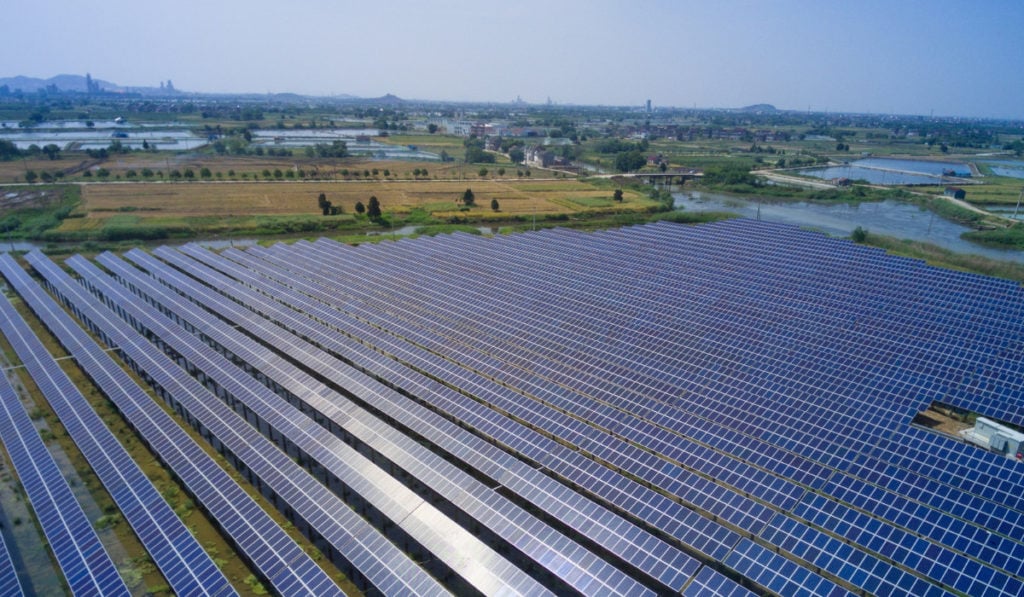
This week, German politicians discussed the proposed ‘Solarpaket I’ reforms to the country’s solar sector, with the Bundestag expecting to approve the new laws by the end of this week.
The Bundestag, Germany’s national parliament, first agreed on the terms of the Solarpaket on 14 April, which was proposed on 5 May 2023 by the Federal Ministry for Economic Affairs and Climate Action.
Try Premium for just $1
- Full premium access for the first month at only $1
- Converts to an annual rate after 30 days unless cancelled
- Cancel anytime during the trial period
Premium Benefits
- Expert industry analysis and interviews
- Digital access to PV Tech Power journal
- Exclusive event discounts
Or get the full Premium subscription right away
Or continue reading this article for free
The proposed laws will see changes made to both the utility-scale and distributed solar sectors in Germany, with the upper bid limit for government tenders for ground-mounted systems to be increased from 20MW to 50MW, and the feed-in tariff for commercial PV rooftop systems, with a capacity of between 40-750kW, to be increased by €0.015 (US$0.016).
This could be particularly notable as interest in rooftop solar in Germany is growing. Last month, the German Federal Network Agency, Bundesnetzagentur, announced the winners of a competitive auction for 264MW of rooftop solar capacity. This auction was notably oversubscribed, with the agency receiving 194 bids for 378MW of capacity, and industry leaders welcomed the Solarpaket’s potential impacts on the deployment of new solar capacity.
“We expressly welcome the fact that a large number of other small-scale changes to reduce bureaucracy will increase the potential for accelerating the energy transition,” the Bundesverband Solarwirtschaft (BSW), the country’s solar trade body, said this week.
“The reform package contains a large number of measures that will simplify the further expansion of photovoltaics and solar power storage,” added the BSW. “With the solar package, the energy transition can now finally reach tenants and homeowners in cities.”
Calls for further reform
However, there were calls for more to be done. Wolfgang Saam, from the Central Real Estate Committee (ZIA), called for the discussion and implementation of a follow-up piece of legislation, dubbed ‘Solarpaket II’, with a particular focus on making rooftop solar financially viable for real estate companies and landlords.

Indeed, the BSW suggested that some of the components of the Solarpaket represent a diminishing, not expansion, of the German solar sector.
“But three steps forward in the solar package unfortunately also means one step back,” said the BSW this week. “The planned lowering of the tendering limit for solar power systems on buildings to 0.75MWp, after this was rightly increased to 1MWp by the Bundestag only last year, is incomprehensible.”
There is growing uncertainty in the German solar sector, that is perhaps reflected in the Bundestag’s activities. Earlier this month, the German Energy Agency (dena) reported that renewable power purchase agreement (PPA) volumes nearly quadrupled in Germany in 2023, suggesting considerable interest in developing and acquiring new renewable power, but this follows Meyer Burger’s closure of its only module assembly plant in Germany over fears that European-based manufacturing is no longer commercial viable compared to modules made in China.
“The solar industry is also particularly disappointed that the coalition has not reached an agreement on industrial policy stimuli, such as resilience bonuses within the reform package,” added the BSW, suggesting that German module manufacturing could have been supported through financial incentives to buy domestically-made products.
“In the tough location competition with Asia and the US for the solar factories of the future the last chance for a renaissance of the solar industry in Germany and for more security in the supply of solar technology components has been squandered.”
“A decisive contribution”
Germany has among the most ambitious solar targets in Europe, having announced plans to increase its installed solar capacity to a massive 215GW by the end of the decade. The plans were announced as part of the EU’s latest call for updates to member states’ National Energy and Climate Plans (NECPs), and Germany is now aiming to add more capacity than Italy, Spain and France combined.
There has already been sustained growth in the German solar sector, with the graph below demonstrating how Germany added more than 1GW of new solar capacity each month in the year to February 2024.
The BSW is keen to capitalise on this growth, and reiterated that it was broadly supportive of the Solarpaket legislation.
“The reform package should make a decisive contribution to achieving the photovoltaic expansion targets in the coming years,” said the BSW. “The investment conditions will be improved in almost all market segments, regardless of whether they are tenants, homeowners or companies [and] access to inexpensive solar power will become much easier.”