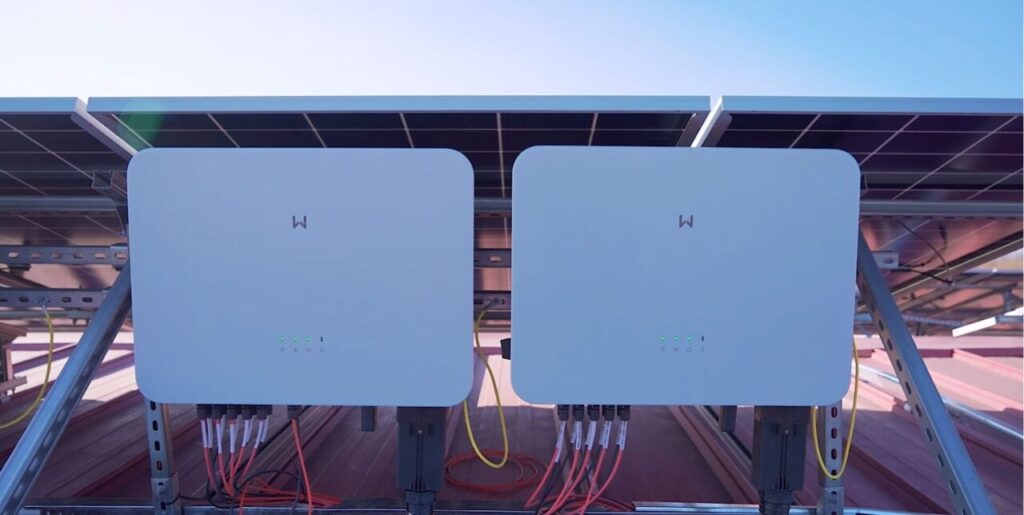
Chinese solar inverter producer GoodWe has launched a new “low noise, low weight” string inverter for the European corporate and industrial (C&I) solar market.
The 50kW SDT G3 inverter, part of GoodWe’s SDT series, was specifically designed for small- to medium-sized C&I installations and, according to the company, meets “growing market demand” for quiet and easily installed inverters.
Try Premium for just $1
- Full premium access for the first month at only $1
- Converts to an annual rate after 30 days unless cancelled
- Cancel anytime during the trial period
Premium Benefits
- Expert industry analysis and interviews
- Digital access to PV Tech Power journal
- Exclusive event discounts
Or get the full Premium subscription right away
Or continue reading this article for free
The product was certified by German technological testing house TÜV Rheinland with a “dedicated low-noise certification”, which GoodWe said is the first awarded for a C&I solar inverter. The inverter, around 100,000 of which have been deployed in China since 2024, can operate at below 50dB with a full load, which the company said is “15-20dB lower” than comparable products.
The system weighs 33kg and supports cheaper aluminium cables, lowering the cost of the PV system.
The inverter can facilitate up to 20A of input current and accommodates up to 180% PV oversizing, “to ensure optimal performance by maximising energy harvest during low irradiance periods”. The inverters can also be operated in parallel to accommodate bigger PV systems.
“This product was developed based on insights gathered from hundreds of C&I site visits, giving us a clearer and more accurate understanding of real-world application needs,” said Alex Pan, vice president at GoodWe. “Many small- to medium-sized C&I scenarios are near areas of human activity where quiet operation is essential.”
Chinese solar inverters in Europe
Fortunes for the European C&I market are mixed; smaller commercial systems declined by 1% in 2024 while “large industrial rooftop systems” grew by 14%, according to SolarPower Europe’s Global Market Outlook for Solar Power 2025-2029.
In general, the continent’s rooftop market, including residential and C&I systems, is having to adapt to new realities and more stable energy prices, which have curbed the massive growth the sector saw in 2022-23.

At the same time, the share of Chinese inverters in the European market has grown, driven by the rooftop and small-scale sectors where inverter sales are higher. Data from PV wholesale platform sun.store has shown that Chinese firms Huawei, GoodWe, Deye and Sungrow are all among the top five hybrid inverter suppliers in Europe, joined in October by Austria’s Fronius. Non-Chinese firms have a higher market share for string inverters.
Market challenges and the increasing presence of Chinese vendors in Europe have seen German inverter producer SMA Solar, formerly a market leader, blame “weak demand” in the C&I sector for its declining sales in recent quarters. SMA Solar, along with competitors SolarEdge (fro Israel) and Enphase Energy (from the US), has also announced job cuts and financial losses over the last year.
SolarPower Europe called for the EU to support its non-Chinese inverter manufacturers back in November 2024, arguing that inverters are the “brains of the energy system … which become only more important as Europe electrifies and digitalises its energy systems.”
As well as the manufacturing industry, there are growing arguments that Chinese-made inverters could represent a cybersecurity risk to Europe. The Czech and Lithuanian governments have announced restrictions on digital inverter access to their energy grids, highlighting the risk of Chinese products with servers controlled from outside Europe, and this publication has heard that discussions about EU-wide cybersecurity restrictions are ongoing in Brussels.
A report from cybersecurity consultancy Forescout earlier this year analysed cyber vulnerabilities from several inverter brands, including GoodWe, SMA and Huawei. The report did not find significant weaknesses in GoodWe’s cyber infrastructure, though it said: “this does not imply that these vendors are more or less secure than the others.”
Last week, PV Tech Premium published a deep dive feature into the cybersecurity risks facing Europe’s solar energy infrastructure.