India’s flagship solar PV manufacturing incentive has driven “robust growth” in the sector since its launch, but hurdles remain to building a complete domestic supply chain.
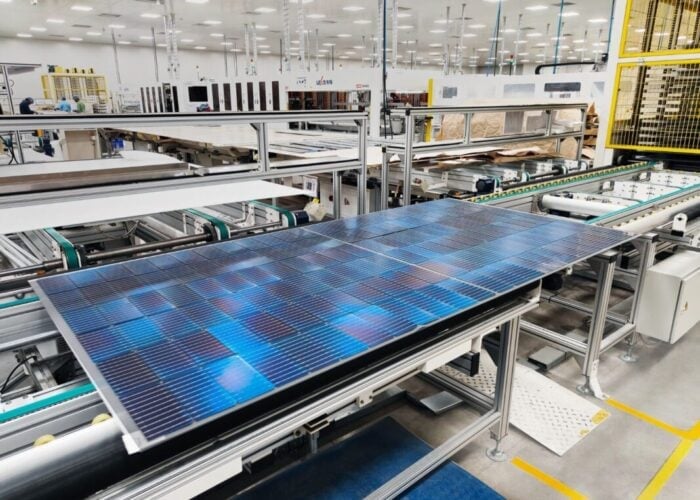
A new report from the Institute for Energy Economics and Financial Analysis (IEEFA), an energy transition think tank, said that India’s Production Linked Incentive (PLI) has driven significant expansions in domestic solar manufacturing capacity since 2022. The country has reached 120GW of operational capacity for modules and 29.3GW for cells as of June, with 82GW in modules and 22.7GW in cells having come online since 2022. This is a 216% and 344% increase, respectively, in the last three years.
Try Premium for just $1
- Full premium access for the first month at only $1
- Converts to an annual rate after 30 days unless cancelled
- Cancel anytime during the trial period
Premium Benefits
- Expert industry analysis and interviews
- Digital access to PV Tech Power journal
- Exclusive event discounts
Or get the full Premium subscription right away
Or continue reading this article for free
“The scheme channels government support towards measurable industrial output, helping build durable, long-term manufacturing capacity,” said Vibhuti Garg, director at IEEFA South Asia.
However, upstream manufacturing capacity lags significantly behind module and cell, the report said. India has 3.3GW of operational polysilicon production capacity and 5.3GW of wafer capacity, all of which was driven by the PLI.
The PLI scheme offers companies rewards for producing solar products and components in India, rather than offering up-front capital subsidies, hence its “production linked” moniker.
Despite its upstream success, “The PLI scheme for solar PV manufacturing faces implementation challenges like high capital intensity of upstream integration, inadequate incentives, inconsistencies in trade policy, import dependency, and global raw material price volatility,” says Prabhakar Sharma, senior consultant, JMK Research, and one of the report’s authors.
India does not have the same restrictions on wafer and polysilicon imports as it does for solar cells and modules. IEEFA said that combined with restrictions on modules under the Approved List of Models and Manufacturers (ALMM) scheme and “frequent ALMM revisions”, this has created uncertainty for domestic manufacturers.
On the other hand, very few countries have managed to effectively build an upstream solar supply chain outside of China. Polysilicon and silicon wafer facilities are more expensive, more complex and slower to build than solar module or cell facilities, a story which has played out in the US as well as India.
The polysilicon sector has also been particularly volatile in recent years, with chronic oversupply and rock bottom prices for major Chinese producers, which have triggered efforts for industry restructuring by Beijing in recent months. This exposes Indian manufacturers to price spikes and uncertainty, IEEFA’s report said.
“India’s reliance on imported machinery, components, and Chinese technical expertise has further slowed capacity ramp-up, a situation worsened by visa restrictions and limited equipment availability,” said Chirag H Tewani, senior research associate at JMK Research, and a co-author of the report.
Moreover, the report said that delays in establishing PLI-compliant manufacturing facilities have meant that India has missed its industry targets.
“Delays in implementing PLI solar PV facilities have also limited the scheme’s economic impact,” said Sharma. As of June 2025, only 31GW of the targeted 65GW module capacity was commissioned, attracting roughly Rs48,120 crore (~US$5.5 billion) in investments and creating 38,500 direct jobs — far below the targets of Rs94,000 crore (US$10.45 billion) and 195,000 direct jobs, the report said.
IEEFA recommended that future PLI iterations should include “comprehensive manufacturing-linked framework that integrates fiscal support, upfront capital subsidies, ancillary development and longer policy tenures.”
“Future PLI iterations should focus on improving cost competitiveness, upstream integration and market resilience,” says Aman Gupta, research associate at JMK Research, and an author of the report. It called for comprehensive measures, including “tax credits, low-cost financing, and risk buffers against global price volatility; layered incentives and longer policy horizons to encourage full value-chain participation; and support for critical components to foster an integrated domestic supply chain.”
PV Tech Premium examined India’s prospects as a major solar exporter last year.