Europe’s solar industry seemed a little downbeat as it trudged to Munich for Intersolar Europe 2026 this week. Under the unforgiving June heat, the themes that were established last year – stable module technology, the rise of energy storage and the ongoing travails of the big solar manufacturers – continued and were added to, as both the upstream and downstream industry adapt to new and difficult circumstances.
Comparisons with the 2024 edition of the show were hard to avoid. Heat, firstly, and football. During Intersolar 2024, which was almost as hot as 2026, the UEFA European Championship was in full swing. Big companies screened matches in the halls of the Messe Munchen during post-work booth parties, and the industry was in a purple patch of deployments and growth as European governments turned to solar to lessen their reliance on Russian gas after 2022.
Try Premium for just $1
- Full premium access for the first month at only $1
- Converts to an annual rate after 30 days unless cancelled
- Cancel anytime during the trial period
Premium Benefits
- Expert industry analysis and interviews
- Digital access to PV Tech Power journal
- Exclusive event discounts
Or get the full Premium subscription right away
Or continue reading this article for free
The World Cup is on now, and Munich was even hotter than in 2024. But interest in the tournament seemed negligible. Most references to football were confined to jokes about “hydration breaks”, and the temperatures were high enough to be oppressive. There was less excitement about the solar industry, too. The market situation is worse; many incentives for deployments have faded, grid constraints have made pure-play solar unviable in numerous markets, and manufacturers are continuing to lose money.
Energy storage is hot
Energy storage has indisputably become the most attractive prospect for every segment of Europe’s renewable industry. Last year, there was a notable increase in interest in storage, but this year the transformation was huge. All of the major Chinese solar manufacturers were exhibiting energy storage solutions and “integrated” offerings, albeit with different levels of maturity and planning.
Some, like Trina Solar, have been in the storage game for a long time, and JA (formerly JA Solar) has formally repositioned itself towards broader offerings, including storage. Others seemed to have less coherent plans and followed the money that is currently in energy storage, both from a demand perspective thanks to Europe’s straining grid and, potentially, to diversify from the cutthroat module production business. Solar developers, EPCs and IPPs were all also leaning into energy storage and the chance it offers for new revenue streams.
Over in the energy storage halls on the other side of the Messe Munchen, things were busy and bustling. Alongside huge, statement offerings from the biggest players in the sector, there were a number of companies with backgrounds in other technologies – domestic appliances, cameras etc. – which have jumped in to capitalise on the rush for energy storage.
Two or three years ago, solar PV was finally heralded as “mainstream”. In 2026, it seems to be energy storage’s turn.
Developers are struggling
In one conversation PV Tech had at the show, we heard that the environment for solar project development across Europe is fairly poor. Representatives from Belectric – a leading German EPC and developer – told us that the lack of grid capacity, inconsistent policies and permits from grid operators, and the abundance of negative prices in mature markets have made things difficult. Energy storage offers an obvious solution, and will be essential to the continuing growth of European solar, but we heard that in Germany, in particular, the 800-900 distribution network operators (DNOs) have inconsistent rules for storage and in some cases fail to grant new project licenses.
This chimes with things we heard earlier in the year. In interviews with both Encavis and Italian developer Limes, we heard commentary on the difficulties of developing standalone solar in much of Europe. The proposition for developers has changed significantly, with many having to become full-fledged IPPs and develop ownership, power trading and grid interaction operations. This is a far more complex and difficult operation than straight project development, made necessary by the fact that in mature European markets solar has hit its physical limit on the grid, with little space for more capacity and markets struggling with negative prices.
2025 was the first time that growth slowed in Europe’s solar market in over a decade, and SolarPower Europe doesn’t expect to return to 2024 installation levels until the end of the decade. The combination of lagging grid infrastructure and market changes – well-discussed dynamics by now – showed in the conversations heard at Intersolar.

Manufacturers paper over losses
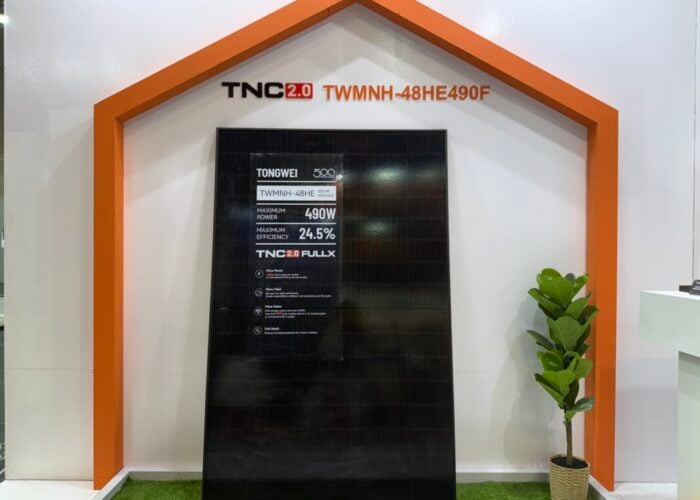
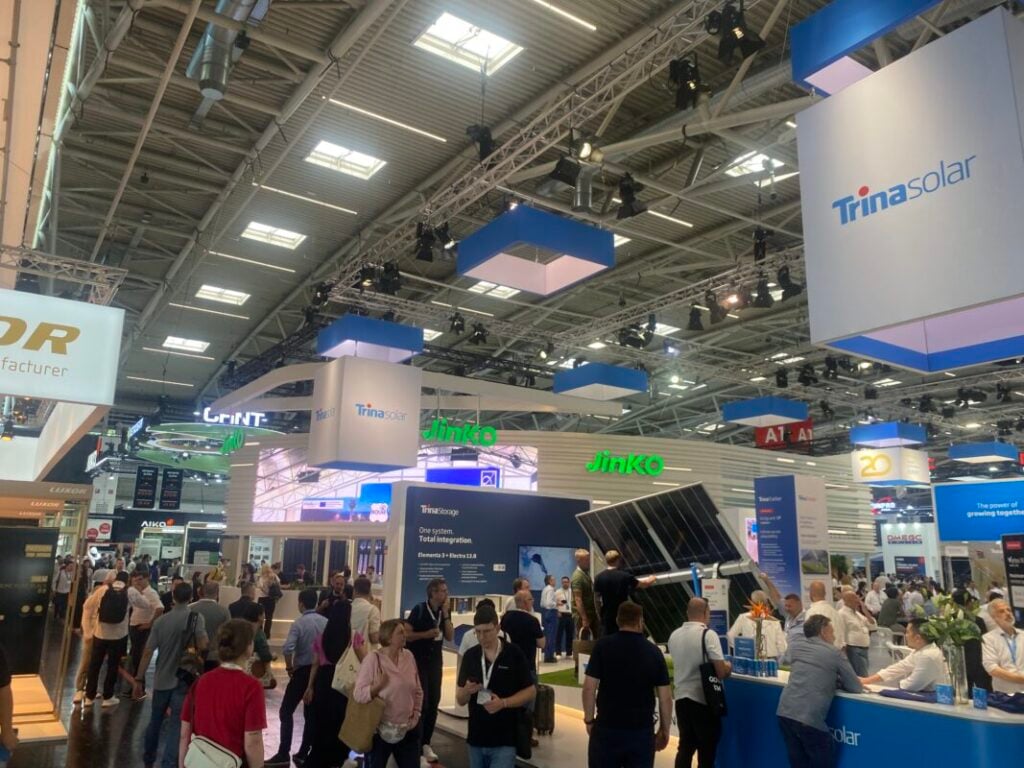
The major Chinese module manufacturers were at the centre of things at Intersolar 2026, taking their usual places at the entrance to the first hall, their towering stalls the first thing you see when you enter the show floor. Trina Solar, Jinko Solar, GCL, JA, Astronergy and Tongwei were all clustered round the main thoroughfare.
However, there was little that felt new or exciting from a technology perspective. Most firms are still settled on their own variation of TOPCon modules, with LONGi and Aiko predictably showing BC products and Huasun pushing HJT. As mentioned above, many of them brought energy storage offerings to bolster their stalls, with various different focuses on either utility-scale or small-scale, batteries or more comprehensive energy systems.
But there is more going on than a response to demand for batteries. Speaking to industry analysts, PV Tech heard that the major Chinese producers seem to have accepted the financial losses and ongoing oversupply in the industry, with no real prospect of an end point. All of the major producers that issue financial statements recorded losses in Q1 2026, having recorded them all through 2025, too. And while those losses have contracted, they are still significant.
We also heard that there is still massive overcapacity in the industry, and consistently low utilisation rates across major producers. Yet, when we spoke to representatives from some major manufacturers, they claimed the outlook was “stable” and “positive”. Our analyst sources said that there were seemingly no plans for these companies to change tactics, and that they had likely accepted their module producing businesses would be loss-making. One spokesperson from a top-tier Chinese manufacturer told PV Tech that it actually had no overcapacity and had returned to profits. Their most recent financial statements do not support the latter statement.
This could be fine. Profits from battery energy storage could offset the module businesses, and some PV manufacturers are subsidiaries of larger companies with other businesses that could prop them up, if they want to keep a strategic presence in solar.
But we were told that the situation is causing quality issues. Technical and testing houses have been finding worrying rates of module failures and defects over the last year, which is a direct result of cost-cutting measures that manufacturers have to engage in because oversupply across the value chain has pushed module prices down dramatically. We heard that thin glass and issues with cell alignment have caused significant problems, which are unlikely to improve without a change of direction from the Chinese manufacturers. The Chinese PV association and the government have attempted to step in to regulate further and impose more measured behaviours on the industry, but these measures are yet to make a big change. Based on data we were shown, global solar demand would have to increase two-to-threefold, or manufacturers would have to stop producing anything for an extended period, if the backlog of excess PV inventory and overcapacity is to disappear.
Last year, there were predictions of major industry consolidation as a result of these same dynamics. The absurd thing, as we were told by an anonymous industry expert, is that we have seen neither consolidation nor any major changes from manufacturers. The things that were present last year have stayed entrenched and nobody seems to want to look at them.
Overall, 2026 seems set to be a forgettable year for Europe’s solar market. The issues facing it are large and structural, from grid issues and market challenges to the deep-seated challenges around the manufacturing industry. We were told that regaining growth as quickly as possible will be the job of governments and lawmakers in Brussels and around Europe.