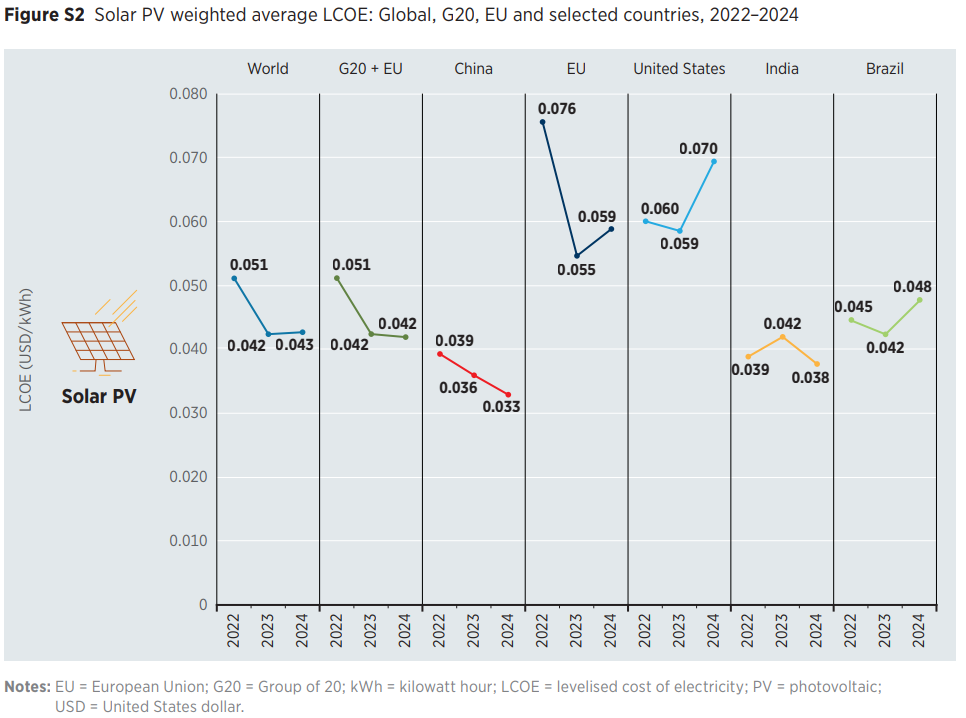
According to a report from the International Renewable Energy Agency (IRENA), the global levelised cost of electricity (LCOE) for solar PV reached US$0.043/kWh in 2024.
This is the second-lowest LCOE across all technologies, only behind onshore wind, which sat at US$0.034/kWh. Despite the low average global LCOE for solar PV in 2024, its LCOE increased slightly on the previous year, by only 0.6%.
Try Premium for just $1
- Full premium access for the first month at only $1
- Converts to an annual rate after 30 days unless cancelled
- Cancel anytime during the trial period
Premium Benefits
- Expert industry analysis and interviews
- Digital access to PV Tech Power journal
- Exclusive event discounts
Or get the full Premium subscription right away
Or continue reading this article for free
Some countries such as China and India have even registered below-average LCOE prices for solar PV with US$0.033/kWh and US$0.038/kWh, respectively. LCOE has continued to decrease in China due to abundant domestic manufacturing capacity exerting downward pressure on cost, according to IRENA.
In the US and the European Union, LCOE for solar PV increased in 2024, as shown in the image above, due to permitting delays, interconnection bottlenecks and higher balance of system costs, which limited further cost reductions. The LCOE for solar PV in the US increased quite drastically from US$0.059/kWh in 2023 to US$0.07/kWh in 2024. A recent report from US financial analyst Lazard registered an LCOE for utility-scale solar in the US to be between US$38-78/MWh in 2025.
Renewables have remained the most cost-competitive option for new electricity generation in 2024, with nearly all (91%) newly commissioned utility-scale capacity delivering power at a lower cost than the cheapest newly installed fossil fuel-based alternatives.
“Cost competitiveness remains the defining characteristic of renewable energy sources. In 2024, 91% of all newly commissioned utility-scale renewable projects delivered electricity at a lower cost than the cheapest new fossil fuel-fired alternative,” said Francesco La Camera, Director-General at IRENA.
Hybridising energy storage is becoming standard in many markets
“Meanwhile, emerging enabling technologies, such as battery energy storage systems, continue to see rapid cost reductions. In 2024, the cost of utility-scale battery storage fell to USD 192/kWh – a 93% decline since 2010 – driven by manufacturing scale-up, improved materials and production efficiencies,” said La Camera regarding the costs for energy storage.
The report highlighted that hybridising solar PV or wind with energy storage has become the standard in many markets, while enhancing grid reliability and improving capacity factors. In China, for example, solar-plus-storage systems have helped mitigate curtailment risks in provinces with high renewable energy penetration. And in the US, integrating battery energy storage systems (BESS) with solar PV has accelerated, which has enabled dispatch during peak demand and deferred investments in peaking gas plants.
Despite a scarcity of estimates for the LCOE of hybrid systems, available data indicate that renewable energy coupled with BESS is increasingly approaching cost parity with fossil fuel-based generation in key markets, said IRENA. Its data shows that 17 operational hybrid projects in the US – which combine 4.5GW of solar PV and 7.7GWh of battery storage – achieved a weighted average LCOE of US$0.079/kWh.
This aligns with the midpoint of the LCOE range for combined-cycle gas turbines, which sits at US$0.077/kWh and is well below that of coal with US$0.119/kWh. In Australia, the LCOE of eight hybrid projects that combine solar, wind, and BESS – with a total of 412.2MW of generation and 188.4MWh of storage – is even lower, with a weighted average of US$0.051/kWh.