JinkoSolar’s ‘Tiger’ module can generate up to 460Wp of power output

November 18, 2019
Facebook
Twitter
LinkedIn
Reddit
Email
The Tiger module has a conversion efficiency of 20.78% and can generate up to 460Wp of power output, which is suitable for both utility-scale and rooftop markets, globally. Image: JinkoSolar

JinkoSolar has showcased its forthcoming ‘Tiger’ solar module at All-Energy Australia event, held in Melbourne, Australia in late October 2019. The Tiger module has a conversion efficiency of 20.78% and can generate up to 460Wp of power output, which is suitable for both utility-scale and rooftop markets, globally. The Tiger module series will be available in both mono & bifacial options.

Problem

This article requires Premium SubscriptionBasic (FREE) Subscription

Try Premium for just $1

  • Full premium access for the first month at only $1
  • Converts to an annual rate after 30 days unless cancelled
  • Cancel anytime during the trial period

Premium Benefits

  • Expert industry analysis and interviews
  • Digital access to PV Tech Power journal
  • Exclusive event discounts

Or get the full Premium subscription right away

Or continue reading this article for free

The global PV market is rapidly shifting towards high-performance modules to reduce system costs. Customers demand high power output and high efficiency modules to save on initial upfront capital investment. In addition, considering the energy gain from bifacial modules coupled to single-axis trackers, project owners can significantly lower the LCOE (Levelized Cost of Electricity) as the downstream PV market becomes subsidy free. 

Solution

The new Tiger module combines the half-cut cell design to reduce cell current mismatch and ribbon power losses. In addition, 9-Busbar technology and Tiling Ribbon (TR) technology reduces the distance between the main busbar and finger grid lines, which decreases the resistance loss and increases power output and efficiency of the module. The Tiger series has several different options for both utility scale project and DG market. The mono-facial Tiger module has a power output up to 460Wp from a module efficiency of 20.78%. In addition, JinkoSolar has also a small type mono-facial Tiger and the power output should be 390Wp. For the DG market, JinkoSolar can produce an all black series to further enhance the design’s aesthetics. The bifacial Tiger module will be available with a power output of 455Wp with a module conversion efficiency of 20.06%. Bi-facial Tiger module could match transparent backsheet very well to keep it as light as mono-facial module.

Applications

Utility-scale PV and DG markets.

Platform

The Tiger module also includes the special TR ribbon with better suppleness to ensure the reliability for the cell overlap area. Specially made EVA/POE is applied with higher gram weight that fills the overlapping region that is said to give an excellent buffering effect to ensure the reliability. There are 3 key benefits characterizing half-cell technology which includes a reducing internal resistance to increase power output. They also improve shading tolerance to achieve higher power output and reduce hot-spot issues. Half-cell technology also has lower working temperature to generate more energy.

Availability

The Tiger module series will be available in both mono & bifacial options starting in the first half of 2020.

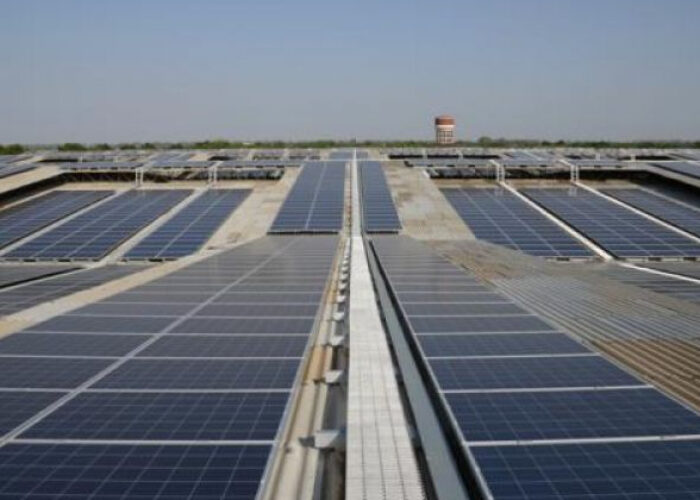
9-Busbar technology and Tiling Ribbon (TR) technology reduces the distance between the main busbar and finger grid lines, which decreases the resistance loss and increases power output and efficiency of the module. Image: JinkoSolar
16 June 2026
Napa, USA
PV Tech has been running PV ModuleTech Conferences since 2017. PV ModuleTech USA, on 16-17 June 2026, will be our fifth PV ModulelTech conference dedicated to the U.S. utility scale solar sector. The event will gather the key stakeholders from solar developers, solar asset owners and investors, PV manufacturing, policy-making and and all interested downstream channels and third-party entities. The goal is simple: to map out the PV module supply channels to the U.S. out to 2028 and beyond.
13 October 2026
San Francisco Bay Area, USA
PV Tech has been running an annual PV CellTech Conference since 2016. PV CellTech USA, on 13-14 October 2026 is our third PV CellTech conference dedicated to the U.S. manufacturing sector. The events in 2023, 2024 and 2025 were a sell out success and 2026 will once again gather the key stakeholders from PV manufacturing, equipment/materials, policy-making and strategy, capital equipment investment and all interested downstream channels and third-party entities. The goal is simple: to map out PV manufacturing in the U.S. out to 2030 and beyond.

Read Next

Premium
April 2, 2026
Analysis: Some in the US solar industry are positioning tariffs as a silver bullet for manufacturers, but it may not be as straightforward as that.
April 1, 2026
Toyo Solar shipped 4.5GW of cells in FY2025, surpassing its full-year target, while module shipments reached 249MW.
March 30, 2026
Indian solar manufacturer Premier Energies has commissioned a 5.6GW solar module manufacturing facility in Seetharampur, Telangana.
March 30, 2026
The scope of supply chain diligence for PV projects in the US seeking tax credits has expanded, requiring greater vigilance in procurement, writes Intertek CEA's Paul Wormser.
Premium
March 27, 2026
PV Tech Premium explores the challenges of solar panel recycling, the evolving policy landscape and opportunities for recyclers in the US.
March 27, 2026
The US International Trade Commission (ITC) has begun an investigation into tunnel oxide passivated contact (TOPCon) solar products in the US, following a complaint by US thin-film module manufacturer First Solar.

Upcoming Events

Solar Media Events
April 15, 2026
Milan, Italy
Solar Media Events
June 16, 2026
Napa, USA
Solar Media Events
October 13, 2026
San Francisco Bay Area, USA
Solar Media Events
November 3, 2026
Málaga, Spain
Solar Media Events
November 24, 2026
Warsaw, Poland