In April, solar testing company Kiwa Group announced the integration of its three subsidiaries, including PV Evolution Labs (PVEL), PI Berlin and Extel Energy, into one brand.
After the integration, the subsidiaries operate under the Kiwa umbrella. Kiwa PVEL, added to the company’s portfolio in 2021, continues to provide extended reliability testing for PV modules and equipment, including its flagship Product Qualification Program (PQP). Meanwhile, Kiwa PI Berlin, acquired by the Kiwa Group in May 2022, remains to offer all current technical advisory, risk management and quality assurance services for PV plants, modules, inverters, transformers and battery energy storage systems (BESS).
Try Premium for just $1
- Full premium access for the first month at only $1
- Converts to an annual rate after 30 days unless cancelled
- Cancel anytime during the trial period
Premium Benefits
- Expert industry analysis and interviews
- Digital access to PV Tech Power journal
- Exclusive event discounts
Or get the full Premium subscription right away
Or continue reading this article for free
Kiwa ExTEL, which joined Kiwa Group in February 2022, continues to perform inspections, analysis and technical advisory for PV plants.
According to Tristan Erion-Lorico, VP of sales and marketing at Kiwa PVEL, Kiwa Group will be “business as usual” for customers after the integration. Moving forward, the subsidiaries will have “Kiwa” added in front of their names.
“They can expect the same level of quality and service that our teams have always provided. We will continue to operate as separate business units under the same brand,” he says.
Synergies among the companies after integration
Although the service scope of the subsidiaries will not change significantly after the integration, Erion-Lorico says there are some advantages of bringing the brands under the same roof, including better collaboration, cost savings and more strategic alignment in terms of complementary services.
“For example, for each PQP, we deploy PI Berlin, our sister company and fellow member of the Kiwa Group, to perform a PQP sample production factory witness. Whereas this was previously a contract with an outside vendor to PVEL, we’re now coordinating internally as Kiwa, which reduces the time it takes to deploy our solutions,” he says.
“This is the natural progression, allowing us to better align our service offerings, better position ourselves in the market and combine our relative expertise,” Erion-Lorico comments.
The future of the solar testing industry
The integration is also Kiwa Group’s effort to better cope with the challenges and opportunities in the solar testing industry.
Erion-Lorico says extended reliability testing becomes increasingly important in the industry as new technology types emerge. Therefore, Kiwa Group constantly refines its testing process based on feedback from its upstream and downstream industry partners.
One of the examples is the updates to the PQP in November 2023.
The updates contained four major changes. One of the notable updates to the PQP was refocusing the Hail Stress Sequence on identifying the threshold of glass breakage.
Another update was a new test that addresses concerns around UV-induced degradation (UVID), which focuses on front-side power losses. Although new cell technologies, such as heterojunction (HJT) and tunnel oxide passivated contact (TOPCon), are marketed with improved first-year and annual degradation rates, both technologies have been shown to be sensitive to UVID, according to Kiwa Group.
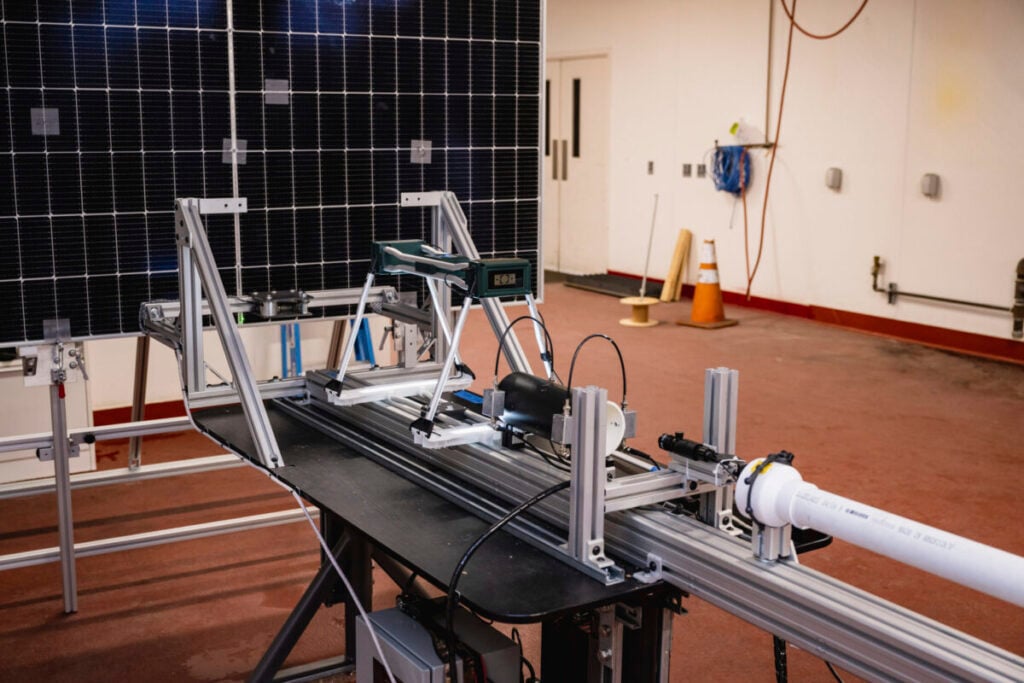
One of the main mechanisms of UVID degradation is damage to the cell passivation layers and interfaces with the silicon bulk caused by UV light. Therefore, by following the guidance of IEC 61215:2021 MQT 10, the module is subjected to a front-side UV dose equivalent to 60 kWh per square metre in a UV chamber capable of maintaining the modules at a temperature of 60°C.
Other updates of the PQP include modifying the Mechanical Stress Sequence to target module mechanical durability concerns and streamlining processes for light-induced degradation, damp heat, light and elevated temperature-induced degradation, and backsheet durability sequence testing.
PV Tech Premium also asks how the changes in the solar PV industry will benefit the business of all subsidiaries. Erion-Lorico says the increased adoption of solar PV systems offers more opportunities for the company, as it looks forward to “serving more clients around the world”.
“We’re excited to see new manufacturers and suppliers enter the market, but new entrants can also mean new risk, which means we expect to see more companies relying on our reporting for their due diligence,” he says.
As the frequency and severity of extreme weather events increase, the solar PV industry will have a greater need for technical advisory services before and after commissioning.
PV Tech recently reported the record number of manufacturers and failures in Kiwa PVEL’s Module Reliability Scorecard. In an analysis, Erion-Lorico and Max Macpherson, data analytics and reports manager at Kiwa PVEL, highlight some failure trends. Over a quarter of manufacturers experienced at least one of the following failures, including missing junction box lids, peeling nameplate labels, wet leakage testing failures, delamination and diode failures. These “out of the box” failures should be far less prevalent than what we’re seeing in the lab.
The complete analysis can be read here.