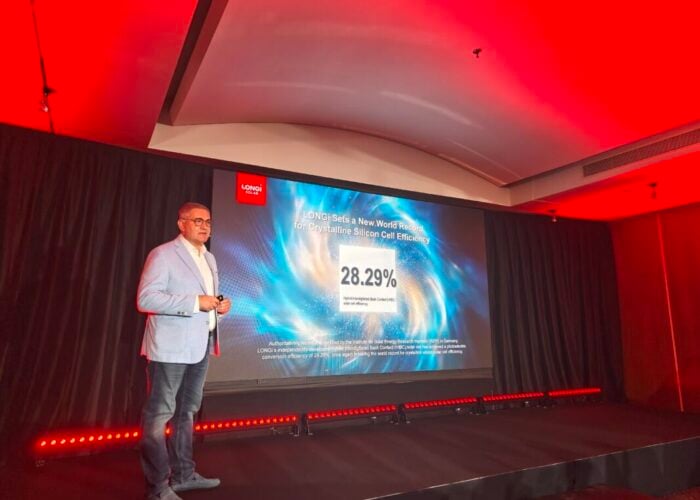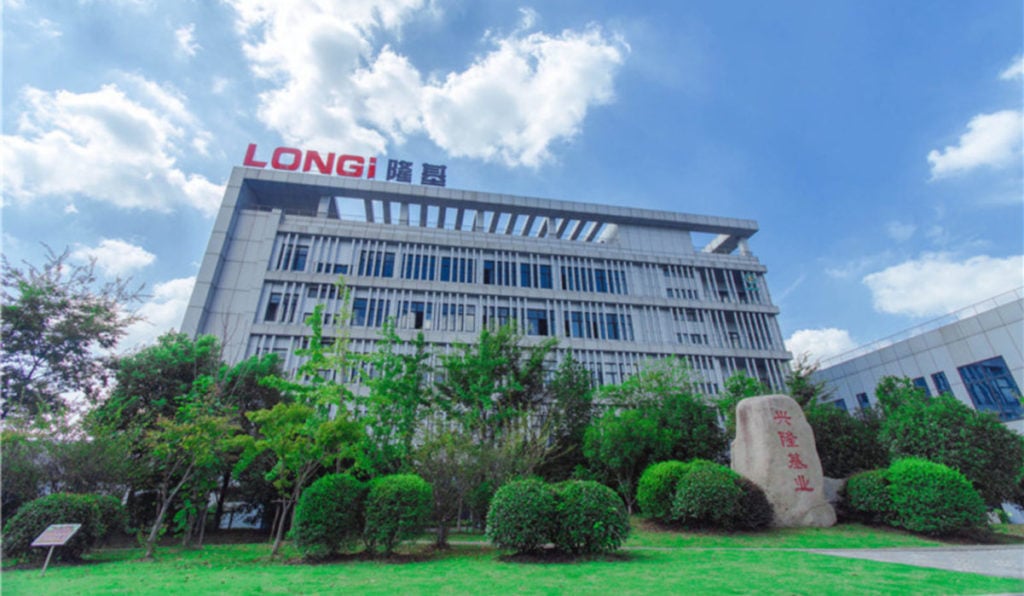
Major Chinese solar manufacturer LONGi has developed a crystalline silicon-perovskite tandem solar cell with a power conversion efficiency of 33.9%, the highest on record for this type of cell.
The cell’s efficiency was confirmed by the US National Renewable Energy Laboratory (NREL) and exceeds two efficiency records set earlier this year by researchers from the King Abdullah University of Science and Technology (KAUST) in Saudi Arabia.
Try Premium for just $1
- Full premium access for the first month at only $1
- Converts to an annual rate after 30 days unless cancelled
- Cancel anytime during the trial period
Premium Benefits
- Expert industry analysis and interviews
- Digital access to PV Tech Power journal
- Exclusive event discounts
Or get the full Premium subscription right away
Or continue reading this article for free
In April, KAUST researchers developed a photovoltaic (PV) cell with a conversion efficiency of 33.2%, and a second cell with a conversion efficiency of 33.7% the following month, and LONGi’s latest cell breaks both these records, and the Shockley-Quieser theoretical efficiency limit, which has been in place for single-junction solar cells since 1961.
The Solar Module Super League (SMSL) member company noted that the theoretical conversion efficiency limit of crystalline silicon-perovskite tandem solar cells could be as high as 43%, suggesting that such cells could be an important part of the solar sector as the industry looks to optimise its operations.
“For a long time, we have laid out various technological routes in the research and development sector, and collaborated with multiple parties to create efficient models and collaborative innovation mechanisms,” said LONGi founder and president Zhenguo Li. “This not only builds the ‘moat’ of LONGi, but also helps enterprises cross the industry development cycle.”
Of course, the cell is not in commercial production, and LONGi has announced no plans to produce the cell on a commercial scale. While perovskite has considerable potential for more efficient solar modules, questions remain as to how best perovskite cells can be produced on a large scale, with many would-be developers still in the testing phase of development.
The news follows a number of announcements in solar cell efficiency, including LONGi’s unveiling of a perovskite cell with a conversion efficiency of 33.5% in June this year. In October, developers in the heterojunction (HJT) space also began to make progress towards new efficiency records, with Huasun developing an HJT module with a conversion efficiency of 23.96%.