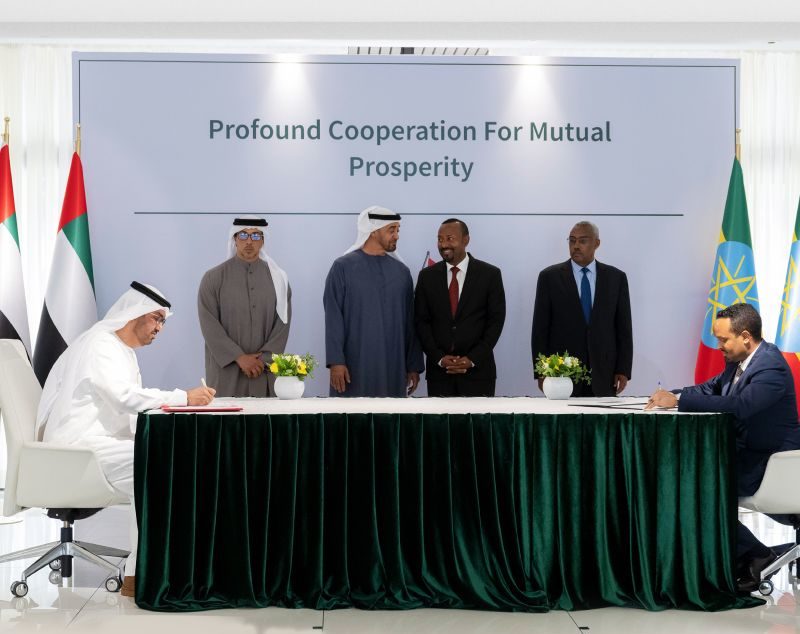
State-owned UAE renewable energy company Masdar has signed an agreement with Ethiopia to build 500MW of new solar capacity in the country.
The agreement was signed by Sheikh Mohammed bin Zayed Al Nahyan, president of the UAE, Sheikh Mansour bin Zayed Al Nahyan, vice-president of the UAE, and Abiy Ahmed Ethiopian prime minister, as part of the UAE leadership’s visit to Ethiopia.
Try Premium for just $1
- Full premium access for the first month at only $1
- Converts to an annual rate after 30 days unless cancelled
- Cancel anytime during the trial period
Premium Benefits
- Expert industry analysis and interviews
- Digital access to PV Tech Power journal
- Exclusive event discounts
Or get the full Premium subscription right away
Or continue reading this article for free
The two countries first discussed the potential of building new solar capacity in 2021, although no commercial projects have yet started operation. Masdar has also signed other clean power agreements in Africa, most notably a plan to develop 5GW of new capacity across Angola, Uganda and Zambia, announced in January of this year, as the UAE government looks to establish itself as a leader in the global energy transition.
The latest agreement is part of the Etihad 7 programme, a project introduced by the UAE in January 2022 aiming to install 20GW of renewable energy capacity in Africa by 2035. The involvement of the broader UAE policy could also help deliver an operational solar project in Ethiopia.
The work of companies such as Masdar has helped expand UAE-backed renewable power projects around the world, and meet these ambitions. In March, Masdar announced plans to develop a 70MW PV plant in the Republic of Côte d’Ivoire, and the Ethiopian project is the next step in the company’s plans for expansion in Africa.
While neither the Masdar nor Ethiopian leadership announced further details of the plans, the project could be an important component of Ethiopia’s long-term energy plans.
The government plans to deliver reliable electricity access to 100% of its urban population by 2025, up from 44% of its total population which had access to electricity in 2019. Much of this planned power generation will come from the renewables sector, with the state planning to bring power generated by renewable sources in particular to six million new citizens by 2030.
The involvement of foreign companies, such as Masdar, could be crucial to this end. A UN report noted that Ethiopia would require US$5.7 billion of investment to reach its 2030 energy goals, so overseas investment could be necessary to meet these targets.