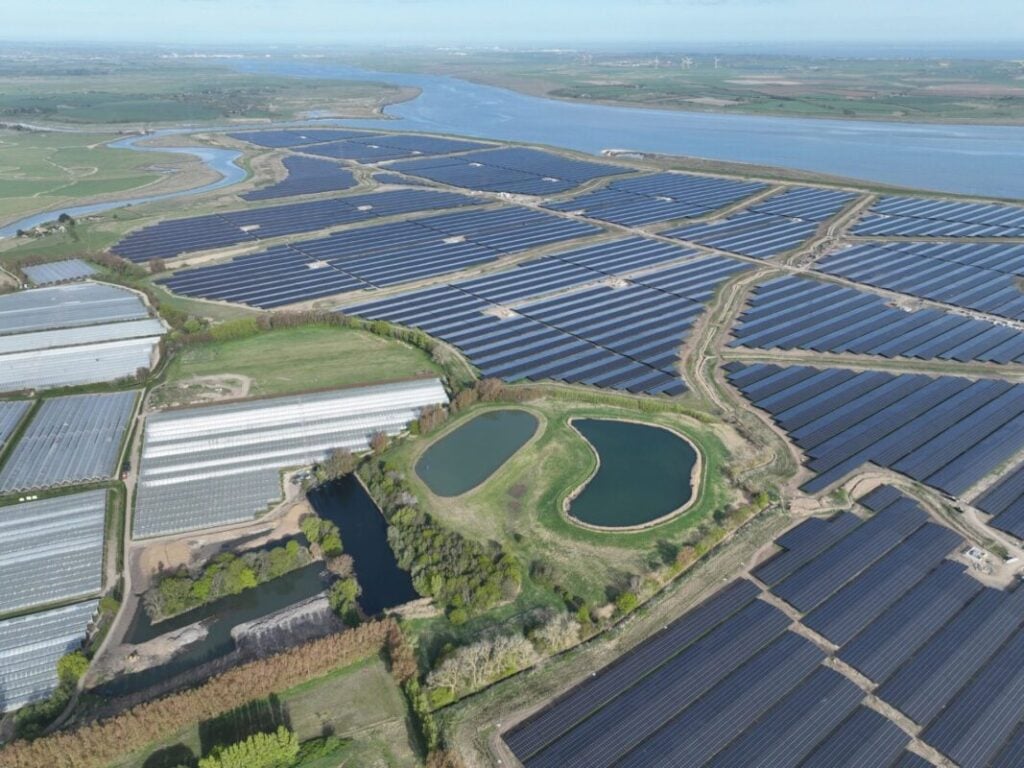
“BESS and solar are the perfect bedfellows,” says Natasha Luther-Jones, of solar PV and battery energy storage systems (BESS) in Europe. Luther-Jones is a partner, international head of sustainability and global co-chair of the energy and natural resources sector at law firm DLA Piper, and speaks to PV Tech Premium about the rise of co-located solar and energy storage, as investors are increasingly keen to back these projects.
According to SolarPower Europe, 2024 marked the 11th consecutive year of record-breaking BESS installations on the continent, and it expects Europe to add a further 400GWh of batteries by 2029, a sixfold expansion of the current scope of the industry.
Try Premium for just $1
- Full premium access for the first month at only $1
- Converts to an annual rate after 30 days unless cancelled
- Cancel anytime during the trial period
Premium Benefits
- Expert industry analysis and interviews
- Digital access to PV Tech Power journal
- Exclusive event discounts
Or get the full Premium subscription right away
Or continue reading this article for free
Crucially, many of these projects are being co-located with solar PV, particularly in the residential sector. Germany, Italy and the UK boasted the highest solar-plus-storage attachment rates in the residential sector in 2024, of 79%, 76% and 54%, respectively, marking the second consecutive year that all three exceeded 50% in this particular metric.
While Luther-Jones acknowledges that there is a “very country-specific” element to the attractiveness of solar-plus-storage at present, with factors such as grid effectiveness and government policy driving trends in this area, she notes that the underlying technical processes are very compelling across markets.
Luther-Jones explains that solar-plus-storage is a more reliable pairing than wind-plus-storage because the two assets sit more comfortably together on the grid. “You know when it’s going to be sunny and there’s virtually none at night, so you’re not competing for grid,” she explains. “Whereas the co-location of BESS and wind—which we see in the Nordics—doesn’t sit as well as solar and BESS because the wind and the BESS compete for wind capacity as they’re needed at the same time.”
A ‘really good’ investment landscape for solar-plus-storage
Figures from Pexapark show that, between 2024 and just the first nine months of 2025, the year-on-year growth rate in the number of co-located BESS deals stood at a massive 676%, compared to a growth rate of 392% for standalone BESS deals. This translates to an increase in contracted co-located capacity from 392MWh to 3,038MWh over this period.
“The investment landscape for solar and BESS at the moment is really good. I don’t think there’s ever been a better time to bring in co-located solar and BESS,” says Luther-Jones, who points to a number of factors for this attractive investment landscape, beyond the sheer volume of new deals being signed.
“If you look at co-location, it’s definitely the primary tool for mitigating the solar profile risk against cannibalisation and negative prices,” she explains. “In Spain, for example, where there’s a lot of cannibalisation and a lot of negative pricing, co-location makes perfect sense.”
In the first quarter of 2025, Spain saw 404 negative-price hours in the wholesale market; according to Modo Energy, this is 72% more than in Germany, and an issue that batteries are well-positioned to tackle. Indeed, following last April’s blackout across both Spain and Portugal, the Spanish government announced plans to make it easier to add BESS projects to the grid, as part of plans to install 22.5GW of storage by the end of the decade.
“If you were a solar developer, investor or lender, you’re going to look at BESS with solar in some countries and think ‘that absolutely makes sense, it helps me mitigate the most difficult risks we face’, which are risks that are hard for any individual party to take on their own,” continues Luther-Jones, who goes on to suggest that these benefits are not just for a single market, but could be shared across Europe with superior cross-border transmission infrastructure and policy.
“You can help manage negative pricing [and] curtailment in different countries; you can generate in one and transmit to another, so it can only help,” she says. “We do have an interconnected grid across Europe, so why not use it to help industry deal with the most difficult risks in our renewable energy market at the moment?”
Shifting towards storage-first
However, Luther-Jones notes that some of the financial instruments currently used to manage this transition to co-location are only temporary solutions.
“A lot of the offtakes are still separate offtakes for solar and BESS,” she says, suggesting that the power purchase agreement (PPA) structure that has become a cornerstone of renewable energy financing has not yet been properly applied to the renewables-plus-storage space.
“There’s definitely a move to hybrid, and we’re in the midst of that discussion, but the hybrid PPA solution is a current topical issue; there’s no market standard for how you deal with it. It’s very much depending on who is your offtake provider, and why are they entering into the PPA.”
“There are different solutions,” Luther-Jones continues. “There’s a pure hybrid solution, [but] you need to be a very sophisticated buyer of power to be able to go down the pure hybrid [route]. What that means is the developer passes over the solar and BESS to a trader or a buyer of green power, who is very sophisticated, and they will optimise it and deal with it themselves.
“They’ll take the solar and the BESS and be bidding on ancillary markets, so that avenue is only open to people with an internal trading team, and with a sophisticated knowledge of how the power markets work.”
However, she is not pessimistic about this transition to more sophisticated offtake agreements. Indeed, because of the favourable economics involved in the co-location of solar and storage assets, she argues that investors would see a more tailored offtake system as “a real opportunity to get the rates of return that they want from a project by combining the two”.
Perhaps this transition is already underway. Luther-Jones argues that there has already been a subtle shift away from how solar-plus-storage assets are considered and contracted in Europe, moving away from attaching batteries to solar assets, to the inverse.
“Historically, we used to see only the solar part of the project‑finance lenders’ base case, with BESS viewed as something equity could develop in the future,” she explains. “Solar developers started, quite a while ago, putting BESS in their planning consent so they had the ability to bring BESS on, but as long as it didn’t affect the parameters of solar, BESS was just an upside for the developers.”
“Now, we’re seeing solar and BESS combined being treated in the base case. One of the biggest deals, which won an award at the 2025 Energy Storage Awards, was for Quinbrook’s Cleve Hill project in the UK, and they actually brought the BESS in, so you have a good example of solar and BESS being financed in the base case, whereas historically the BESS could be an upside for the developer at a later stage.”
Shifting GOO protocols in solar-plus-storage
Looking ahead, Luther-Jones suggests that potential changes to Europe’s guarantees of origin (GOO) system, a form of market-based energy tracking that allows buyers to guarantee the renewable credentials of the electricity they purchase, could be beneficial for the BESS sector in particular.
“GOOs at the moment relate to the generation of solar, so you don’t have, at the moment, GOOs for BESS,” she explains. “Some countries in Europe are in the process of implementing it, but it won’t happen straight away, and what that means is that you could have GOOs—proving the ‘green-ness’—coming from your BESS facility, if you have a co-located generation facility.
“At the moment, the certificates are generated when it’s sunny and the solar [generation] is hitting the meter. Instead, you’ve put it into the BESS and you might hold onto that power, and then export it through the meter at a later stage.” She says that shifting the time that power is exported could offer more flexibility to offtakers in when they use or register green certificates for their power.
Such an approach would add a new element of flexibility to the operation of solar-plus-storage assets, a kind of financial flexibility that aligns neatly with the power generation and distribution flexibility offered by batteries in the first place. Luther-Jones stressed that not all the hyperscalers she has spoken to would be keen for such a system, but “a couple of the significant ones” would be hesitant to sign a BESS corporate PPA without generation co-located, suggesting that hyperscalers, too, see solar-plus-storage as a key component of the European energy mix.
“If [offtakers] want to match their consumption more closely, then BESS and solar combining [with] GOOs for BESS could be the perfect solution.”
Luther-Jones will be speaking at the 13th edition of the Solar Finance & Investment Europe event in London on 3 – 4 February 2026, hosted by PV Tech publisher Solar Media. This event annually attracts infrastructure funds, institutional investors, asset managers, banks and development platforms at the forefront of European renewables. For more details, visit the website.