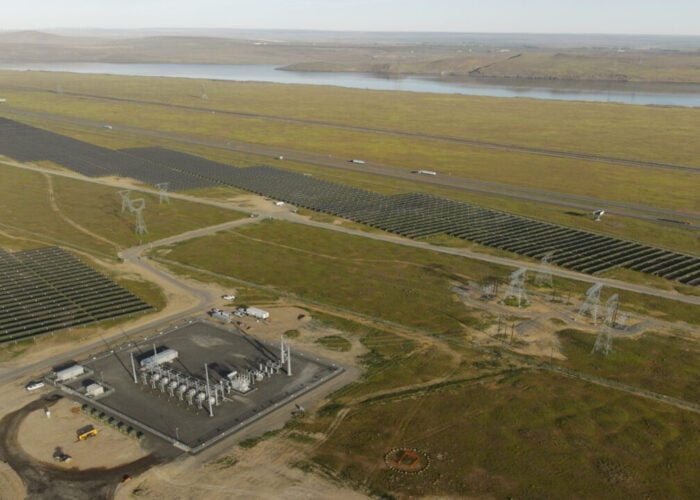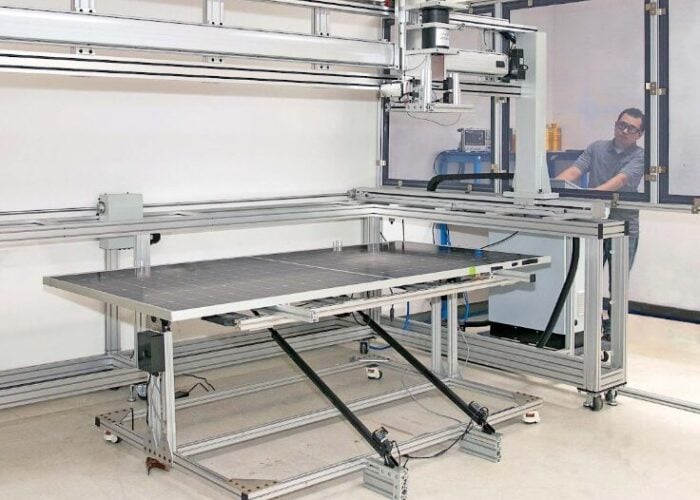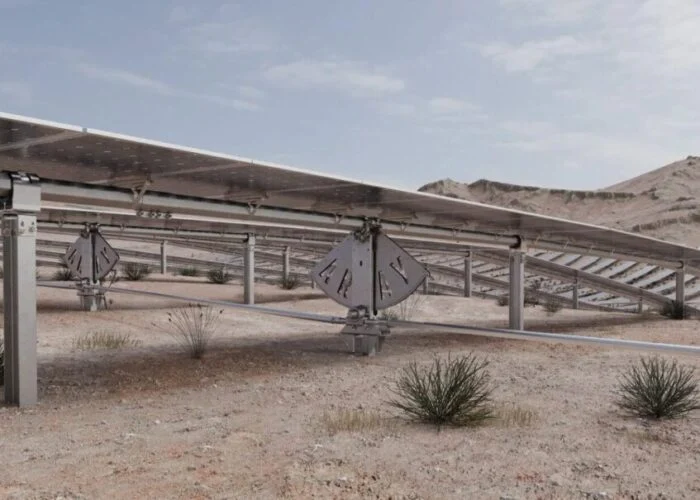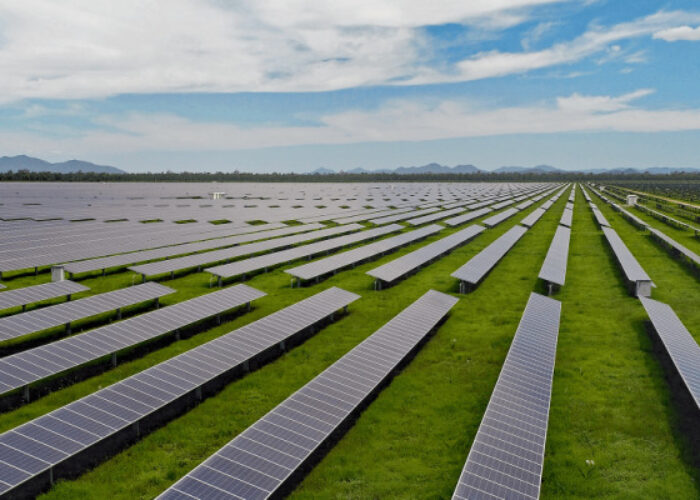
US solar technology company Terabase Energy has completed testing work on its Terafab version 2 (V2) autonomous solar module installation process, which is now “ready for commercial shipment”.
The process aims to accelerate the installation of a solar project by using robotics and automation to replace activities typically completed by human workers. Under the Terafab V2 system, modules are pre-assembled onto tracker torque tubes at an on-site factory that Terabase says can be set up in four hours. These modules are then checked for defects, and the tubes are delivered to the project site by a vehicle dubbed a ‘rover’.
Try Premium for just $1
- Full premium access for the first month at only $1
- Converts to an annual rate after 30 days unless cancelled
- Cancel anytime during the trial period
Premium Benefits
- Expert industry analysis and interviews
- Digital access to PV Tech Power journal
- Exclusive event discounts
Or get the full Premium subscription right away
Or continue reading this article for free
The rovers then connect the torque tubes to the ground and to existing tubes, installing the solar modules much more quickly than the conventional method, which relies on human workers manually adding each solar module, one by one, to torque tubes in the field.
The speed of the operation, in addition to the fact that the machines can work day and night, means the process can install modules very quickly. Terabase estimates that the process can install more than 20MW of solar capacity per week, which translates to 1GW per factory per year; this speed is a key selling point of the process, according to Terabase CEO and co-founder Matt Campbell.
“Every week we shave off a construction schedule means earlier revenue for project owners, lower financing costs, and faster delivery of clean electrons to the grid,” said Campbell. “That’s the speed-to-power advantage.”
Over the next year, Terabase plans to expand a factory in northern California to bring its annual installation capacity to 10GW. The company also said that it expects its rovers to be able to operate “fully autonomously soon”, but did not provide further details of this timeline.
The news follows considerable testing of the company’s process; Terabase noted that it has deployed its Terafab process at five projects, including the 225MW White Wing Ranch solar project in 2023, the first deployment of the technology. In the years since, the company has secured additional financing to expand its services, including raising US$130 million last March.
As with other industries, automation in the solar sector is growing. At the Solar Quality Summit in Barcelona last month, industry members said they expected their operations to be between 45% and 75% automated by 2030, which could result in drastic job cuts over the next five years. Plant construction has been one of the least easily automated parts of the industry, as it relies on physical robots in conjunction with AI replacing manual labourers.
Speaking to PV Tech at last month’s event, David Moser, managing director of the Becquerel Institute Italia and a leading expert on AI in the solar sector, said that balancing automation and job losses was a “very difficult element to address.” He specifically referenced early models of automated construction as a significant point of concern for industry jobs.