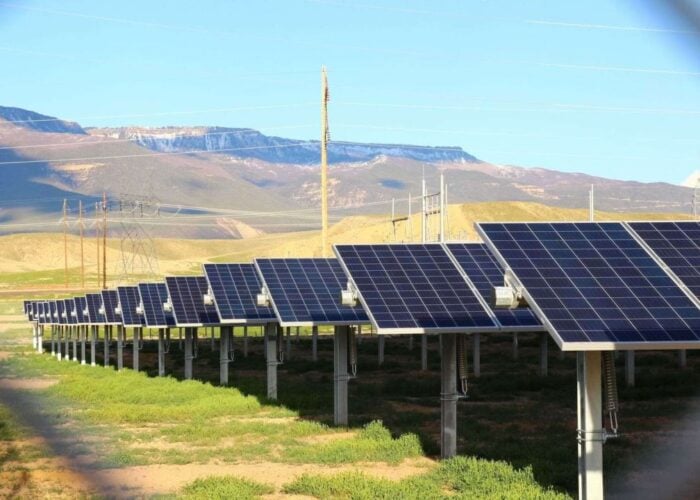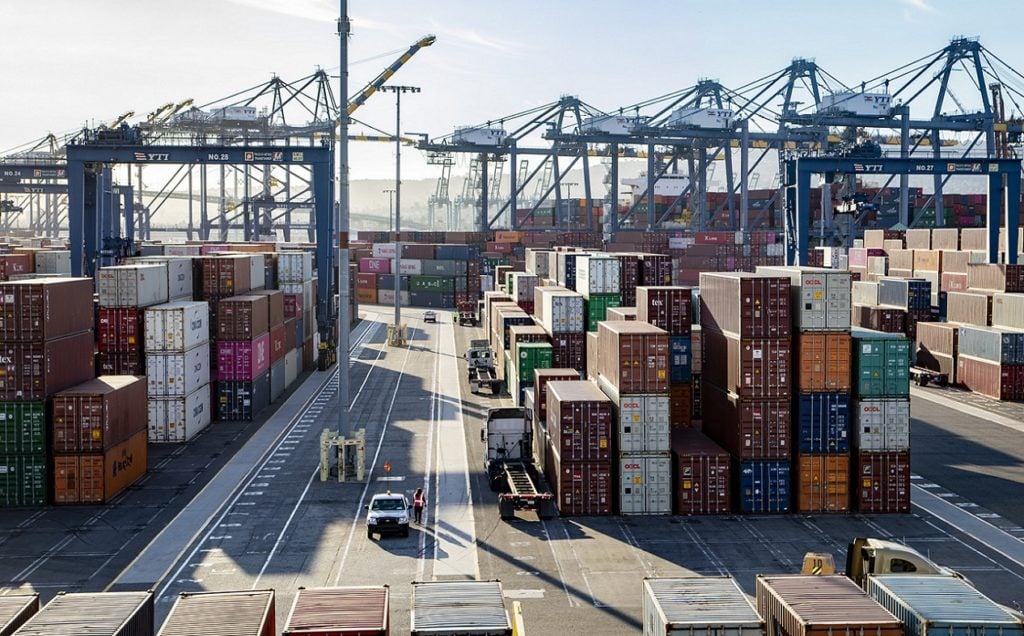
The global tariffs announced by US president Donald Trump last week will have a limited effect on solar imports from Asia, according to a report from BMI.
BMI, a unit of consultancy firm Fitch Solutions, expects a limited decrease in solar imports from the region due to existing US tariffs on imported solar products and the country’s current reliance on solar cell imports.
Try Premium for just $1
- Full premium access for the first month at only $1
- Converts to an annual rate after 30 days unless cancelled
- Cancel anytime during the trial period
Premium Benefits
- Expert industry analysis and interviews
- Digital access to PV Tech Power journal
- Exclusive event discounts
Or get the full Premium subscription right away
Or continue reading this article for free
The ongoing antidumping and countervailing duty (AD/CVD) investigation on solar cell imports from four Southeast Asian countries is already set to increase the price of incoming products.
Although the US Department of Commerce still needs to finalise the AD/CVD tariff rates later this month, preliminary duties have already been set for Thailand (with a 71% preliminary duty), Cambodia (254%), Malaysia (22%) and Vietnam 274%). According to BMI, if implemented, these tariffs would increase the price of Chinese solar panels by US$0.1-0.15/W and bring them closer to price parity with US modules.
T1 Energy, a US solar manufacturer, expressed its support for the global tariffs imposed last week by Trump. The company expects to benefit from these tariffs as it ramps up its domestic solar manufacturing capacity in Texas. It recently executed a lease and purchase option to build a 5GW solar cell plant in Austin, while its module assembly plant already produced 220MW of modules in the first two months of 2025.
“The tariffs introduced this week dovetail with our strategy, and the anticipated financial benefits should accelerate our plans to expand T1’s U.S. solar value chain,” said Daniel Barcelo, T1’s chairman of the Board and CEO.
Increase in domestic manufacturing costs
However, the US solar manufacturing industry still relies heavily on imported solar cells, due to its limited cell nameplate manufacturing capacity. The new tariffs and the ongoing uncertainty regarding funding from the Inflation Reduction Act, coupled with the reliance on imported cells, could further raise solar manufacturing costs, BMI said.
This was the same sentiment shared by US industry figures with PV Tech last week, who said the tariffs will “undermine” the establishment and growth of a domestic PV supply chain (Premium access).
In the short and medium term, BMI expects solar panel price increases to be absorbed by US buyers, which could also affect the growth of solar PV installations.
“Since the US’s manufacturing capacity is insufficient to meet demand for solar, wind and grid components, we do expect that costs will increase for developers due to the tariffs which will now be imposed upon these components,” wrote BMI.
Moreover, it will lead to increased project costs and potential project delays as developers navigate a new financing landscape
“Overall, while the power sector may not be as adversely affected as others, these tariffs still pose further headwinds to a sector which has been badly affected since Trump’s return to office,” concluded BMI.
PV Tech publisher Solar Media will be organising the fourth edition of Large Scale Solar USA in Dallas, Texas 29-30 April. After a record year for solar PV additions in the US, the event will dive into the ongoing uncertainties on tariffs, tax credits and trade policies as more domestic manufacturing becomes operational. Other challenges, such as the interconnection queues and permitting, will also be covered in Dallas. More information, including how to attend, can be read here.