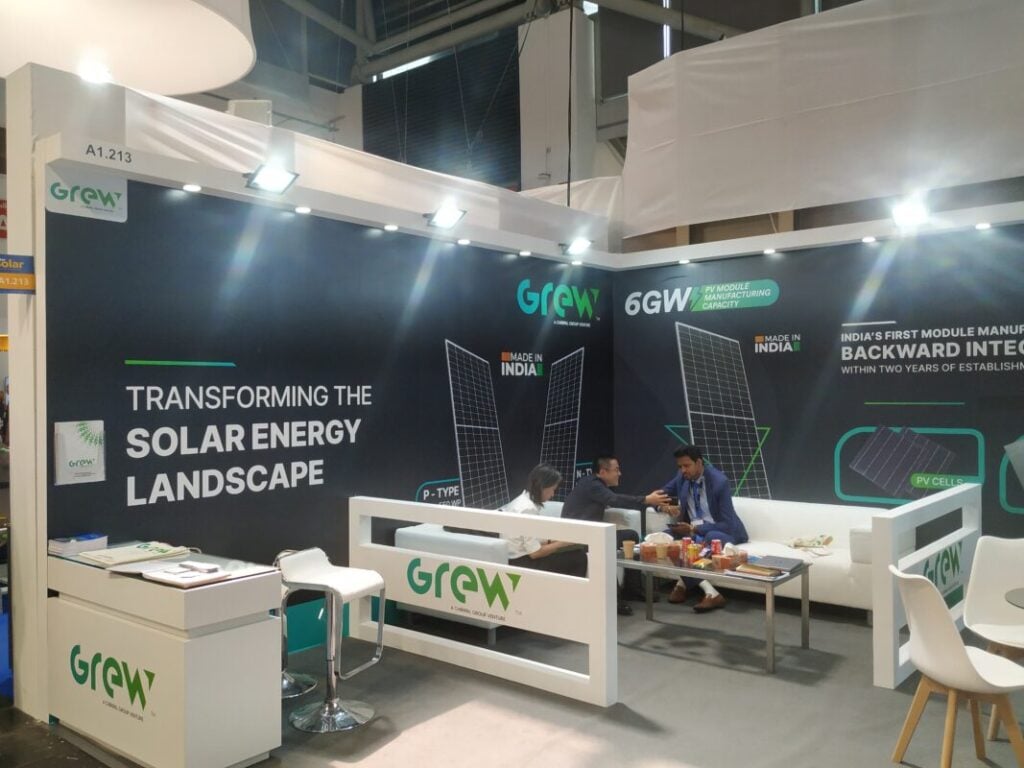
Greater supply chain independence is a priority for companies in the solar sector, particularly for those with the capacity for and interest in both upstream and downstream development.
This is according to Hardip Singh, chief operations officer at Indian manufacturer Grew Energy, who spoke to PV Tech yesterday afternoon at the Intersolar Europe 2024 event in Munich, Germany. Grew is one such vertically-integrated company, involved in the production of ingots, wafers, cells, and modules. Singh suggested that this has helped the company achieve a greater degree of independence, and resilience.
Try Premium for just $1
- Full premium access for the first month at only $1
- Converts to an annual rate after 30 days unless cancelled
- Cancel anytime during the trial period
Premium Benefits
- Expert industry analysis and interviews
- Digital access to PV Tech Power journal
- Exclusive event discounts
Or get the full Premium subscription right away
Or continue reading this article for free
Grew Energy’s annual module nameplate capacity is currently at 2.8GW, which it expects to increase to 6GW by 2025.
“All countries are trying to be independent, or self-dependent, I should say, especially after Covid,” Singh told PV Tech. “Covid taught us not to rely on the supply chain as it can be disrupted by the slightest of reasons.”
This is particularly significant considering many of the challenges faced by the global solar sector, with shifting legislative landscapes, such as the US’ passage of the Inflation Reduction Act (IRA) and anti-dumping and countervailing duty (AD/CVD), affecting the commercial viability of manufacturing projects in China, and exporting them to the US.
Singh noted that this need for greater resilience has coincided with a greater emphasis on locating industrial manufacturing capacity in India, which could be of benefit for the Indian solar sector, as it looks to scale up operations.
“India has always promoted, in the last 20 years, ‘made in India,’ not only for solar but for all the industries,” explained Singh.

“You have solar, wind and hydro. In wind and hydro you have a very limited scope, but solar is unlimited,” he continued, suggesting that solar may well dominate India’s renewable energy power mix in the long-term, with India currently boasting 83GW of operational solar capacity. “[There are targets for adoption of] 500GW of renewables by 2050; if that is to happen, solar will have to be added at a rate of 35-40GW a year.”
‘Aligning policies and processes’
“[India benefits from] aligning certain policies and processes to help you achieve the target,” continued Singh, suggesting that the Indian government has supported new solar projects in the country. In the first quarter of the year, India added over 10GW of new solar capacity, a massive 400% increase over the first quarter of the previous year, and Singh notes that the government has sought to incentivise Indian manufacturing, as well as deployment.
“The government has come up with some very attractive policies to help local manufacturing. Not only to achieve the target, but help local manufacturing,” said Singh.
He pointed to the work of First Solar in the country, which inaugurated its first module manufacturing facility in the country earlier this year. The facility has an annual thin-film cadmium telluride (CdTe) manufacturing capacity of 3.3GW, and the choice of a US company to locate new manufacturing facilities is an indication of the potential of the Indian manufacturing sector.
“The policies have stabilised, the technology is, more or less, stabilised around tunnel oxide passivated contact (TOPCon) – it’s likely to stay for a year or two, and [manufacturing] is part of our DNA,” continued Singh, highlighting Grew’s vertically-integrated supply chain. “We have been in manufacturing for the last 50 years.”
European market challenges
Singh also noted that the company’s presence at Intersolar is intended to “mark our presence” among leading US solar companies.
“Europe is interesting, but it’s dominated by the Chinese guys because of the price,” Singh said. “We are hopeful that there will be some kind of non-Chinese restriction, like what the US has. We are ready to enter the US and Europe markets, even today; it’s just [a question of] when the other markets are ready to accept us.”
Ultimately, Singh suggests that while individual module manufacturers, such as Grew, are eager to sell products in Europe, some of the macro-economic challenges that have plagued the European solar sector continue to present a challenge for manufacturers in other countries. On the first day of Intersolar Europe 2024, German supplier Memodo forecast “crazy” ongoing price pressures on the continent.
“[Oversupply is] a secondary issue, as far as we’re concerned,” said Singh, when asked about Europe’s much-discussed oversupply challenge. “Even when there was no oversupply, we were not able to sell, because of the price. Now, of course, we have added agony.
“Already we were struggling with the price, now we have excess stock here, which is bringing the prices down even further.”