The US Department of Commerce (DOC) has begun an antidumping and countervailing duty (AD/CVD) investigation into solar cells produced in Ethiopia.
The DOC will determine whether solar cells produced in Ethiopia are using Chinese-made components before shipping direct to the US or to Vietnam for assembly into modules, thus circumventing AD/CVD orders on Chinese products. Toyo Solar and Origin Solar are prominent manufacturers in the country, with shipments to the US.
Try Premium for just $1
- Full premium access for the first month at only $1
- Converts to an annual rate after 30 days unless cancelled
- Cancel anytime during the trial period
Premium Benefits
- Expert industry analysis and interviews
- Digital access to PV Tech Power journal
- Exclusive event discounts
Or get the full Premium subscription right away
Or continue reading this article for free
These allegations were brought by a group of US-based solar manufacturers, including cadmium telluride (CdTe) thin-film module producer First Solar, Korean-owned Hanwha Qcells, Suniva, Swift Solar and Silfab Solar. They brought a petition to the DOC in May.
The petitioners claimed that they have documented an increase in Ethiopian-made silicon PV cells and modules entering the US, which coincided with a “surge” in Chinese exports of “key cell and module imports” to Ethiopia. They said that cell and module imports from Ethiopia had reached US$277 million in the second half of 2025, “and have continued climbing”.
The complainants argue that the investigated companies are damaging US manufacturers by undercutting their prices with Chinese-made components.
“Our sustained monitoring of these trade flows is delivering results, and this new investigation sends a clear signal to bad actors: we will not stand by while they repeatedly circumvent our trade laws to undercut American manufacturing,” said Tim Brightbill, lead counsel for the petitioners and co-chair of Wiley’s International Trade Practice. “We commend the Department of Commerce for following the evidence and initiating this inquiry.”
Toyo denies using Chinese wafers
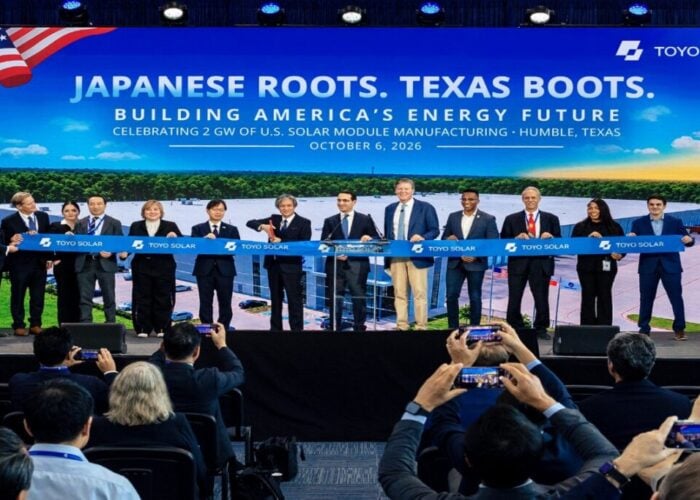
Toyo Solar began production at its 2GW solar cell plant in Ethiopia in April, with plans to double the annual production capacity to 4GW. It is also in the process of building manufacturing capacity in the US. Origin Solar operates a cell and module production facility in Ethiopia and reportedly shipped its first products to the US in early 2026.
When the case was started, Rhone Resch, chief strategy officer at Toyo Solar, told PV Tech that “all [Toyo’s] solar cells manufactured in Ethiopia use exclusively polysilicon supplied from the US and Malaysia, and our wafers are processed in Southeast Asia. We plan to vigorously clarify these facts through the appropriate official channels.”
In comments we received today, he doubled down: “The allegations do not accurately characterise Toyo’s current supply chain or the sophisticated manufacturing performed at our Ethiopian facility,” Resch told PV Tech.
“Toyo respects the right of interested parties to participate in US trade proceedings. We also believe that allegations must be tested against complete, company-specific evidence.
“Toyo’s current Ethiopian production does not use Chinese-origin wafers. At our 4GW facility in Hawassa, approximately 1,800 employees operate an advanced TOPCon manufacturing platform that performs the complete wafer-to-cell conversion process,” he continued.
He added that wafers entering the Ethiopian facility “undergo chemical texturing, high-temperature emitter and p-n junction formation, tunnel-oxide and passivating-contact formation, plasma-enhanced coating, metallization, firing, and final electrical testing.”
Previous legal cases have used the addition of a p-n junction to a wafer – known as doping – as a means to determine their “origin” and thus their eligibility under AD/CVD. Doped, “blue” wafers are capable of conducting electricity, and there is some confusion over whether the process constitutes a “substantial” manufacturing transformation.
Resch continued: “It would be premature to quantify the potential effect of an affirmative determination. No respondents have yet been selected, and Commerce has not made any preliminary findings or determined the scope, timing or company-specific treatment that might result. Toyo is evaluating potential scenarios while continuing to serve its customers and advance its previously announced US manufacturing expansion.”
Solar AD/CVD runs on
The impacts of AD/CVD rulings on manufacturers and product importers can be severe and unexpected. The DOC has applied vastly different rates for different producers in its historical AD/CVD cases, with variation between each of the two components (antidumping duties and countervailing duties). There is also potential for retroactive duties collected on products which entered the US since the start of the investigation.
This is the latest in a series of AD/CVD complaints and ensuing investigations brought by the same section of the US solar industry. There have been investigations and duties applied to cells and modules coming from Thailand, Cambodia, Malaysia and Vietnam, a separate and ongoing case on India, Indonesia and Laos, and a historic case on Chinese products. Potential future cases may turn to the emerging solar manufacturing capacity in the Middle East, leading industry experts to liken the process to a game of “whack-a-mole” (subscription required).
More recently, the US tariff war became more complex, as a different set of North America-based manufacturers brought a petition to the DOC seeking an investigation into South Korean products.
This case targeted Hanwha and its subsidiary, Qcells, which has been a major player in bringing the other AD/CVD cases, along with other Korea-based producers. It was brought by Canadian Solar, Heliene and SEG Solar, and effectively set up internecine battle lines between two parts of the US solar industry.