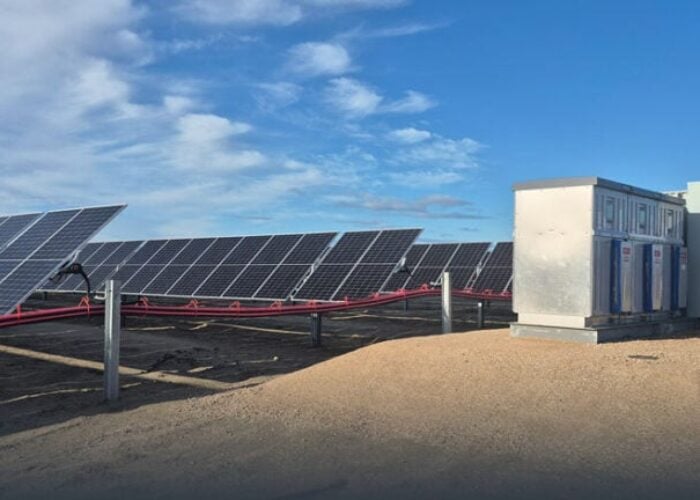
Plug-in photovoltaic (PIPV) systems are built around a simple idea: mount solar panels on a balcony, connect them to an inverter and plug them into a household outlet. For renters and apartment owners unable to install rooftop solar, the appeal is clear. But that simple connection entails a fundamental change in how a household outlet is used.
A conventional appliance draws electricity from a residential circuit; a PIPV system can put electricity back into it.
Try Premium for just $1
- Full premium access for the first month at only $1
- Converts to an annual rate after 30 days unless cancelled
- Cancel anytime during the trial period
Premium Benefits
- Expert industry analysis and interviews
- Digital access to PV Tech Power journal
- Exclusive event discounts
Or get the full Premium subscription right away
Or continue reading this article for free
That distinction has become a central focus for Illinois-based testing and certification company UL Solutions, which has spent considerable time examining the safety implications of plug-in solar in the US.
Ken Boyce, vice president, principal engineering at UL Solutions, tells PV Tech Premium that the organisation’s assessment identified two broad areas of concern: the inherent safety characteristics of the PIPV system itself and the way the system interacts with the electrical wiring of the building into which it is connected.
The starting point, Boyce says, is to stop thinking about plug-in solar as a collection of individual components. “It really does have to be considered as a system, not just an assembly of these individual components,” he emphasises. “These systems generate electricity, right? They’re tiny power plants, if you will,” Boyce says. That means the safety assessment must account not only for the equipment itself, but also for how electricity is produced, controlled and exported into a residential electrical system.
UL Solutions used hazard-based safety engineering to assess PIPV’s shock, fire and injury risks, which subsequently fed into the development of UL 3700, published earlier this year.
A familiar plug with an unfamiliar job
PIPV plugs look like those used by everyday appliances, but their function is fundamentally different.
“We’re all familiar with these as consumers, where we plug in an appliance or a laptop into a receptacle and we draw power from the wiring system to power the equipment that we’re using,” Boyce says. PIPV systems use that same cord and plug, but they effectively reverse the main assumptions of how household plugs have traditionally been used.
Unlike normal plugs, when a PIPV system is disconnected, the panel continues to produce electricity if it is absorbing light, which the inverter converts into AC power. If the system can export that power through the plug, disconnecting the plug does not necessarily mean that the plug blades are safe to touch.
“In the absence of other safety protective circuits, there would be hazardous voltage accessible on plug blades,” Boyce warns. “So, a person could easily touch those and be subjected to an electric shock hazard.”
The risk is not theoretical. The typical 120V AC supply used in US residences is “very definitely an electric shock hazard”, Boyce says, that could result in serious injury or death if a consumer were exposed to it.
UL 3700 requires additional protection to shut down power export before a consumer can contact a hazardous voltage at the plug. Existing inverter shutdown requirements, designed to protect utility workers, are too slow to address this shock risk. PIPV systems therefore need an additional safety function built into the system.
The current a circuit breaker cannot see
The plug itself is only one part of the problem. Residential electrical circuits are designed around established rules governing how power is distributed and protected. Overcurrent protective devices, most commonly circuit breakers, are intended to protect the wiring, connections and equipment on a circuit from excessive current.
A conventional load draws current through the circuit breaker, meaning the breaker can detect the current passing through the circuit and interrupt the supply if it exceeds the permitted level. A PIPV system connected downstream of that breaker can change the calculation because it introduces another source of current into the circuit.
“They inject current into that electrical circuit that the circuit breaker in the panel board is blind to,” Boyce cautions. “It cannot be perceived because it’s being injected into the circuit downstream of the circuit breaker.”
This could overload parts of the circuit without the upstream breaker detecting it.
The most likely consequence is a fire rather than an immediate electrical failure. While a sufficiently large overload could produce a problem relatively quickly, Boyce says that gradual degradation in the electrical connection or insulation on conductors could cause issues.
“You could have a glowing electrical connection that takes weeks or even months to manifest itself as a fire hazard,” he says.
For UL Solutions, that makes overloading one of the central hazards that must be addressed before PIPV can be treated as a conventional residential electrical installation.
There is not, however, a single engineering solution. One approach is to ensure that the wiring and electrical equipment on the relevant circuit are rated for the combined current that could be supplied by the utility and the PIPV system. Another is to use power control systems that monitor the circuit and intervene when the current reaches an unsafe level.
Boyce distinguishes those systems from conventional energy management systems, which are generally concerned with reducing electricity consumption or managing energy costs. A power control system can instead perform a safety function, detecting excessive current and shutting down or reducing loads to prevent an overload.
A second layer of protection
UL Solutions’ analysis also looked at the interaction between PIPV systems and ground-fault circuit-interrupters (GFCIs), which provide additional protection against electric shock in locations where people may be exposed to both water and electricity, like bathrooms, around sinks and in outdoor applications.
The issue identified by UL Solutions is that connecting PIPV to a circuit in a way that effectively backfeeds a GFCI can result in the protective device being misused. According to Boyce, the device can potentially be damaged so that it no longer provides its intended protection while continuing to supply power.
That creates a particularly difficult failure mode from a consumer-safety perspective: the equipment may appear to be functioning normally without actually protecting the consumer.
It is this kind of interaction that has driven UL Solutions towards a system-level assessment of PIPV.
Turning the hazards into a standard
UL Solutions published a white paper in December 2025 detailing its research into the hazards associated with PIPV. The organisation then examined practical ways those risks could be mitigated and translated those findings into the requirements.
“We took these ideas and captured them in the requirements of UL 3700,” Boyce says.
The purpose of the standard is not to dictate a single technological architecture. He says the organisation recognises that manufacturers may develop alternative approaches capable of delivering the same safety outcomes.
“The manufacturing community can be very innovative,” he adds. “There may be other innovative ways that may be developed to mitigate those hazards that could be perfectly acceptable.”
That is an important distinction for a developing technology. A safety standard can establish the conditions that have to be met without necessarily preventing manufacturers from finding different ways of meeting them.
The more immediate issue, however, is whether the products already being sold to consumers meet those safety expectations.
According to Boyce, UL Solutions bought products from the market and tested them as part of its research. None of the products tested complied with the requirements of UL 3700.
“That really is important because it does show that there are safety issues with products that are on the market today,” he says. Boyce adds the technology can be made safe with existing engineering, provided safety is built into the design from the start.
The regulatory gap
Even a product that meets an appropriate safety standard still faces another question in the US: where can it be installed?
The 2026 National Electrical Code (NEC) does not specifically address PIPV systems. The significance of that omission is complicated by the way electrical regulation works in the US.
The NEC is a model code. It becomes enforceable when it is adopted by a state or local jurisdiction, potentially with amendments. Enforcement is then carried out by authorities having jurisdiction (AHJs), such as electrical inspectors.
“Until that model code gets adopted by your jurisdiction, it’s not enforceable,” Boyce says.
States are unlikely to adopt identical legislation independently. He believes the more realistic route is for a common technical framework to emerge through the NEC, which individual jurisdictions can then adopt.
According to Boyce, more than 30 US states have either passed legislation or are actively considering legislation relating to PIPV, although the number is changing as states continue to address the technology.
One driver is the desire to simplify the interconnection of small-scale generation. A conventional rooftop PV installation can involve a significant utility interconnection process. PIPV systems are considerably smaller, and some states are looking to establish pathways that make it easier for consumers to connect them.
Safety, however, remains part of that legislative process. The approaches differ between jurisdictions, with some referencing UL 3700 and others using different mechanisms.
“It really is important, in our view, to make sure that if you’re going to permit the use of these systems, you need to protect the people that are using them,” Boyce adds.
The next significant opportunity for greater consistency could come through the NEC itself. The 2029 edition is already under development, and Boyce says there are “many, many proposals” addressing PIPV systems.
UL Solutions expects that the 2029 NEC will contain explicit requirements covering how PIPV systems can be installed and used. There is also a potential mechanism for changes to be introduced before then through a tentative interim amendment to the 2026 NEC, although Boyce emphasises that would depend on whether the industry and code-development process can reach consensus.
A route into the energy transition
UL Solutions sees significant potential for PIPV over the next five years, particularly for renters and apartment or condominium owners who cannot install rooftop solar. “If you live in a condo or you’re a renter in an apartment, it gives you a chance to create your own clean energy,” Boyce says.
But scaling the technology will depend on bringing product design, safety certification, electrical codes and regulation into alignment. He believes the technology can be made safe today, with UL 3700 providing a framework for doing so.
For consumers, the clearest signal could ultimately be a certification mark. Boyce says a UL mark demonstrating compliance with UL 3700 would be the “most important practical indication” that a PIPV system is safe.
UL Solutions is now working towards its first certification — a potentially important milestone for a technology whose simplicity is both its appeal and its safety challenge.
This is PV Tech Premium’s second deep dive into the US plug-in solar market. Read our first interview with a Wood Mackenzie expert on the outlook for plug-in PV in the US here.