French renewables developer Voltalia has published its financial results for the first half of 2023, which include a 44% growth in turnover in energy sales, compared to the first half of 2022, and 41% increase in earnings before interest, taxation, depreciation and amortisation (EBITDA) over the same period.
While the company’s turnover across all operations showed a negligible increase, from €198.1 million in the first half of 2022 to €198.9 million (US$210.6 million) in the first half of 2023, the company’s growth in revenue from its electricity generation and sales will be of particular interest, considering Voltalia’s considerable investments into its renewable portfolio in recent years.
Try Premium for just $1
- Full premium access for the first month at only $1
- Converts to an annual rate after 30 days unless cancelled
- Cancel anytime during the trial period
Premium Benefits
- Expert industry analysis and interviews
- Digital access to PV Tech Power journal
- Exclusive event discounts
Or get the full Premium subscription right away
Or continue reading this article for free
“The commissioning of power plants owned by Voltalia has been occurring one after the other since the beginning of 2023 as well as in 2022,” said Voltalia CEO Sébastien Clerc. “Electricity production therefore jumped by 41% in the first half. The base effect of the commissioning in the first half of the year as well as those to come will allow this trend to continue.”
The graph below highlights how the company has invested in both its operational portfolio, through bringing projects online, and its development pipeline, by backing new renewable projects, suggesting that the company’s energy generation capacity is primed for continued growth.
In the first half of this year, the capacity of the company’s total portfolio, comprising projects in operation and under development, exceeded 4GW for the first time, and since June 2022, the company has been granted approval for 1.4GW of new projects.
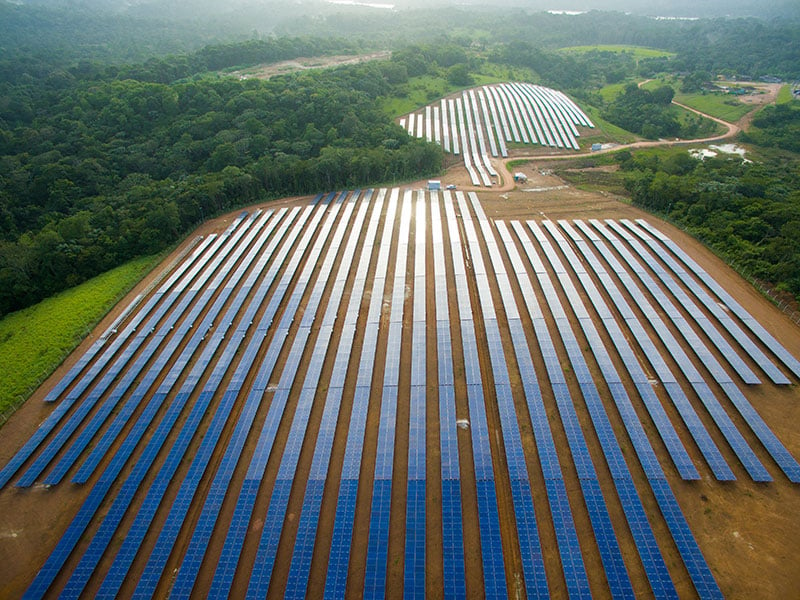
Much of this investment has gone towards the company’s solar portfolio in particular, with the European Bank for Reconstruction and Development providing a €29 million loan to finance a new 140MW solar project in Albania in April this year. In the months since, the company has started commercial operations at utility-scale projects in Brazil and Portugal, projects brought online in the second half of this year that are not accounted for in the latest results, and are further evidence of the company’s potential for sustained expansion.
Voltalia’s EBITDA target is significantly higher than its earnings in the first half of the year, which reached €56 million, up from €47.2 million in the first half of 2022, and the encouraging results have led to more ambitious targets in the coming years. The company’s leadership is optimistic about meeting its 2027 production ambition, which includes the ownership of 5GW of projects in operation or under construction, and the operation of 8GW of renewable power generation on behalf of other companies.
However, the company posted a net loss of €19.4 million in the first half of the year, which it attributed to “the seasonal nature of the electricity production of the Voltalia power plants,” suggesting that its renewable portfolio has not delivered electricity consistently.
The seasonal nature of renewable power projects is well-documented, and often alleviated with the installation of battery storage facilities, to allow projects to store power to be deployed when demand is higher. Voltalia has sought to embrace the technology in recent months, commissioning such storage projects in the UK in January last year, and French Guiana in May this year.
“The pace of ramp-up has temporarily slowed in Brazil where, following a widespread power blackout, that affected almost the entire network for a few hours,” said Clerc, pointing to a blackout in Brazil in August that temporarily suspended production at power facilities with a combined capacity of 16GW.
“The connection of new power plants has therefore been delayed. This is the case for the Canudos and SSM3-6 plants, which are now fully built.”