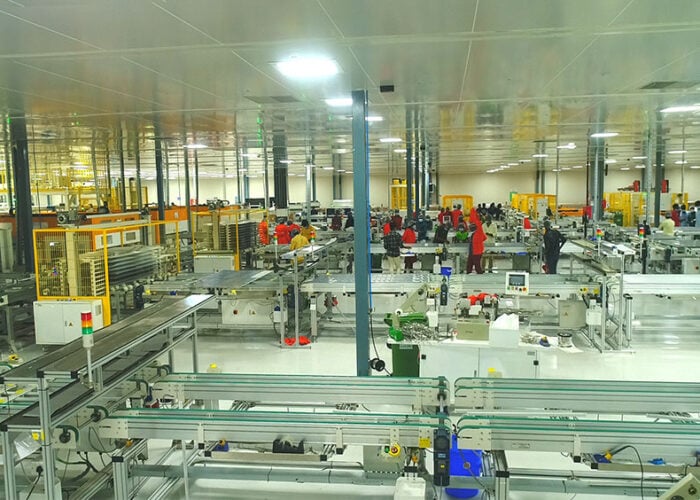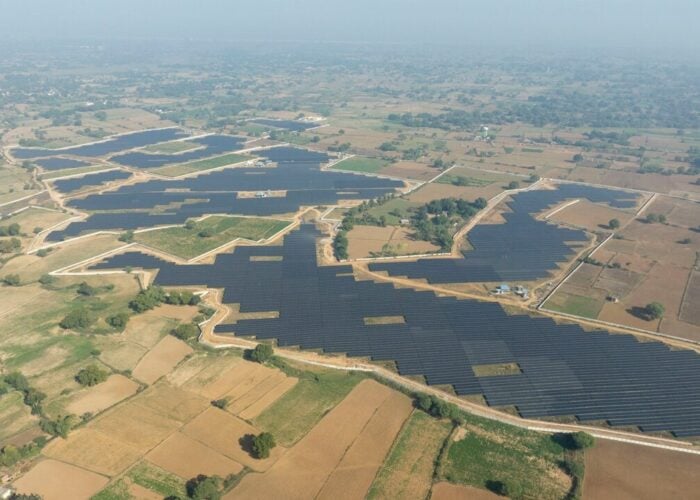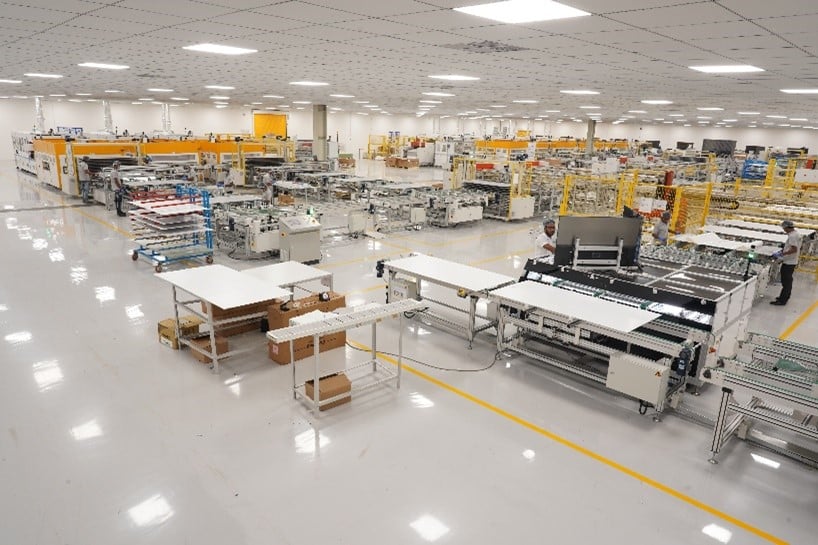
Indian module manufacturer Waaree Energies is taking advantage of rising interest in its products from export markets as it looks to maintain a full order book, the company’s CEO has said.
With current module production capacity at 3GW, Waaree is set to have another 2GW come onstream within the next 45 days, CEO Vivek Srivastava said, adding that the manufacturer has already received “huge enquiries” from export markets.
Try Premium for just $1
- Full premium access for the first month at only $1
- Converts to an annual rate after 30 days unless cancelled
- Cancel anytime during the trial period
Premium Benefits
- Expert industry analysis and interviews
- Digital access to PV Tech Power journal
- Exclusive event discounts
Or get the full Premium subscription right away
Or continue reading this article for free
Speaking during a webinar hosted by consultancy JMK Research & Analytics last week, Srivastava said Waaree is “running at 50% or less of certified capacity… and that’s why we are having to look up to export markets to ensure the order book is full.”
In September 2020, Waaree secured a US$105 million order to supply more than 300MW of its mono PERC modules for a solar project in California. The company last month got approval from Indian regulators to launch its initial public offering.
The JMK webinar coincided with the publication of a report from the consultancy and think tank the Institute for Energy Economics and Financial Analysis (IEEFA) that revealed that while India’s nameplate module capacity was around 18GW as of November 2021, production output is far lower as many facilities operate at a capacity utilisation factor of less than 50%.
With India set to introduce a 40% basic customs duty (BCD) on modules and 25% duty on cells as of April 2021, recent research from consultancy Fitch Solutions warned that the country could face a supply and demand mismatch for solar equipment if domestic PV manufacturers can’t meet the quantity and quality required by project developers.
Among the developers that have flagged concerns about solar equipment supply in India is Scatec, which last month announced it was putting on hold a 900MW solar plant due to a lack of domestic modules supply and the upcoming BCD introduction.
Commercial and industrial solar installer CleanMax has warned that India’s solar deployment could stall as a result of the BCD. “With the current domestic manufacturing capacity inadequate to serve the nation’s clean energy ambitions, these duties will eventually lead to increase in solar tariffs and hamper growth of new installations in India,” the company’s CFO, Nikunj Ghodawat, said in a statement sent to PV Tech Premium.
However, Srivastava, who was appointed Waaree Energies CEO last year, remains bullish about the ability of domestic PV players to meet demand as solar deployment in India accelerates. “I don’t see any way a situation in the coming years where the demand will outstrip production in India. In fact, it would be the other way around, trailing continuously,” he said.
With India aiming to reach 500GW of deployed renewables capacity by 2030 and global demand for solar equipment set to rise on the back of electrification of mobility and green hydrogen production, Srivastava said India should now increase its PV manufacturing targets.
The country should be looking at a “minimum of 80GW” of solar manufacturing capacity “for it to have a say in the world market”, he said.
India’s solar export potential
The report from JMK and IEEFA reveals 76% of India’s current PV exports are shipped to the US and there exists “a tremendous opportunity” to forge strong trade relations internationally.
Indian solar manufacturers “are reporting huge interest and demand, mainly from US and Europe”, according to the research, which said new export opportunities have emerged in markets such as Bangladesh, Sri Lanka and the Middle East and Africa given the lower logistics expenses in shipping from India compared to China.
However, Indian manufacturers that do export are currently impacted by a lack of certification labs in the country. In the absence of a domestic certifying agency permitting the export of PV products, Indian manufacturers must rely on international authorities to obtain certification, a “highly expensive and time-consuming process that is more prohibitive than attractive”, according to the report.
It added that the Indian government needs to aid the development of world-class certifying labs for solar PV.