US solar cell manufacturer ES Foundry is taking a cautious approach to the country’s shift towards n-type technologies, using established p-type passivated emitter rear contact (PERC) technology for its current manufacturing operations while preparing to transition to a next-generation cell technology.
Speaking to PV Tech Premium, ES Foundry CEO Alex Zhu said the company’s strategy is focused on delivering commercially bankable US-made cells today, while its eventual move to n-type technology will depend on intellectual property (IP), supply chain and equipment considerations.
Try Premium for just $1
- Full premium access for the first month at only $1
- Converts to an annual rate after 30 days unless cancelled
- Cancel anytime during the trial period
Premium Benefits
- Expert industry analysis and interviews
- Digital access to PV Tech Power journal
- Exclusive event discounts
Or get the full Premium subscription right away
Or continue reading this article for free
“We will move to n-type technology. However, we haven’t decided which n-type technology we will go with because this depends on multiple things like IP issues, the supply chain, and equipment availability,” Zhu said.
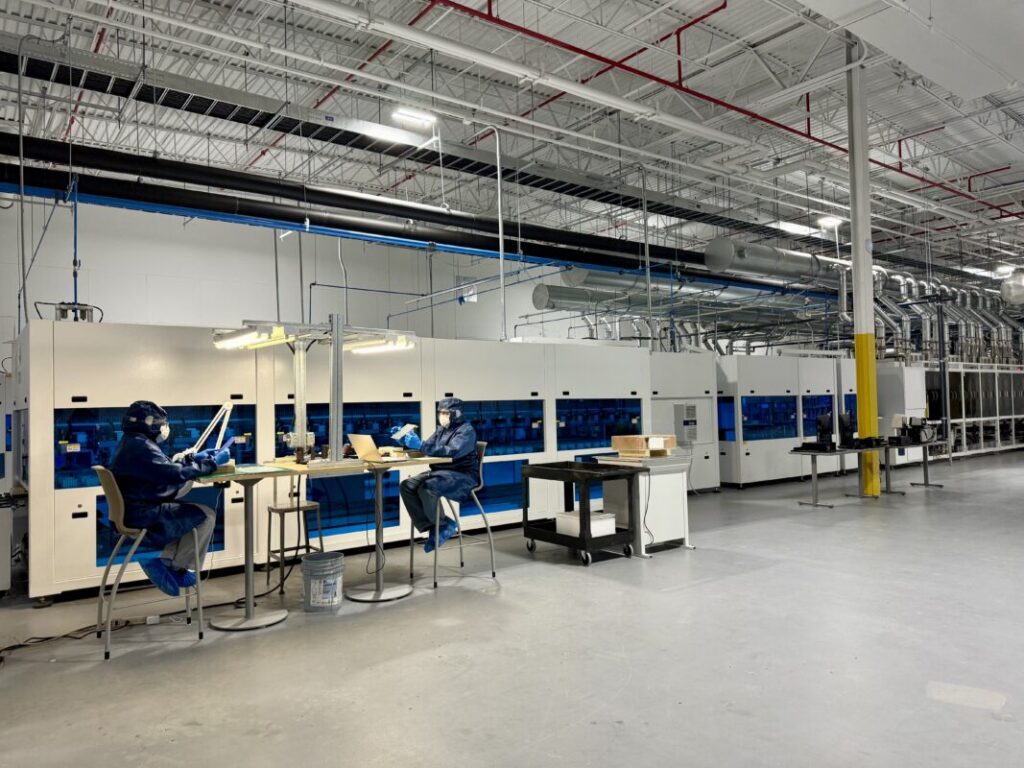
ES Foundry recently completed a 2GW expansion at its Greenwood, South Carolina facility, taking its total annual cell manufacturing capacity to 3GW. Its initial 1GW capacity began operations in 2025, with the expanded capacity expected to be fully ramped by October.
Zhu said the company’s focus on operating production capacity differentiates it from a US market that has seen numerous large-scale manufacturing announcements.
“In terms of actual production, we are the largest crystalline solar cell manufacturer in the US,” he said.
While tunnel oxide passivated contact (TOPCon), heterojunction (HJT) and back-contact (BC) technologies have increasingly displaced PERC in international markets, Zhu said ES Foundry selected PERC because of its manufacturing maturity and established market acceptance.
“The reason we chose PERC is that it is very reliable and has a robust process window,” he said.
He added that PERC’s established track record provides greater familiarity for financial institutions and customers, while helping the company train a US manufacturing workforce with limited experience in large-scale solar cell production.
US trade measures are creating both challenges and opportunities. A recently announced 15% tariff on imported polysilicon and its derivatives under Section 232 is expected to increase ES Foundry’s wafer costs.
“Our current wafer cost is, for example, from 4 cents to 7 cents imported from overseas. And after that, our cost will increase to like 15 cents plus 2 cents tariffs,” Zhu said.
However, he expects stronger demand for domestic-content products could partly offset higher costs, particularly from projects supporting AI data centres.
“Even a domestic content module by itself is more expensive, but when you’re calculating into the whole formula, the total project cost will reduce,” he said.
The company currently expects demand to support its 3GW capacity, with offtake agreements extending through 2028.
Read our full interview with Zhu here.
The state of the US solar supply chain will be explored in detail at our annual PV CellTech USA conference in San Francisco on 13-14 October 2026. For full agenda and booking details, click the link above.