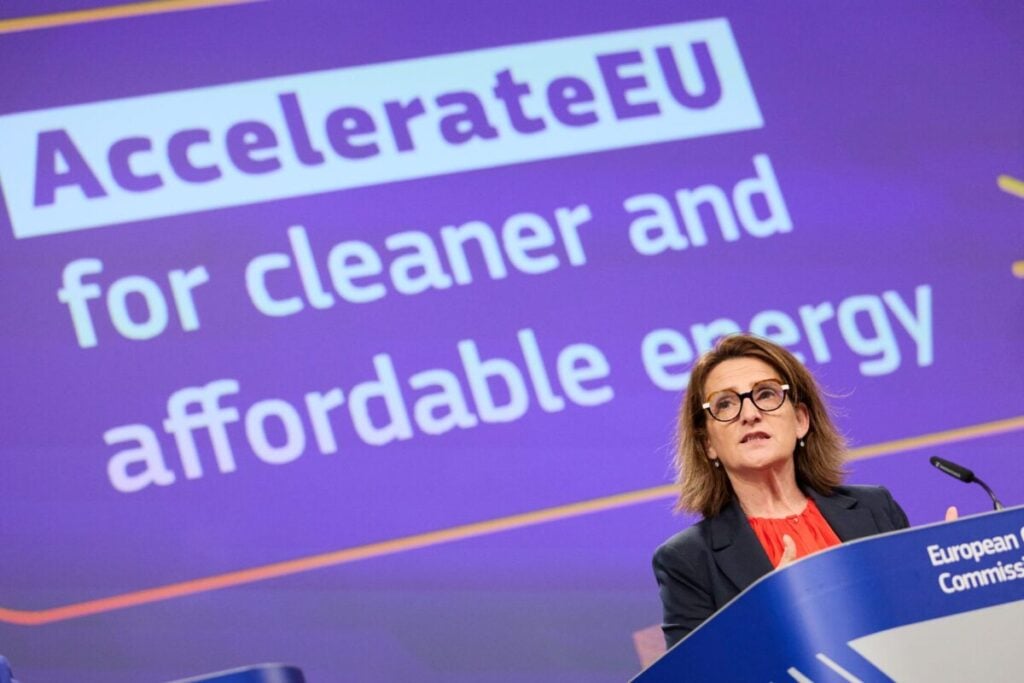
The European Commission (EC) has launched a new strategy to address the fossil fuel energy crisis in the Middle East and accelerate the “shift to homegrown, clean energies”, said EC president Ursula von der Leyen.
Called AccelerateEU, the new set of measures from the EC responds to a March request from EU heads of government to present “a toolbox of targeted temporary measures to address the recent spikes in the prices of imported fossil fuels arising from the crisis in the Middle East”.
Try Premium for just $1
- Full premium access for the first month at only $1
- Converts to an annual rate after 30 days unless cancelled
- Cancel anytime during the trial period
Premium Benefits
- Expert industry analysis and interviews
- Digital access to PV Tech Power journal
- Exclusive event discounts
Or get the full Premium subscription right away
Or continue reading this article for free
Among the measures proposed earlier this week are a decision to set a single electrification target across the EU, supported by the Industrial Decarbonisation Bank and a request to Member States to lower taxes on electricity.
The EC also proposed accelerating the shift to homegrown clean energy and improving grid networks, including reforms to network tariffs and taxation.
Moreover, the EC recognised that public funding will be insufficient to cover a projected €660 billion investment in the energy transition to 2030 and seeks to mobilise private investment through the Clean Energy Investment Strategy. A Clean Energy Investment Summit will be organised to bring financial services industry stakeholders to the table.
“This communication aims at reinforcing EU coordination and protect the most vulnerable while accelerating deployment of homegrown clean energy and electrification to make a real and lasting difference,” said Teresa Ribera, EC’s executive vice-president for Clean, Just and Competitive Transition.
The plan, AccelerateEU, “will bring both immediate and more structural relief measures to European citizens and businesses,” Ursula von der Leyen said.
However, clearer measures for solar PV and other renewables, such as energy storage, have yet to be proposed.
The EC said that AccelerateEU is “one part of the Commission’s dynamic response” and will evolve as the situation develops. EU leaders will discuss the measures in a meeting this week (23-24 April), while the Commission will present an Electrification Action Plan in the coming months. This plan aims to set an ambitious electrification target and measures to remove barriers to electrification from the industrial, transport and building sectors.
Commission ‘fails to propose concrete measures’ for energy storage
Furthermore, AccelerateEU also recognises that EU energy storage capacity needs to scale dramatically to the order of 200GW by 2030, largely driven by battery deployments.
“Renewable-based electrification is the most effective way for Europe to cut its fossil fuel import dependence, and AccelerateEU rightly puts it at the centre of the EU’s crisis response,” the deputy CEO of trade association SolarPower Europe, Dries Acke, said in a statement responding to the proposals.
However, while welcoming the decision to set an EU electrification target and scale up energy storage deployment, Acke said the EC had failed “to propose concrete measures to get to these levels of battery storage and other non-fossil flexibility,” which he described as essential in reducing the impact of international gas prices on electricity prices in Europe.
The European trade body is calling for a market-based mechanism to boost non-fossil fuel flexibility, which could secure electricity supply and lower wholesale electricity prices, Acke added.
“AccelerateEU set the direction under crisis conditions. Delivering on the energy transition now means pairing ambition with financing tools that make it future-proof,” concluded Acke.
This article was first published on our sister-site Energy-storage.news.