Energy market turmoil in Europe at the end of last year is causing a fundamental change in the power purchase agreement (PPA) market as volatility spikes reach 250% and throw into question the viability of long term PPAs.
That is according to the European PPA Market Outlook 2022 report published today by renewable advisory firm Pexapark, which also showed how corporate PPA volumes significantly surpassed utility PPAs in Europe for the first time as the rise of the ‘mega buyer’ continues.
Try Premium for just $1
- Full premium access for the first month at only $1
- Converts to an annual rate after 30 days unless cancelled
- Cancel anytime during the trial period
Premium Benefits
- Expert industry analysis and interviews
- Digital access to PV Tech Power journal
- Exclusive event discounts
Or get the full Premium subscription right away
Or continue reading this article for free
As a result, the report argued that utilities and corporates may need to work closer together to maintain the 10-year PPA market.
Last year, annualised volatilities of front year contracts realised volatility levels of up to 250% – five times the level of usual spikes – in part because of soaring European gas prices. At the same time, PPAs activity in renewable energy jumped 58%.
2021 saw 6.5GW of disclosed contracted capacity for corporate PPAs, and 4.6GW for utility PPAs, the first time corporate contracts have exceeded those from utilities. And, despite acute volatility at the end of the year, December witnessed 3.2GW of PPAs signed over 21 PPAs.
Pexapark said the market turbulence and high demand would “herald in the era of the short-term PPA and new baseload structures” and “drive the rise of the ‘next generation utilities’”, causing investors to upgrade their operating models to include new facets such as risk management infrastructure.
Utilities are seeing their margins suffer as a result of high energy prices and this could lead to a decline in the common 10-year PPA as producers look to insulate themselves from future shocks, said the report.
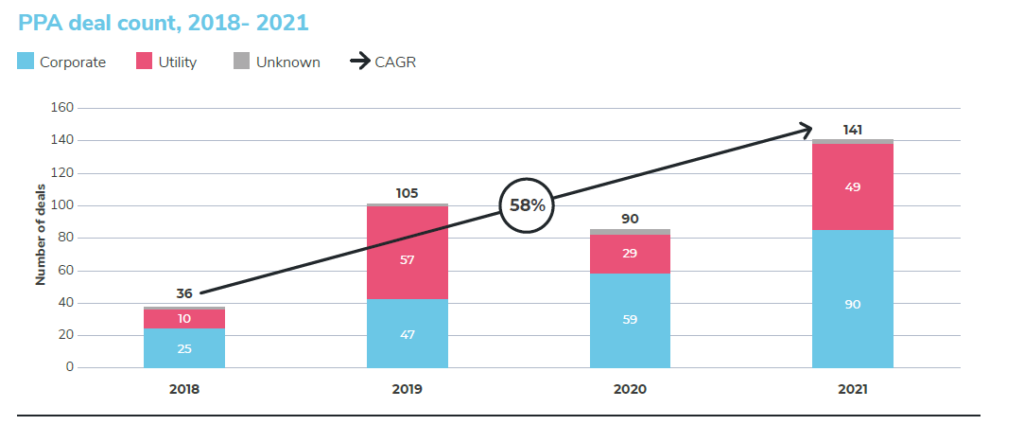
On the other hand, the larger corporate share of PPAs was a trend that is likely to continue this year with “the rise of the ‘mega buyer’ offtake segment” that is willing to pay a higher price, said Pexapark, which tracked 11.2GW of European PPAs.
Amazon was the biggest PPA offtaker, responsible for 16% of the year’s contracted capacity and 30% of European corporate PPAs overall, said the report.
The firm predicts that “the total long-term PPA market will languish in absolute numbers” but that corporate contracts, which are predicated on favourable market conditions, will increase risks for sellers.
Given this, it argued that utilities and corporates could better work together to support long-term PPAs and suppress market volatility. For example, a utility could de-risk its hedging programme with “a few long-dated corporate offset deals”, which would allow some of the offset volumes to be unleashed in long-term PPA volumes with investors.
In August last year, Pexapark’s PPA transaction manager Amanda Niklaus spoke with PV Tech Premium about the constantly evolving nature of PPAs and the new structures and styles emerging as the solar sector matures.