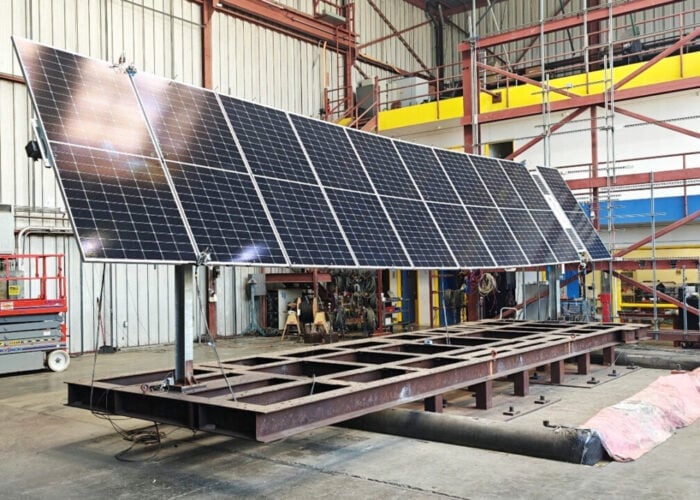
Fixed-tilt trackers and bifacial modules installed vertically could be the most effective way of deploying solar PV systems in Arctic environments, according to the International Energy Agency (IEA).
Task 13 of the IEA’s Photovoltaic Power Systems (PVPS) programme published a report this week into the viability and challenges of installing PV systems in what it calls the “greater Arctic region”, defined as regions at latitude of greater than 60 degrees North. Specifically, this includes Nordic countries and the US state of Alaska, where remoteness and challenging physical conditions, such as frequent snowfall and low temperatures, can make it difficult to install electricity generation infrastructure.
Try Premium for just $1
- Full premium access for the first month at only $1
- Converts to an annual rate after 30 days unless cancelled
- Cancel anytime during the trial period
Premium Benefits
- Expert industry analysis and interviews
- Digital access to PV Tech Power journal
- Exclusive event discounts
Or get the full Premium subscription right away
Or continue reading this article for free
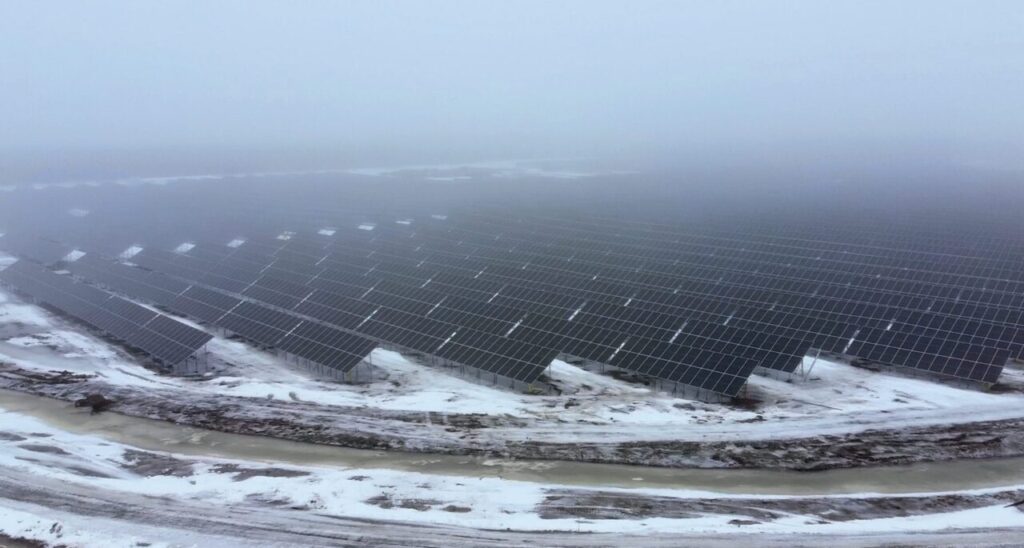
However, the report notes that solar PV modules can be effectively deployed in these environments. Frequent snowfall means that these regions have a high snow albedo effect—the phenomenon by which sunlight is reflected by the light surface of the snow—so bifacial panels can be particularly effective in converting this reflected sunlight into electricity. The report also notes that such panels can be installed vertically, in an east-west orientation, to reduce the area of snow covered by the panels, which would in turn reduce the albedo effect.
In addition, fixed-tilt trackers are considered to be particularly useful in Arctic environments, due to their “simplicity and reliability in freeze-thaw cycles”, that is they are less prone to damage or malfunction in extreme environments. Ground-mounted fixed-tilt systems also typically include larger row spacing, which can minimise shading losses, and higher mounting heights to prevent the build-up of snow on the modules themselves.
“Arctic communities have unique needs for which innovative applications of PV and renewable energy technologies can be applied,” explained the IEA researchers in the report, who went on to suggest that greater research and investment into Arctic solar could be of benefit to the broader solar industry as projects are deployed in more remote and extreme environments.
“As the cost of solar installations continues to drop worldwide, solar PV technology is migrating into not just high-latitude regions but also upper mid-latitude regions which also experience snow and cold temperatures, thus necessitating research into these parameters and their effects on solar PV performance, operation and maintenance.”
Arctic energy security through renewables
The report notes that currently, many of the world’s populated Arctic regions are served by renewable energy, and continued investment in new forms of renewable power, such as solar, will be important if these regions are to remain independent of fossil fuel import and usage, in particular.
“Fossil fuel supplies to many Arctic communities are subject to costly transportation challenges and global price fluctuations, which reduce the security of these communities and challenge the sovereignty goals of Indigenous communities in the region,” explained the report’s authors.
“Electricity costs in isolated Arctic communities can be much higher and less stable compared to grid-connected regions due to volatility in fuel prices and challenging logistics of fuel deliveries by water or air, which may not be possible in the winter.”
Indeed, the report notes that Norway, Sweden and Iceland—which have a combined annual electricity consumption of 126.1TWh—are all heavily reliant on hydropower to meet their energy demand, with hydropower accounting for 89.1%, 70.7% and 70.6% of electricity demand, respectively. Finland, meanwhile, has the highest annual electricity consumption of the countries profiled—80TWh—and while almost half of this is met with nuclear power, hydropower and wind are the second- and third-most important energy sources, accounting for 18.8% and 18.2% of total electricity consumption, respectively.
The report also notes that distributed solar could be particularly useful for isolated Arctic communities, where a lack of transport infrastructure makes importing power sources like oil challenging.
Indeed, the report describes the integration of battery energy storage systems (BESS) into such projects as “expensive” and requiring rare earth metals, of which there are “limited resources globally”, and suggests that local generation through distributed solar projects would be a more feasible way of meeting electricity demand than the construction of large-scale solar projects co-located with batteries, as has become commonplace in other regions.
‘Limited data availability’ remains key challenge
However, the report identifies several challenges that remain ahead of large-scale solar PV deployment in Arctic environments. Alongside the practical difficulties of installing new electricity generation capacity in remote areas without robust grid infrastructure, and in parts of the world that can be difficult to reach should maintenance and repair work be needed, there is a lack of information available about PV operations in Arctic environments, which can impede decision-making for future investments.
The report names “limited data availability” about the performance of solar PV in Arctic environments as a challenge, as this lack of data means less accurate forecasts about a project’s output can be made, which in turn may dissuade investors from backing such a project. Similarly, economic modelling regarding a project’s costs and returns “is complicated” in high-latitude regions, further making the business case for such investments less compelling.
These challenges echo some of those presented by a report from the IEA PVPS last year into floating solar (FPV), which found deficiencies in the accuracy of modelling work for FPV projects. For both Arctic solar and FPV, a lack of precedent for solar deployment means there is less data that can be used to forecast the performance of future projects, which can lower interest in deploying these new projects.
‘Photovoltaics and Energy Security in the Greater Arctic Region’ can be read here.