The Fraunhofer Institute for Solar Energy System (Fraunhofer ISE) has completed testing work of grid-forming inverters currently available in the energy industry, and plans to publish the study’s results at the Wind & Solar Integration Workshop next month in Berlin.
The German testing house noted that “customer systems must also contribute to stabilising the power grid” of the future, as conventional grid systems are unlikely to be able to accommodate the volume of new renewable energy capacity planned in many countries. For example, the EU estimates that Europe’s grid systems would require over €1 trillion (US$1.2 trillion) in new investment for distribution and transmission grid developments in the next 15 years.
Try Premium for just $1
- Full premium access for the first month at only $1
- Converts to an annual rate after 30 days unless cancelled
- Cancel anytime during the trial period
Premium Benefits
- Expert industry analysis and interviews
- Digital access to PV Tech Power journal
- Exclusive event discounts
Or get the full Premium subscription right away
Or continue reading this article for free
In the solar industry, these “customer systems” would take the form of residential and community solar projects, potentially co-located with battery energy storage systems (BESS).
Whereas California has seen a more adversarial relationship between residential solar and storage operation and traditional grid operators emerge – this week the California Solar & Storage Association (CALSSA) called for utilities to be fined for approving residential projects in the state too slowly – Fraunhofer has worked in collaboration with German transmission system operators (TSOs) to build test criteria by which residential inverters could be assessed.
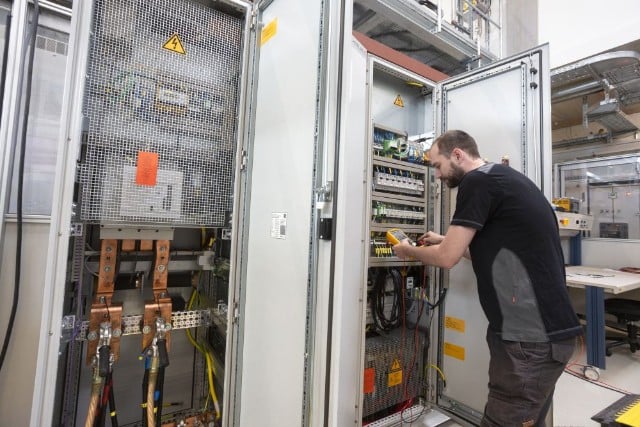
Fraunhofer and the four TSOs – 50Hertz Transmission, Transnet BW, Amprion and Tennet – assessed inverters supplied by seven companies, with a power range of up to 5MW and including pilot technologies and those in “series production”, against these criteria.
While the testing house did not provide further details on the assessment process, and said that it would provide the full anonymised results at the Berlin event from 7-10 October, it noted that a “willingness and commitment” of original equipment manufacturers (OEMs) to produce grid-forming products is essential.

“The devices exhibited similar behaviour under clearly defined requirements,” said Roland Singer, Fraunhofer ISE project manager of the ‘GFM Benchmark’ test. “In other cases, however, there were major differences, and we were able to provide the manufacturers with suggestions for optimisation for almost every device.”
Earlier this year, Sandy Klengel, group leader at the Fraunhofer IMWS, wrote a piece for PV Tech Power on the importance of effective testing methods for inverters, considering their role in the future of the world’s energy mix, and this week’s Fraunhofer announcement builds on that idea.
Both this article, and the Fraunhofer announcement, come as interest in European solar, and global small-scale solar, is growing; figures from Bloomberg New Energy Finance (BloombergNEF) show that investments into the European solar sector grew by US$30 billion between the second half of 2024 and the first half of 2025, as investors grow cautious about supporting utility-scale projects, and those in the US.