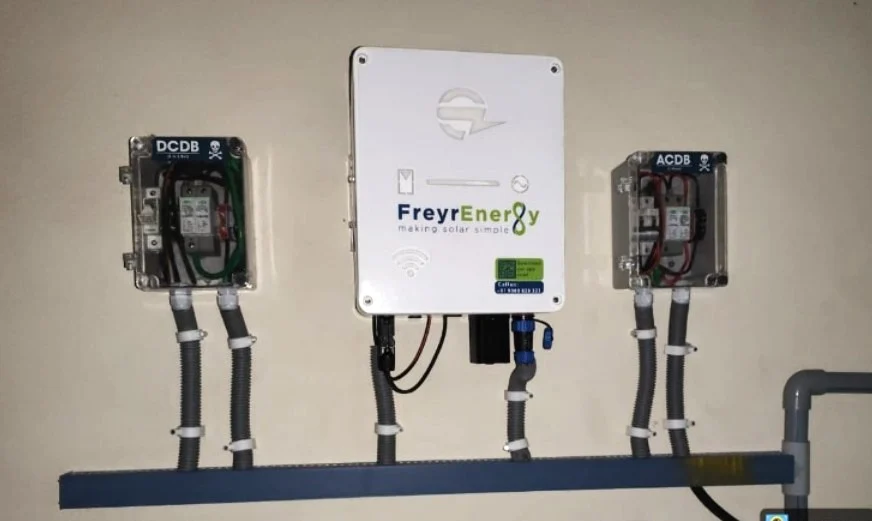
Indian rooftop solar company Freyr Energy has launched a range of single-phase solar PV inverters for residential applications, with 3kW and 5kW models using silicon carbide (SiC) technology.
The Hyderabad-based company said the inverters, developed by Freyr Energy and manufactured by renewable energy and EV charging equipment maker Zenergize, have a stated maximum conversion efficiency of 97.8%.
Try Premium for just $1
- Full premium access for the first month at only $1
- Converts to an annual rate after 30 days unless cancelled
- Cancel anytime during the trial period
Premium Benefits
- Expert industry analysis and interviews
- Digital access to PV Tech Power journal
- Exclusive event discounts
Or get the full Premium subscription right away
Or continue reading this article for free
The on-grid inverters convert DC electricity from solar modules into 230V single-phase AC electricity for residential use. The units include Wi-Fi and Bluetooth connectivity, with system performance monitoring available through Freyr Energy’s mobile application.
The company said the inverters have an IP65 enclosure rating and protection against short circuits, overloads, overheating and voltage surges. The products have also received Bureau of Indian Standards (BIS) certification and approval from India’s Ministry of New and Renewable Energy (MNRE), according to Freyr Energy.
“During periods of low solar generation, such as cloudy conditions or reduced sunlight availability, the inverter continuously tracks the optimum voltage and current from the solar panels using maximum power point tracking (MPPT) technology to maximise energy generation under changing weather conditions,” Radhika Choudary, co-founder and director, Freyr Energy, said.
“The inverter seamlessly synchronises with the utility grid by matching its voltage, frequency, and phase, enabling surplus solar power to be exported whenever available. During periods of low solar generation, it automatically switches to grid power, ensuring uninterrupted and reliable energy supply in urban as well as rural regions.”
The inverters carry a 10-year warranty, while the company said a dust-resistant design and self-cleaning functionality are intended to reduce dust accumulation and maintenance requirements.
Freyr Energy said the new products are designed for operating conditions in Indian residential markets, where rooftop PV systems can be exposed to high temperatures, dust and fluctuations in grid voltage.
PMSGMBY drives rapid growth in India’s residential rooftop solar market
The launch comes as India’s residential rooftop solar market expands under the PM Surya Ghar: Muft Bijli Yojana (PMSGMBY). The government scheme is aimed at increasing rooftop solar deployment among households through financial support and other measures.
India’s cumulative solar capacity reached 164.8GW at the end of June 2026, with rooftop solar accounting for 17%, according to analyst Mercom’s latest report.
More than 3.3 million rooftop systems had been installed under the programme as of June 2026, adding over 12GW of capacity, according to government data. This was up from 9.5GW in March. The MNRE said monthly rooftop installations had risen from around 7,000 before the scheme was introduced to more than 300,000. The time required to add 100,000 beneficiary households had fallen from 118 days to fewer than eight.
More than four million households had benefited from the programme, while over 6.5 million applications remained in the pipeline. The government aims to target 7.5 million households by the end of 2026.
The programme also attracted international development finance. The Asian Development Bank (ADB) approved an US$850 million loan for the second phase of reforms supporting PMSGMBY, while the World Bank approved an US$890 million financing package for India’s national rooftop solar programme.
The rapid increase in installations have raised questions over financing, deployment capacity and whether the pace of growth could be sustained.
PV Tech Premium spoke with Gaurav Upadhyay, South Asia energy finance specialist at the Institute for Energy Economics and Financial Analysis (IEEFA), about the development of India’s rooftop solar market, the impact of PMSGMBY, financing conditions and remaining challenges. Read the full interview here (subscription required).
India’s renewable energy transition, from solar PV and energy storage to grid integration, will be a key topic of discussion at the Renewable Energy India (REI) Expo, co-located with the Energy Storage Summit India (ESS India), in Greater Noida on 22-24 October 2026. For the full agenda and booking details, click here.