The German state of North Rhine-Westphalia has launched a Federal Council initiative to accelerate the development of floating solar (FPV) on artificial lakes.
The state calls on the federal government to introduce more flexible regulations, given that the current requirements from the Federal Water Resources Act “severely” restrict its coverage area and distance.
Try Premium for just $1
- Full premium access for the first month at only $1
- Converts to an annual rate after 30 days unless cancelled
- Cancel anytime during the trial period
Premium Benefits
- Expert industry analysis and interviews
- Digital access to PV Tech Power journal
- Exclusive event discounts
Or get the full Premium subscription right away
Or continue reading this article for free
According to the state authorities, the expansion of FPV systems on artificially created water bodies makes “economic sense from an energy perspective and can be designed in a way that is compatible with water resources, even for larger systems”.
Lakes created by gravel and sand mining are usually very deep and have only small shallow water zones with corresponding plant growth, with FPV offering the possibility to be built and avoid relying on agricultural land or other onshore resources.
“This will make floating photovoltaics more attractive because larger systems are more economical. Especially in regions like the Lower Rhine, with a lot of gravel mining and gravel pits, this creates potential for generating electricity in a land-saving manner and also for using it directly on site,” said North Rhine-Westphalia’s Environment Minister Oliver Krischer, who initiated the initiative.
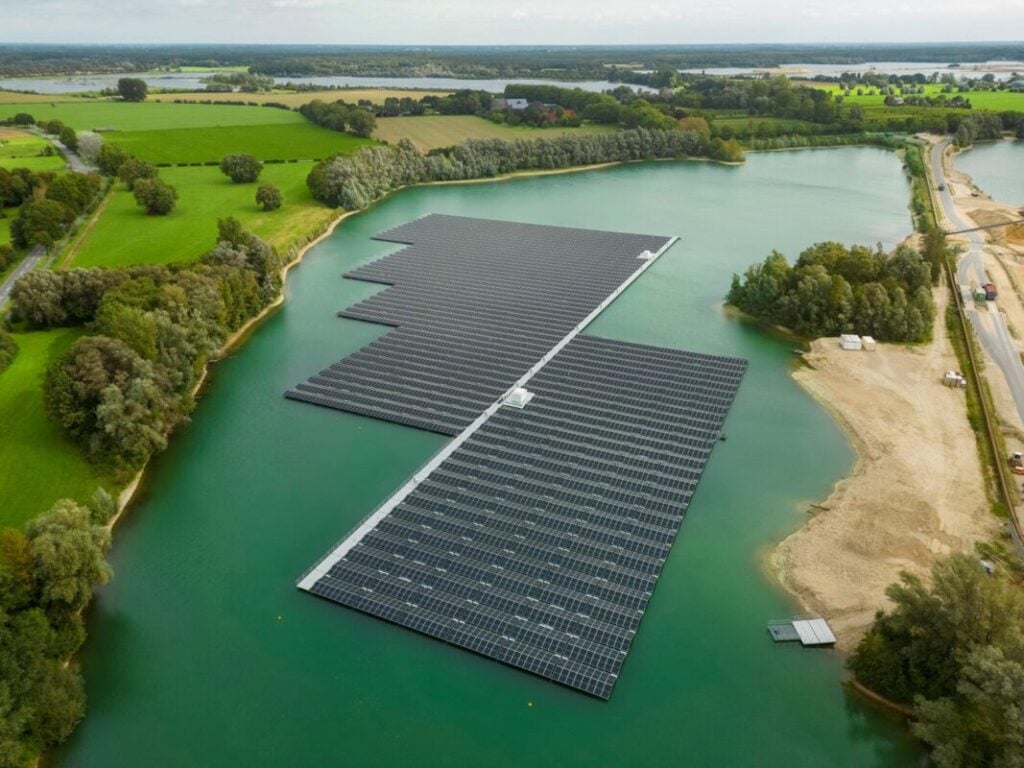
There are currently six FPV systems operational in North Rhine-Westphalia. The largest of these FPV systems has a 5.6MW capacity and is located on the Bislich quarry lake, shown in picture above.
Christopher Schulze, who is in charge of FPV in Germany at BayWa r.e., told PV Tech: “We strongly support the current initiative by the state of North Rhine-Westphalia in the Bundesrat to improve the regulatory framework for floating PV in Germany. The current, highly restrictive regulations prevent the immense potential of floating PV from being realised, as many projects are not financially viable under these conditions. The dual use of space is both sensible and necessary and should be made easier. We therefore hope that the new federal government will support the NRW initiative – in line with the coalition agreement, which states: “We are committed to land conservation and want to facilitate dual-use opportunities, such as parking lot, agri-, and floating PV.
“As a renewable energy developer with more than 285MWp of floating PV installed, we’ve been pioneering floating PV in Europe. Our experience and various studies show that environmentally sound implementation of floating PV systems is possible even with higher coverage ratios and shorter distances to shore.”
At this year’s Intersolar Europe event held in Munich, Germany, speakers on an FPV panel mentioned the need for more policy framework at the European Union level, and also in Germany, that could boost the technology in Europe. A recent report by the International Energy Agency’s Photovoltaic Power Systems Programme (IEA PVPS) examined some of the challenges FPV was still facing. This included the regulatory barriers mentioned above, but also uncertainties about yield modelling.
The state of North Rhine-Westphalia is the third most with installed solar PV in Germany. Earlier this year, when Germany passed the 100GW milestone of installed solar PV across the country, North Rhine-Westphalia had contributed with 12.3GW of that total, a little bit over 10%.
Dutch offshore PV specialist Oceans of Energy recently marked a milestone for the technology by installing the anchoring system at the “world’s first” floating offshore solar-wind project in the North Sea, the Netherlands.