Germany installed 16.2GW of solar PV in 2025, according to an analysis by the Fraunhofer Institute for Solar Energy Systems (ISE) and based on the energy-charts.info data platform.
Cumulative installed solar PV capacity stood at 116.8GW at the end of 2025, exceeding the 108GW target set by the government for last year.
Try Premium for just $1
- Full premium access for the first month at only $1
- Converts to an annual rate after 30 days unless cancelled
- Cancel anytime during the trial period
Premium Benefits
- Expert industry analysis and interviews
- Digital access to PV Tech Power journal
- Exclusive event discounts
Or get the full Premium subscription right away
Or continue reading this article for free
Solar PV additions in 2025 would put it on par with numbers registered in 2024 by the German Federal Network Agency. However, to meet its target set for 2026, the country will need to add significantly more solar PV capacity, needing 22GW of new additions in 2026.
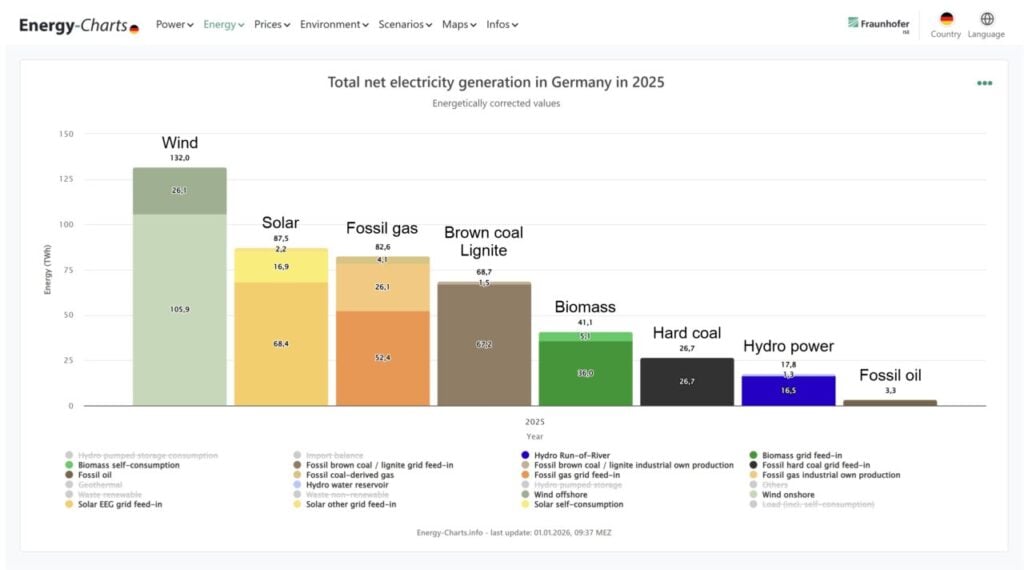
With the increase in installed solar PV installations in Germany, the electricity generated by solar PV power plants reached 87TWh in 2025, up 21% from the previous year.
The majority of this electricity generation (71TWh) was fed into the public grid, while 16.9TWh was for self-consumption, up from 12.2TWh in 2024. Interest in self-consumption continues to increase in Germany since 2022, due to high power prices and increased energy storage adoption.
The rise in solar power generation in 2025 was not exclusive to Germany but was a trend seen across the European Union, according to Fraunhofer ISE’s analysis. Electricity generation from solar PV in the EU exceeded the combined total from lignite and hard coal for the first time, with 275TWh compared to 243TWh.
In the past decade, solar PV generation trebled, while coal-fired power generation fell by 60%.
Moreover, on 20 June 2025, the German grid witnessed the highest capacity power fed to the grid by solar PV, with 50.4GW between 12:45 and 1pm. During that time, solar PV’s share represented almost the entire power load (98.6%) fed into the grid. A day later, solar energy reached its maximum share of the total daily load with 41.2%.
Solar PV was not the only renewable energy source that saw a sharp increase in 2025. Large-scale battery energy storage installations rose by 60% in Germany last year from 2.3GWh to 3.7GWh. In total, nearly 25GWh of battery storage capacity is currently installed, of which 20GWh is from home storage systems.
“The ramp-up of large-scale battery storage is fundamentally changing the way the German electricity system works. While effects on short-term flexibility provision are already visible, systemic impacts, e.g., on reserve power plants, can only be estimated at this stage,” explained Leonhard Gandhi, project manager of the energy charts at Fraunhofer ISE.
“These developments require battery storage to be explicitly considered for expansion planning, system planning, and electricity market design.”