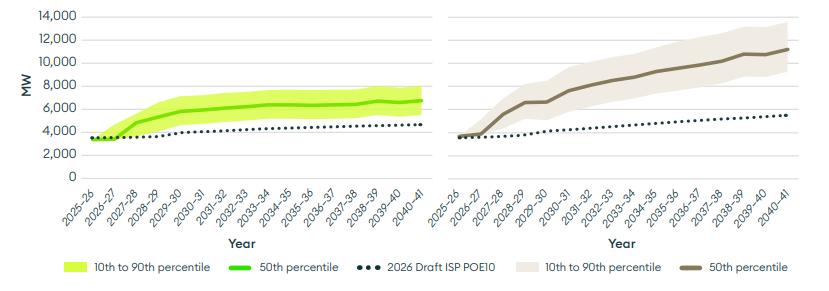
South Australia is experiencing a dramatic reversal of decades of flat electricity demand, with peak load projected to double from 3.3GW today to potentially 6.5-7GW by 2040.
According to ElectraNet, South Australia’s principal electricity transmission network service provider, this will be driven by an unprecedented industrial expansion that could see the state’s annual energy consumption triple to 50TWh under high-growth scenarios.
Try Premium for just $1
- Full premium access for the first month at only $1
- Converts to an annual rate after 30 days unless cancelled
- Cancel anytime during the trial period
Premium Benefits
- Expert industry analysis and interviews
- Digital access to PV Tech Power journal
- Exclusive event discounts
Or get the full Premium subscription right away
Or continue reading this article for free
ElectraNet’s 2026 Transmission Annual Planning Report (TAPR), released yesterday (31 March), reveals that over 75 prospective projects across 41 proponents are currently in discussions to connect to the South Australian transmission network, representing multiple times the state’s current peak demand in potential new load.
This marks a stark contrast to the decade between 2012 and 2022, when only one new large industrial load of approximately 50MW connected to the grid.
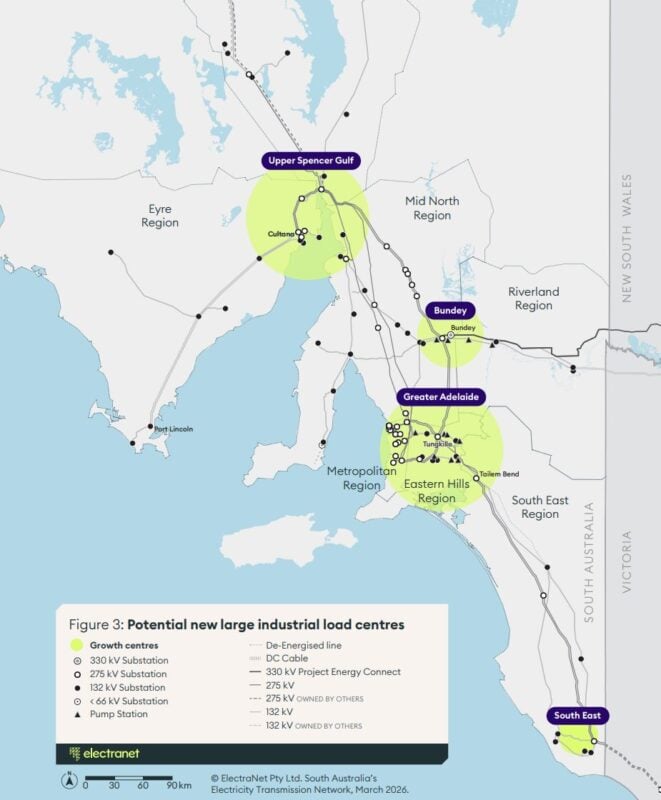
ElectraNet notes that the surge in connection enquiries spans data centres, critical minerals processing, green steel production, defence manufacturing, hydrogen production facilities and large-scale desalination infrastructure.
Adding just 1,500-3,000MW of new industrial demand would raise South Australia’s peak load by 50-100% over current levels.
Transmission network under pressure
The industrial boom is colliding with South Australia’s world-leading renewable energy transition, creating urgent challenges with transmission capacity.
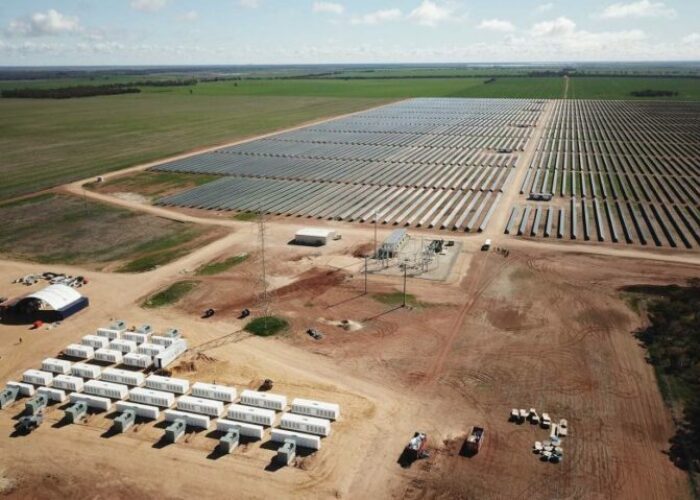
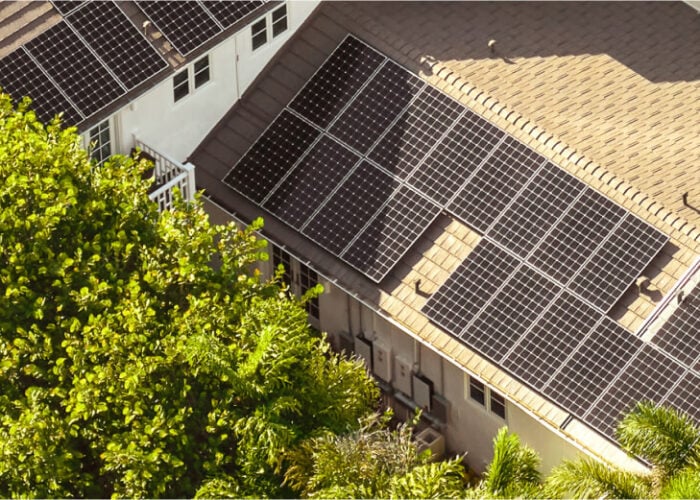
The state already generates approximately 75% of its electricity from renewable energy sources and is targeting 100% net renewable energy by 2027, supported by 3,400MW of grid-scale wind and solar capacity plus 3,000MW of rooftop solar across 439,664 installations.
However, the existing 275kV transmission backbone was not designed for current conditions of sustained high renewable energy penetration, material two-way power flows, and large new regional loads.
Practical transfer capability into Greater Adelaide currently maxes out at 1,470MW and averages closer to 1,100MW, while transfer capability into the Upper Spencer Gulf region around Whyalla is limited to approximately 450MW.
“Studies indicate that around 2030, congestion hours on key interfaces into Adelaide will increase materially,” the TAPR states.
“Without augmentation, this will restrict access to lower-cost renewable energy supply and increase the risk of higher wholesale prices and reduced reliability margins.”
The challenge is compounded by the retirement of traditional dispatchable generation. The Torrens Island B steam plant (800MW) is scheduled to retire by 2028, Osborne CCGT (175MW) by 2027, Pelican Point CCGT (478MW) by 2037, and Dry Creek (156MW) by 2030.
This will eliminate most firm generation capacity within Greater Adelaide, making the city increasingly reliant on transmission imports from renewable-rich northern regions.
Three major transmission projects
ElectraNet is advancing three major transmission augmentation projects to address emerging constraints.
The first is the Northern Transmission Project (NTx). This was first identified as an actionable project in AEMO’s 2024 Integrated System Plan and comprises a new high-capacity transmission line in two stages.
NTx South would run from Adelaide to the Mid North (Bundey, near Robertstown), while NTx North would extend from Bundey to the Upper Spencer Gulf near Whyalla/Cultana.
The project would create a 2,000MW+ north-south “electricity highway,” materially increasing transfer capability and providing a geographically distinct pathway into Greater Adelaide to improve resilience against bushfire and extreme weather risks.
Another major transmission project in South Australia is the Eyre Peninsula Upgrade. This builds on the Eyre Peninsula Link commissioned in 2023 and would enable the connection of significant new industrial loads and renewable energy generation.
The 132kV double circuit line from Cultana to Yadnarie was designed with the option to upgrade to 275kV to support future load development from energy-intensive industries including mining, data centres, and green steel processing.
The final transmission project noted in the TARP is the South East Expansion (Stage 1). This targeted reinforcement would string a second 275kV circuit on the Tailem Bend-Tungkillo corridor, increasing transfer capability between the South East, Mid North and Adelaide regions.
The upgrade would improve flexibility in routing power flows and support more robust utilisation of South East renewable energy output, and interconnector flows through the Heywood interconnector to Victoria.
Industrial demand drivers
The TAPR identifies several key sectors driving unprecedented demand growth across South Australia’s electricity network.
Adelaide is now hosting data centres designed for artificial intelligence and high-density computational workloads, serving government, defence, space, health and mining clients.
These facilities anchor continuous, high-load demand profiles that compound with AI adoption across the economy, representing a fundamentally new category of electricity consumption for the state.
The proposed transformation of steel-making facilities at Whyalla from coal-based production to electric arc furnace (EAF) technology, coupled with a direct reduction iron (DRI) plant, will have materially higher electricity requirements.
This green steel transformation leverages South Australia’s renewable energy resources to produce low-emissions iron and steel, positioning the state as a potential leader in decarbonised heavy industry.
Meanwhile, the Osborne Naval Shipyard precinct is entering a multi-year expansion phase to deliver Hunter-class frigates and prepare for AUKUS submarine construction.
New production facilities and advanced manufacturing lines will add steady industrial loads with specialised reliability requirements, reflecting the strategic importance of defence manufacturing to South Australia’s industrial future.
The Northern Water Project, a US$5 billion+ strategic initiative, proposes a large-scale desalination plant on Spencer Gulf and a 600km pipeline to deliver water to the state’s north. The facility will be powered by renewable energy and will require significant grid integration, adding another major electricity consumer to the network.
Finally, South Australia’s Upper Spencer Gulf is being positioned as a hydrogen export hub, with state ambitions targeting approximately 1.8 million tonnes of hydrogen production by 2030.
Electrolytic hydrogen production is fundamentally electricity-intensive, representing a major potential demand source that could reshape the state’s energy consumption profile if projects proceed at scale.
Demand forecasting challenges
ElectraNet’s analysis reveals a significant divergence between its demand projections and AEMO’s national scenarios. The transmission company’s central outlook shows annual energy consumption growing from approximately 12TWh in 2025 to around 30TWh by 2040, approximately 40% higher than AEMO’s Step Change forecast for South Australia.
“The weightings attached to AEMO’s scenarios continue to understate South Australia’s expected economic development, advanced position in the energy transition, and significant interest in connecting new large industrial loads,” the TAPR states.
The challenge for transmission planning is acute because lead times for network development are generally longer than for load and generation development.
Major transmission investments commonly require multi-year development timelines, and delayed delivery carries high costs: higher wholesale prices, greater curtailment of low-cost renewables, tighter reliability margins, and reduced ability to accommodate new industrial demand at least-cost.
Storage expansion and grid integration
Grid-scale battery storage is playing an increasingly important role in system firming.
The Mid North region is anticipated to host approximately 2,300MW of battery energy storage systems (BESS), representing 65% of the state’s total grid-scale battery capacity.
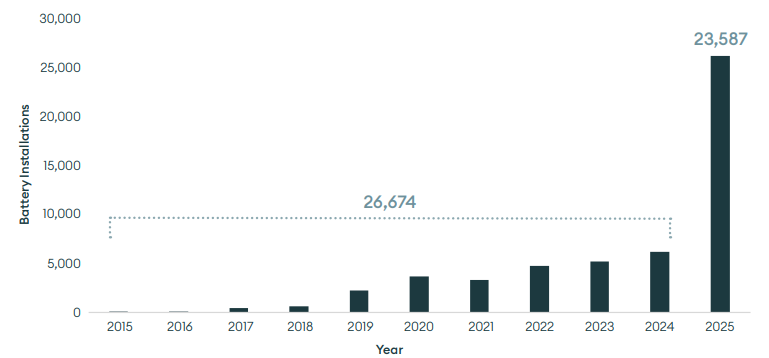
Behind-the-meter storage is also expanding rapidly. Between July and December 2025, 23,587 residential batteries with a combined capacity of 527MWh were installed in South Australia, nearly matching the 26,674 batteries installed over the entire decade from 2015 to 2024, driven by the Federal government’s Cheaper Home Batteries Program.
You can find out more about the Cheaper Home Batteries Program and Australia’s energy storage rollout on our sister site, Energy-Storage.news.
ElectraNet has already delivered four synchronous condensers commissioned in 2021 to provide inertia and voltage support, upgraded the System Integrity Protection Scheme into a Wide Area Protection Scheme (WAPS), and implemented automated voltage control schemes at key nodes.
These measures supported an important milestone in late 2025: agreement to reduce the minimum number of synchronous gas units required to be online from two to one under certain conditions.
The TAPR emphasises that South Australia is moving toward an era of sustained ultra-high renewable energy penetration and ultimately toward secure operation under conditions where synchronous generation may be absent, requiring continued evolution of system strength arrangements and wider deployment of advanced protection and control schemes.