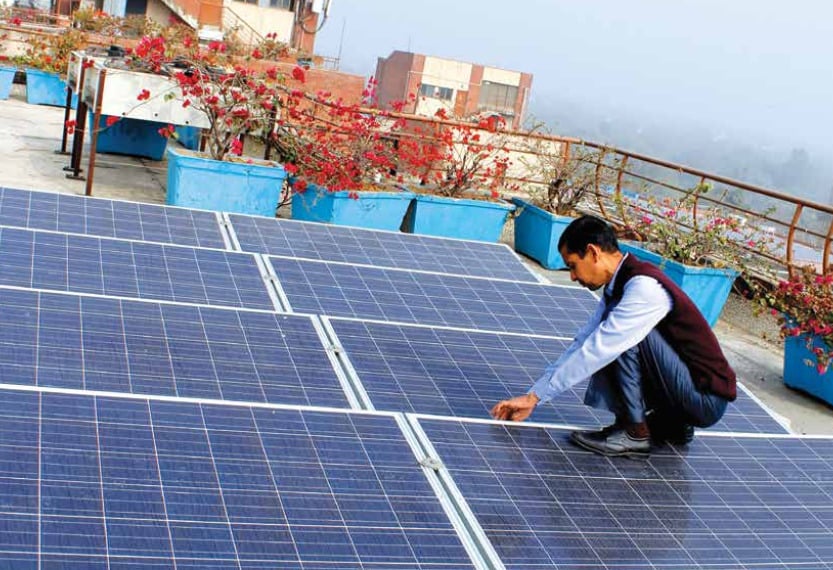
The Delhi government approved its first solar policy on 6 June 2016. The policy understandably focuses on rooftop solar development because of a shortage of available land space in the city. It has many innovative provisions and provides for exemptions and simplification of procedures for rooftop system installation.
The policy introduces ‘Group Net Metering’ for the first time in India, whereby surplus energy exported from a solar plant can be credited against consumption at any other location of the same entity within the same Distribution company (Discom) territory. In another first for India, the policy introduces ‘Virtual Net Metering’ whereby consumers with insufficient rooftop space can co-invest in a solar power system at any other location and get pro rata benefit of electricity output.
Try Premium for just $1
- Full premium access for the first month at only $1
- Converts to an annual rate after 30 days unless cancelled
- Cancel anytime during the trial period
Premium Benefits
- Expert industry analysis and interviews
- Digital access to PV Tech Power journal
- Exclusive event discounts
Or get the full Premium subscription right away
Or continue reading this article for free
The policy also proposes to make several improvements to the existing net metering by providing for several tax and operational exemptions. Key highlights are:
| Operative period | 2016-2020 |
|---|---|
| Target | 1GW of solar power by 2020; target is proposed to be doubled to 2GW by 2025 |
| Incentives | Generation Based Incentive of INR 2 per unit of energy generation for 3 years for residential consumers on first come first serve basis; up to a limit of INR100 million (US$1.48 million) for the first year, INR200 million for the second and INR300 million for the third year |
| Exemptions | (1) Electricity Tax, currently 5%, exempted for all solar energy output. (2) All equipment exempted from VAT and entry tax. (3) Exemption from certification by electrical inspector for solar systems up to 200kW. (4) Building bye-laws relaxed for rooftop solar installations up to a height of 2 metres |
| Mandatory installations | Mandatory rooftop solar installation for all government buildings with a minimum shadow free rooftop area of 50sq.m. |
| RPO fulfilment | Power Discoms required to meet at least 75% of their solar renewable purchase obligation (RPO) from rooftop systems in Delhi |
The introduction of new concepts such as group net metering and virtual net metering really sets this policy apart. The Group net metering concept would be most beneficial for large consumers with multiple buildings and electricity connections.
Given factors such as high afternoon peak demand and low potential for any other locally available renewable source of power, rooftop solar makes the utmost business case for Delhi. The city has to buy expensive power on a short-term basis to meet peak day time demand in summer months. This expensive thermal power can be replaced by locally developed rooftop solar power.
Bridge to India estimates rooftop solar potential of Delhi to be 2.5 GW. Out of this, 26% potential exists in the government/public sector, 25% in commercial/industrial sector and 49% in domestic sector.