Chinese solar manufacturer Huasun has declared new record efficiencies for tandem solar cells combining heterojunction (HJT) and perovskite technologies at both laboratory and commercial scales.
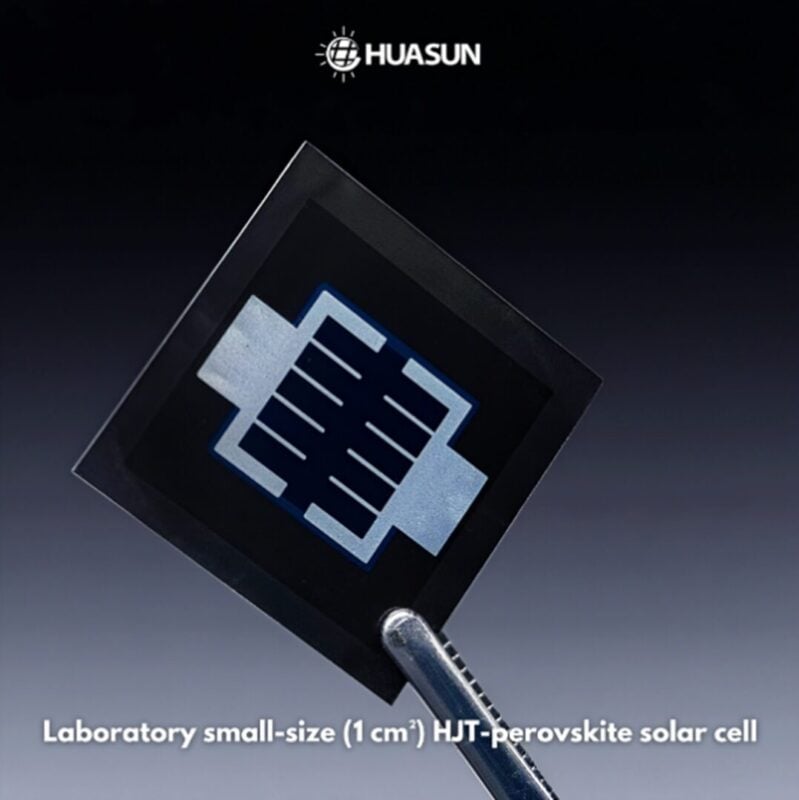
The company has claimed a 34.02% conversion efficiency for a 1cm² HJT-perovskite tandem solar cell, which it said was a new record for HJT-perovskite tandem products.
Try Premium for just $1
- Full premium access for the first month at only $1
- Converts to an annual rate after 30 days unless cancelled
- Cancel anytime during the trial period
Premium Benefits
- Expert industry analysis and interviews
- Digital access to PV Tech Power journal
- Exclusive event discounts
Or get the full Premium subscription right away
Or continue reading this article for free
It also announced a 29.01% efficiency on a large-size 210mm HJT-perovskite cell, which it says is 4% higher than “single-junction crystalline silicon cells”.
Huasun did not provide details of third-party accreditation of its records. PV Tech has contacted the company for more information.
In an announcement, the company said that to produce its small laboratory cell, it used a “dual passivation strategy combining physical field effects and chemical bonds, which significantly reduced interfacial non-radiative recombination losses.”
It said its 210mm cell efficiency used “large-texture thin-film deposition technology, which ensures uniform coating on complex surfaces and overcomes key challenges in scaling perovskite materials.”
Laboratory-size perovskite tandem cells have begun to routinely exceed the 30% efficiency mark. Fellow Chinese producer Risen Energy announced a 30.99% HJT-perovskite tandem cell record earlier this year, certified by the Chinese National Photovoltaic Product Quality Supervision and Inspection Center.
Huasun said its new efficiency figures “not only prove the theoretical feasibility and practical scalability of tandem technology, but also underscore its strategic value.
“Once tandem efficiency exceeds 30%, solar power costs can fall below one US cent per watt, paving the way for cost-competitive green hydrogen and energy storage.”
Some companies have made headway with large tandem cells and even modules. In June, Chinese solar manufacturing giant Trinasolar claimed a 30.6% efficiency on a perovskite-silicon tandem module. This announcement came three months after it signed a patent licensing agreement with UK-based Oxford PV, the company widely regarded as the leader in tandem solar technology. The agreement will allow Trinasolar to use Oxford PV’s technology for tandem products in the Chinese market, once they are commercially viable.
HJT may emerge as the best complement to perovskite layers in tandem solar products. The products are generally constructed with a base layer of silicon technology overlaid with perovskite-based thin films, allowing the cell to absorb a much wider range of the light spectrum. Oxford PV uses an HJT base layer for its products, and claims to have shipped the first commercial silicon-perovskite tandem modules in September 2024.
But there are other options out there. The PEPPERONI project, a joint effort between European firms and backed by the EU to pursue perovskite solar technology, has been based on Qcells’ Q.ANTUM technology, which uses a passivated emitter rear contact (PERC) silicon layer.
The solar industry has been looking for ways to commercialise perovskite products for years. The material – known scientifically as calcium titanate – suffers from rapid degradation when exposed to the elements, which has so far made it unsuitable for commercial solar deployments.
Early this year, we published a deep dive into the hope and hype of commercial perovskites, which you can read with a PV Tech Premium subscription.