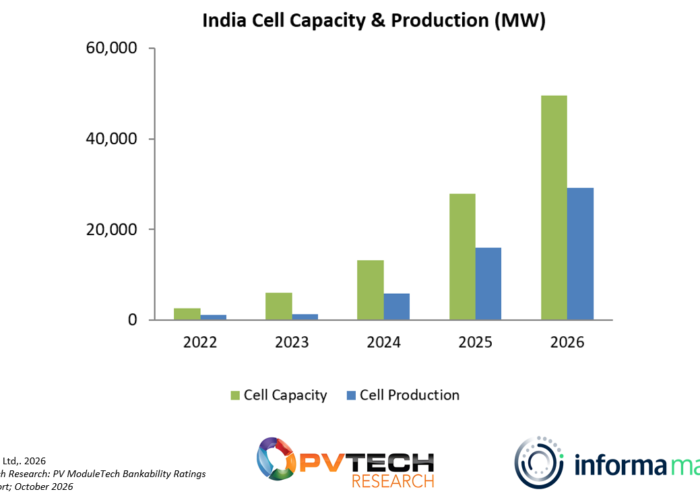
The Indian solar industry has 86GW and 182GW of annual solar cell and module manufacturing capacity, respectively, expected to be commissioned by 2027.
This is one of the key findings from a recent report from market research firm Mercom India, which highlights that a further 85GW and 97GW of solar cell and module manufacturing capacity, respectively, are forecast to come online by 2030 at the latest.
Try Premium for just $1
- Full premium access for the first month at only $1
- Converts to an annual rate after 30 days unless cancelled
- Cancel anytime during the trial period
Premium Benefits
- Expert industry analysis and interviews
- Digital access to PV Tech Power journal
- Exclusive event discounts
Or get the full Premium subscription right away
Or continue reading this article for free
In total, this represents 171GW of solar cell capacity and 279GW of annual module manufacturing capacity to be commissioned by 2030.
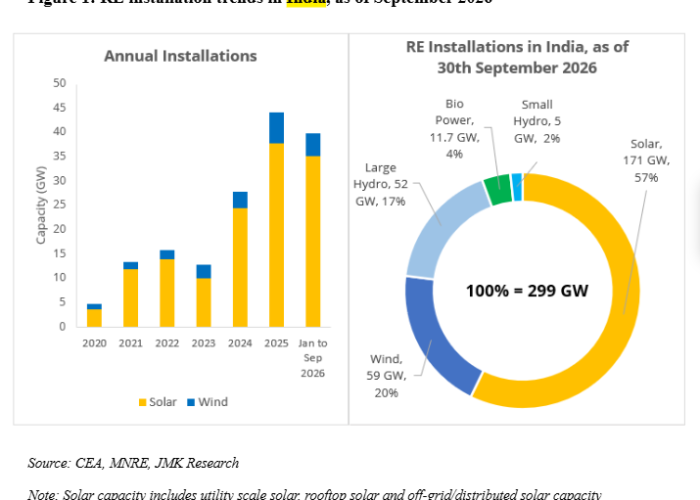
For comparison, the country is forecast to install 28.3GW of utility-scale and rooftop solar during the fiscal year 2026, which is between April 2025 and March 2026. Even if not all of this module manufacturing capacity that is currently under construction or announced comes online, it would still represent a nearly tenfold difference between the two.
Moreover, this would need to be added to the already operational module capacity, which stands at 109.5GW, according to Mercom’s latest data. Over the summer, the operational annual nameplate capacity for modules in India’s Approved List of Models and Manufacturers (ALMM) passed the 100GW threshold.
According to Mercom, the module nameplate additions were driven by the utility-scale pipeline of 186GW projects between 2025 and 2027, the country’s solar installation targets set by 2030 and a strong policy-driven domestic demand for Approved List of Models and Manufacturers (ALMM) modules.
Almost half of the 100GW operational module capacity was added in the first half of 2025, with Mercom reporting that 44.2GW of new module capacity, while 7.5GW of new solar cell nameplate capacity was added in H1 2025. In terms of technology, nearly all the capacity added (90%) was for TOPCon, while for the first time heterojunction capacity was added in the country.
Furthermore, for solar cells, the operational capacity under the ALMM List-II is at nearly 18GW, with the Indian government recently adding 4.8GW of nameplate capacity.
Even though no ingot/wafer or polysilicon capacity has been brought online in the first half of this year, this could soon change, given that the government targets to include wafers in the ALMM list starting from June 2028. A decision that was received positively by several Indian solar manufacturers.
Taking only the figures from the first half of this year into account, India has already added nearly twice the module nameplate capacity in 2025 than it did for the whole of 2024. Mercom published the data for 2024 earlier this year and outlined that the country had added 11.6GW and 25.3GW of annual nameplate capacity for solar cells and modules, respectively.
Gujarat accounts for 42% of India’s operational module manufacturing
The northwestern Indian state of Gujarat accounted for nearly 42% of all operational module nameplate capacity in India as of June 2025, representing nearly 60GW of annual nameplate capacity. The share for solar cells is slightly higher, with almost half (47%) of all Indian solar cell capacity located in Gujarat.
Rajasthan and Uttar Pradesh are ranked second and third for module manufacturing capacity, both accounting for 18%, while Tamil Nadu and Karnataka are second and third for solar cell manufacturing capacity and account for a combined 31% of the country’s share.
Both Gujarat and Rajasthan are leading states in terms of total installed utility-scale solar capacity in the country and have some of the largest pipelines of projects.