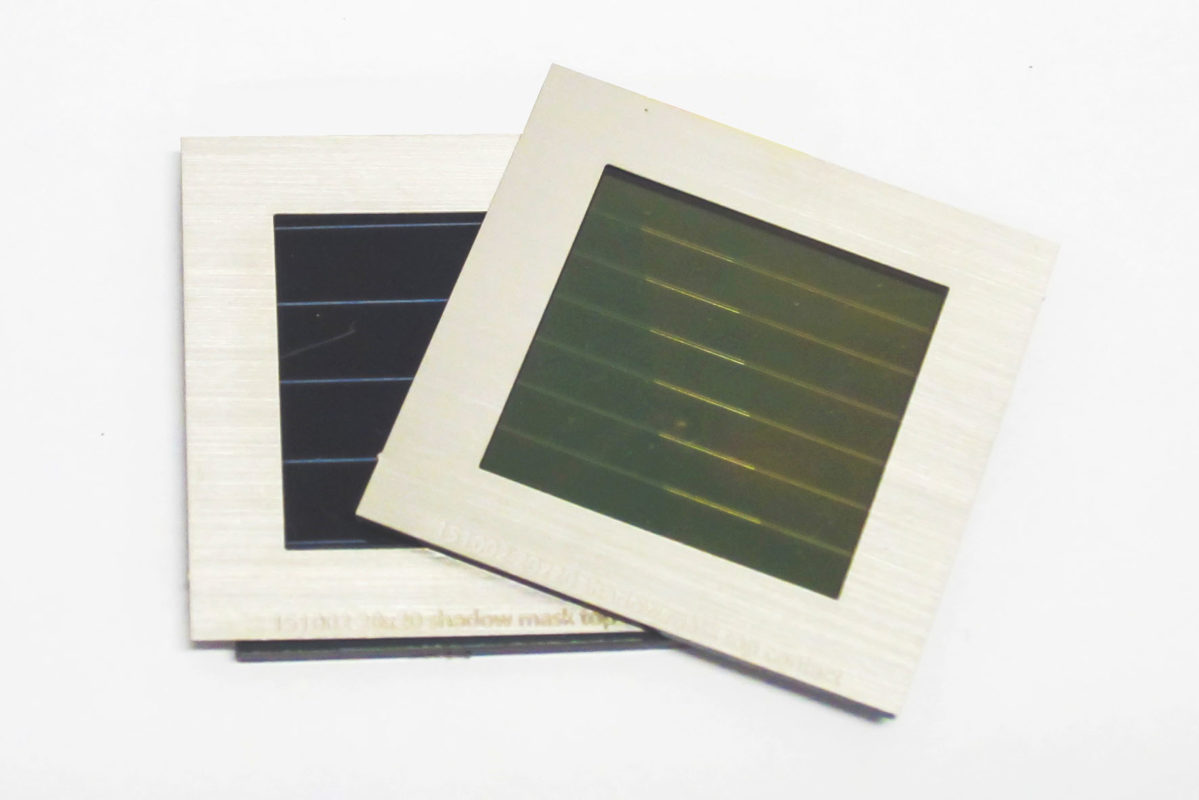
European scientists have teamed from imec, KIT and ZSW to fabricate a thin-film solar module (lab) stack made up of perovskite and Copper Indium Gallium Selenide (CIGS) with a conversion efficiency of 17.8%, which surpasses the highest efficiencies of separate perovskite and CIGS modules.
Using a semi-transparent perovskite module as the top stack, light with lower energy passes through and is harvested in the bottom CIGS cell module. The stacked module (3.76cm2) is claimed to implement a fully scalable device concept which features a monolithic interconnection scheme, using seven and four module cell stripes respectively. The result is a reduction of area loss of less than 8% for both technologies.
Try Premium for just $1
- Full premium access for the first month at only $1
- Converts to an annual rate after 30 days unless cancelled
- Cancel anytime during the trial period
Premium Benefits
- Expert industry analysis and interviews
- Digital access to PV Tech Power journal
- Exclusive event discounts
Or get the full Premium subscription right away
Or continue reading this article for free
Dr. Tom Aernouts, head of thin-film PV research at imec said, “This result was achieved through close and intricate collaboration leveraging the expertise of the three partners. Imec’s expertise in perovskite technology was underscored by the use of a perovskite top module in these stacked solar modules.”
According to Dr. Ulrich Paetzold, head of the research group at KIT, this result is just a starting point, with more exciting results to come in the next years such as perovskite/CIGS multi-junction solar modules surpassing efficiencies of 25%.
The Helmholtz Young Investigator group of Dr. Paetzold is focusing on the optics in multi-junction perovskite solar modules and will develop further specialized nanophotonic materials for these devices.
Prof. Dr. Michael Powalla, member of the board and head of the Photovoltaics Division at ZSW added. “This success is an elegant way of combining the advantages of two highly advanced thin-film technologies. It will contribute greatly to ever more cost-efficient solar power for the customer.”
ZSW holds the current world record for CIGS solar cells at 22.7%.
The module and technical details will be presented to the research community at the PSCO-2016 in Genova, Sept. 26 by Dr. Tom Aernouts, imec; Dr. Ulrich Paetzold, KIT; and Dr. Erik Ahlswede, ZSW.