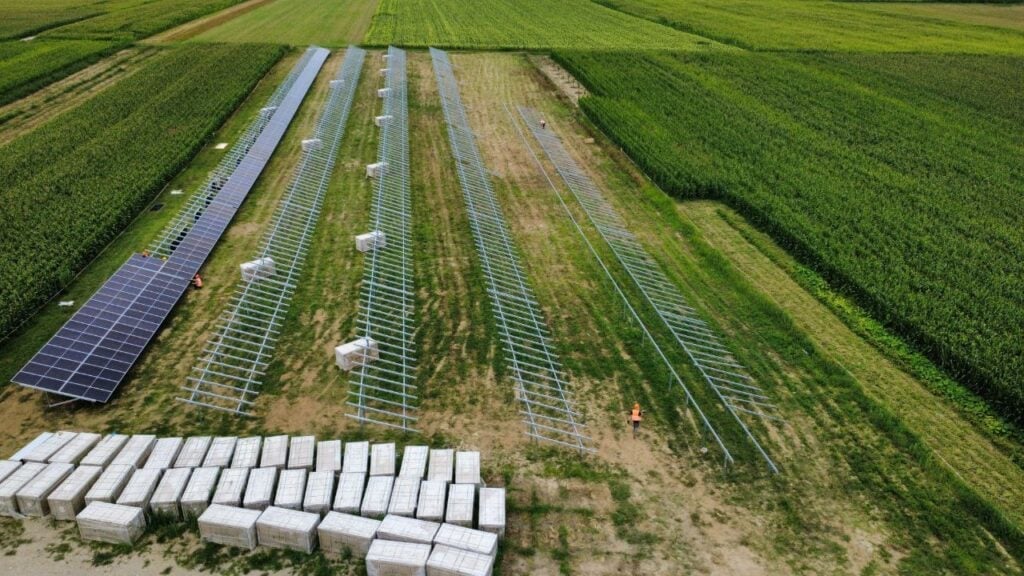
Investment group Pantheon Atlas LLC has announced plans to build a €50 billion (US$58.5 billion) AI data centre in Croatia, which will be powered by an on-site 500MW solar plant and a 2GW/8GWh battery energy storage system (BESS).
Construction at the data centre campus—dubbed “Pantheon AI”—will begin in 2027 and see €12 billion in initial investment. Pantheon Atlas expects the facility to be fully operational by the first quarter of 2029. While it did not specify a timeline for the installation of the project’s solar-plus-storage components, it noted that Spanish independent power producer (IPP) Greenvolt has signed a letter of intent build the project’s solar and storage facilities.
Try Premium for just $1
- Full premium access for the first month at only $1
- Converts to an annual rate after 30 days unless cancelled
- Cancel anytime during the trial period
Premium Benefits
- Expert industry analysis and interviews
- Digital access to PV Tech Power journal
- Exclusive event discounts
Or get the full Premium subscription right away
Or continue reading this article for free
Pantheon Atlas also noted that its on-site solar facility would be a behind-the-meter project, and the development of the data centre would include the construction of four 400kV transmission lines, which Pantheon Atlas says will facilitate the addition of up to 5.2GW of new renewable energy capacity to the Croatian grid.
“This project is the culmination of years of work to bring world-class digital infrastructure to Croatia, and we have assembled the deep local expertise, grid relationships, and regulatory groundwork required to meet demand for data centre capacity,” said Pantheon AI founding partner Jako Andabak.
Earlier this year, the International Energy Agency (IEA) said that global electricity demand will grow 2.5 times faster than overall energy demand by the end of the decade, with data centres a driving force behind what the agency dubbed the “Age of Electricity”, and solar and storage projects have become an integral part of meeting the electricity demand of data centres. In the last year, developers have announced plans to build on-site renewable energy projects at data centres in the US, Europe and Australia.
Some data centre operators have taken a more direct approach to securing clean electricity. In March, Google acquired renewable energy developer Intersect Power, as it seeks to bring solar generation in-house, rather than acquire electricity generated at external projects through power purchase agreements (PPAs). This week, Meta announced an even less conventional option, by signing an offtake agreement to acquire power generated by a solar project that will be deployed in space by startup Overview Energy.