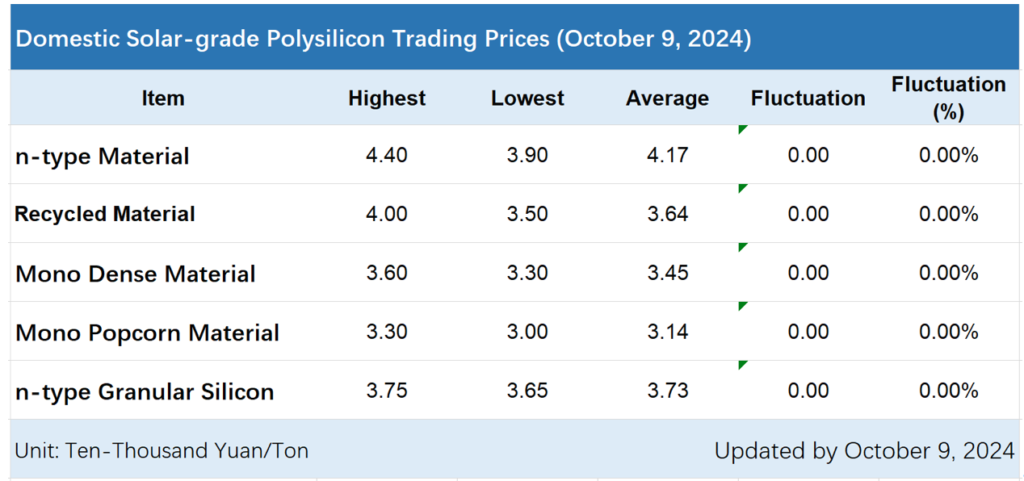
On 9 October, the Silicon Industry Branch of the China Nonferrous Industry Association released the latest polysilicon quotations, with recent prices remaining stable.
Among them, the trading price of n-type rod silicon remained at RMB39,000-44,000/ton (US$5,481-6,184), averaged at RMB41,700/ton. The trading price of mono dense material remained at RMB33,000-36,000/ton, averaged at RMB34,500/ton. The trading price of n-type granular silicon remained at RMB36,500-37,500/ton, averaged at RMB37,300/ton.
Try Premium for just $1
- Full premium access for the first month at only $1
- Converts to an annual rate after 30 days unless cancelled
- Cancel anytime during the trial period
Premium Benefits
- Expert industry analysis and interviews
- Digital access to PV Tech Power journal
- Exclusive event discounts
Or get the full Premium subscription right away
Or continue reading this article for free
According to the Silicon Industry Branch, the main reason for the recent price stability is the inflection point in monthly supply, with a slight increase in polysilicon production and an intensified wait-and-see attitude among downstream buyers. Whether the silicon price will see a new round of increases should be monitored based on the next batch of centralised order signing.
According to statistics, the polysilicon output in September 2024 was 138,000 tons, up 6.36% month-on-month. Power prices in Southwest China have not seen a significant increase, and companies are mainly maintaining stable production, with an expected slight increase of about 5% in silicon production for October.
Wafer prices also continued to run steadily this week, with the average trading price of n-type G10L mono-Si wafers remaining at RMB1.11/piece, at RMB1.26/piece for n-type G12R mono wafers and RMB1.5/piece for n-type G12 mono wafers.
According to the Silicon Industry Branch, the overall wafer supply-demand is satisfying at present. Despite the fact that wafer companies have inventory for less than a month, they are confident prices will remain stable.
It is noted that this week, the operating rate of the two first-tier companies – LONGi and TCL Zhonghuan – remained at 55% and 50% respectively, and the operating rate of integrated enterprises remained between 50% and 60%, and for the rest, between 40% and 70%. According to corporate production statistics, the domestic wafer output in October is expected to be 46-48GW. With the arrival of the peak demand in Q4, there are clear signs of production recovery in wafer manufacturers.
However, looking ahead, it may be difficult to raise prices, and the wafer market is still facing great pressure. According to Infolink’s analysis, due to the fact that the current trading price has not reached the sellers’ expectations, some manufacturers have chosen to temporarily suspend shipments, which also led to the continuous increase in wafer inventory. Companies continued to face difficult shipments amid sluggish market demands.
In the cell sector, it is manifested in a price drop. According to Infolink’s price monitoring, for n-type cells, prices for all sizes remained the same as last week. M10 was averaged at RMB0.27/W, with a price range of RMB0.26-0.28/W. The G12R and G12 were both flat compared to last week, at RMB0.27-0.29/W and RMB0.285-0.29/W respectively.
Infolink said that as manufacturers redoubled their efforts in production cuts in October, the cell segment’s production has become inverted with the module segment. Expecting an overall improved supply-demand balance, cell manufacturers are trying to increase their quotations. However, since module prices have not stopped falling, the price rise in cells is still constrained by the module side. In the short term, the price game between upstream and downstream will continue.
In the past two months, China’s PV installation conditions were not looking good, and the overall installed capacity had also shown a downward trend. As market demand is still sluggish, the overall module price is still declining, and the price of 182mm TOPCon bifacial glass-glass modules has dropped to RMB0.7/W.
Infolink analysis stated that the uncertainty of order receiving in Q4 continues to exert pressure on manufacturers. Infolink’sforecast is that it is difficult for module prices to recover in the short term, and manufacturers’ price competition strategies are becoming more and more aggressive. The prices of Chinese bidding projects continue to fall, and some radical companies temporarily give up their profit demands for the sole purpose of receiving orders. It is not ruled out that the module price will fall below RMB0.7, or even close to RMB0.65 in October.