The shingled panel adopts Thermal Laser Separation (TLS) technology, with the cell cut into several strips and interconnected using conductive adhesive to achieve flexible connection. This optimizes the panel structure, enabling zero cell spacing, which effectively increases the panel’s light-receiving area.
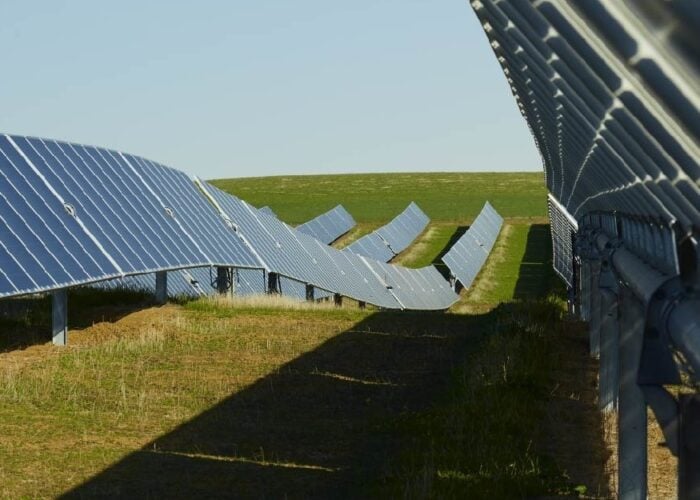
As solar projects become ever larger, sites with slopes and uneven terrain are becoming the norm for project development, leading tracker manufacturers to adapt their offerings accordingly. Molly Lempriere details the latest launches that aim to address this issue.
Public institutions and private companies bought a record number of renewable energy last year, according to BloombergNEF’s (BNEF) 1H 2023 Corporate Energy Market Outlook.
2022 saw the arrival of DAS Solar as one of the PV industry’s rising stars, the five-year-old company attracting strategic investment from, among others, China Merchants Venture Capital, Three Gorges Capital and Yongfu Shares.
The solar industry of the future could see frontier markets become core countries for investment while developers may explore more decentralised projects to overcome land challenges.
The future of solar module deployment may be rooted in mass, rapid deployment rather than precisely tilted, steel-mounted and spaced-out panels extending over acres of land. So says Australian company 5B, which manufactures accordion-style folding solar arrays that arrive at a project site flat-packed and ready to be deployed.
The sale process has commenced of Singapore-based renewables developer Sun Cable, via FTI Consulting which took on voluntary administrative duties after the company collapsed earlier this month.
Energy risk management company and assurance provider DNV has acquired Australian solar data specialist Solcast to strengthen its solar forecasting services.