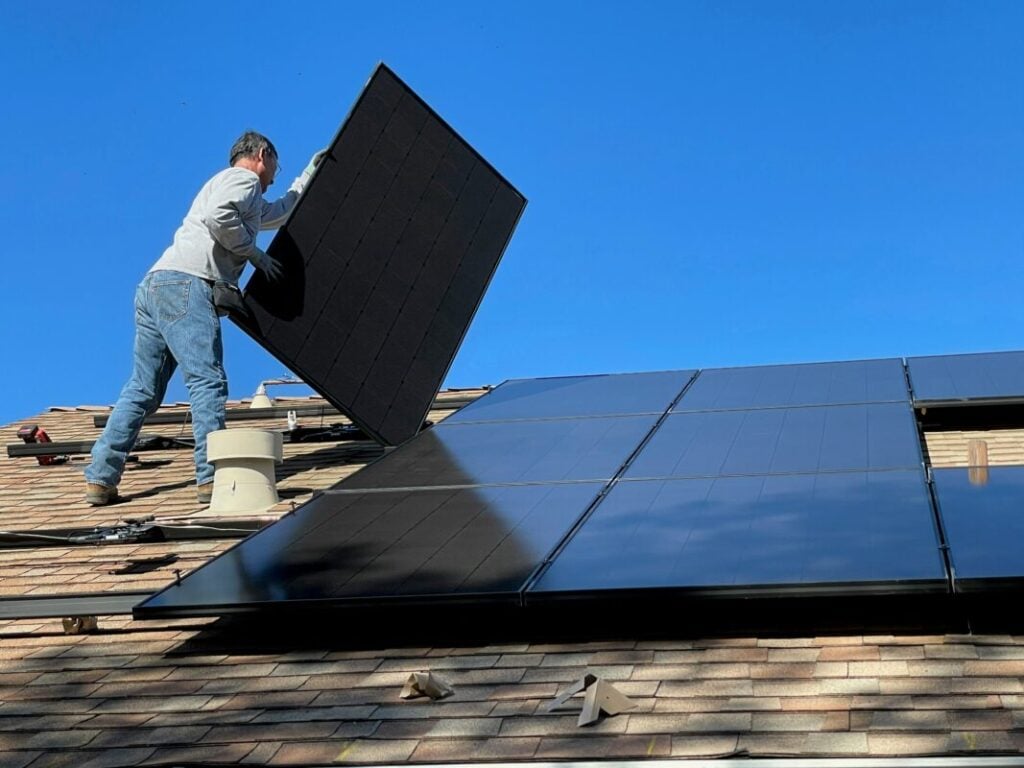
For the third year in a row, self-consumption installs have fallen in Spain, with 611MW of new solar additions in the first half of 2025, according to a report from trade body Asociación de Empresas de Energías Renovables (APPA Renovables).
This represents a 14.6% drop from the same period a year ago, with the decrease mostly focusing on the industrial sector, which dropped by 22.9%, despite representing nearly 70% of the installed capacity for self-consumption.
Try Premium for just $1
- Full premium access for the first month at only $1
- Converts to an annual rate after 30 days unless cancelled
- Cancel anytime during the trial period
Premium Benefits
- Expert industry analysis and interviews
- Digital access to PV Tech Power journal
- Exclusive event discounts
Or get the full Premium subscription right away
Or continue reading this article for free
According to APPA Renovables, the strong energy price differences in the daily market, along with the grid saturation, have hindered the profitability of self-consumption in the industrial sector. Indeed, exporting surplus generation to the grid was challenging, with the trade association noting that 19% of energy generated in 2024 was curtailed, further hindering profitability.
“In a time of great geopolitical uncertainty, especially in the energy markets, we cannot allow a lack of investment in networks and storage to hinder the competitiveness of our industry,” said Jon Macías, president of APPA Autoconsumo.
April blackout drives residential and batteries up
On the other hand, residential solar and battery storage deployments have increased, driven by the Iberian blackout last April (Premium access) and the need for supply security.
Residential self-consumption increased by 11.6% between H1 2024 and H1 2025, with many of the new installations designed to be prepared for any future grid failure. Meanwhile, energy storage installed nearly as much capacity, 146MWh, in H1 2025 as it did in the whole of 2024. Most of the energy storage installations were performed as retrofits and paired with residential solar systems.
Regarding segment split, the residential sector added 58MWh of storage in H1 2025, while the industrial sector added 88MWh. However, the attachment rate was higher in residential (30%) than it was for industrial (21%).
“The residential market is especially susceptible to change, while the industrial market is more rational. The blackout in April marked a turning point for citizens, who are seeking security of supply, including in existing facilities, by equipping them with batteries,” explained Macías.
According to the Spanish trade association, installing storage has not only become the only way to secure a greater supply of power amidst the ongoing grid saturation and long waiting times for new connections, but it also offers greater flexibility to electrify production processes, improve companies’ competitiveness and generate additional income by providing flexibility services to the grid operator.
In order to reach that potential, the trade association said that a specific regulation that incentivises distributed storage is essential.
Furthermore, the trade association highlighted the recent publication of the capacity maps for firm demand access in the grid. Published by the Spanish National Commission for Markets and Competition (CNMC), it showed that more than 83% of the nodes are already saturated, which prevents new demand connections.
In this environment, APPA Renovables calls for a series of measures to help the growth of self-consumption. This includes tax reductions—on corporate tax, property tax and personal income tax—the implementation of a 10% reserved capacity at both transportation and distribution hubs for self-consumption, or a specific regulation for storage self-consumption, as mentioned earlier.
Under the current circumstances, with self-consumption numbers decreasing year after year, the trade association expects that solar self-consumption would not meet the 2030 target set in Spain’s National Energy and Climate Plan (NECP).