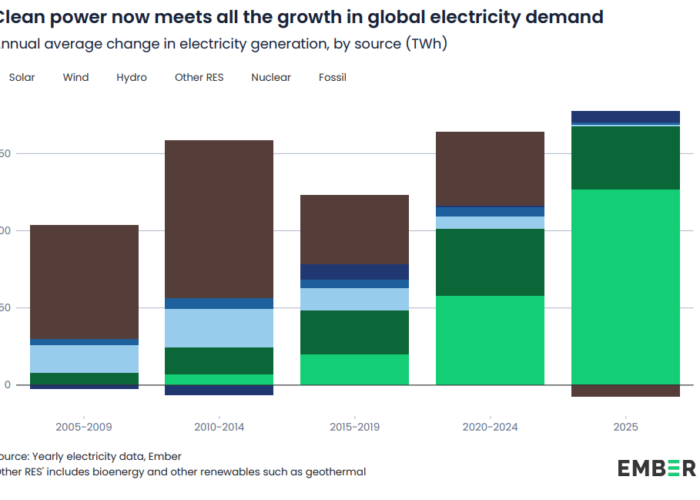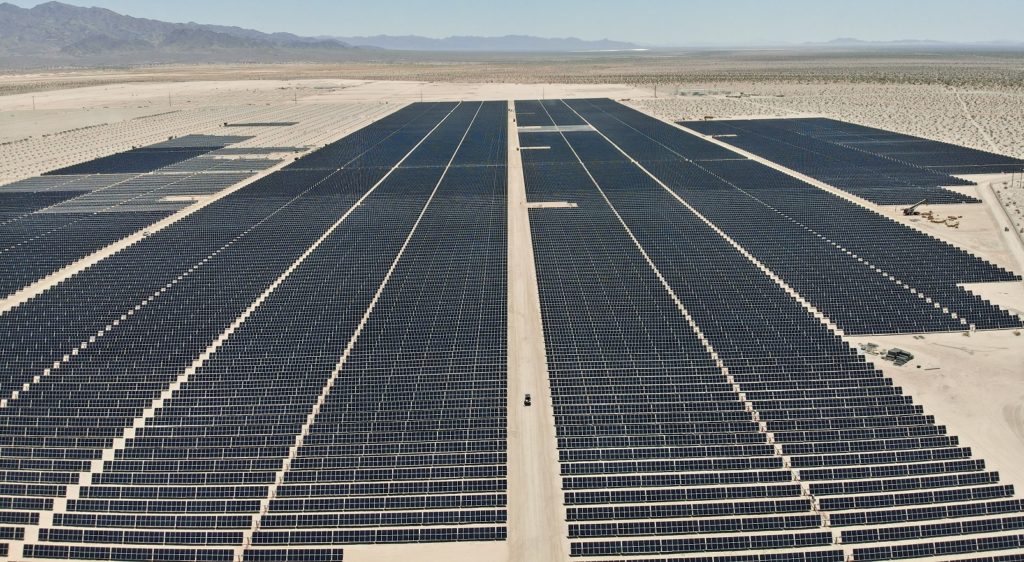
Solar and wind power reached a record 10% of global electricity in 2021. That milestone has now been reached by 50 countries across the world including all five of the world’s largest economies, although power sector emissions have reached an all-time high, according to energy thinktank Ember.
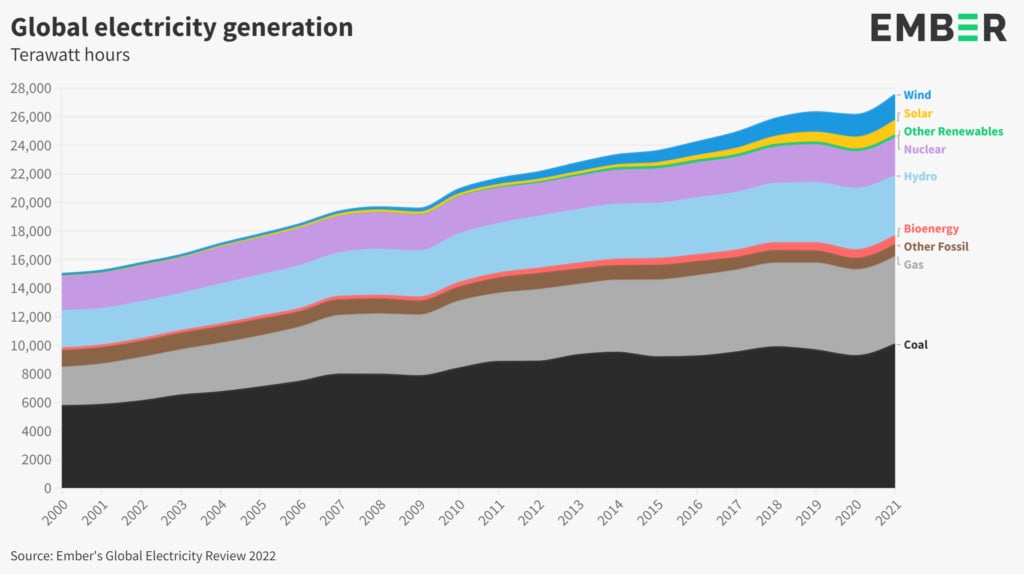
Ember’s third annual Global Electricity Review revealed that wind and solar generation grew by 17% in 2021 – solar by 23% and wind by 14% – while all clean electricity sources generated 38% of the world’s electricity in 2021, more than coal (36%).
Try Premium for just $1
- Full premium access for the first month at only $1
- Converts to an annual rate after 30 days unless cancelled
- Cancel anytime during the trial period
Premium Benefits
- Expert industry analysis and interviews
- Digital access to PV Tech Power journal
- Exclusive event discounts
Or get the full Premium subscription right away
Or continue reading this article for free
Wind and solar generated over a tenth (10.3%) of global electricity for the first time in 2021 – rising from 9.3% in 2020 – and twice the share compared to 2015 when the Paris Climate Agreement was signed (4.6%), the report said.
Both wind and solar need to sustain a compound growth rate of 20% every year to 2030 in order to keep the power sector on track for 1.5 degree Celsius of warming under the Paris Agreement, which is the same rate of growth as their average over the last decade, said Ember.
“Clean electricity now needs to be built on a heroic scale,” said Ember’s global lead Dave Jones. “Leaders are only just waking up to the challenge of how quickly they need to move 100% clean electricity.”
The fastest transformation is happening in the Netherlands, Australia and Vietnam, which have seen 8% of electricity demand switch from fossil fuels to wind and solar in the last two years alone. Previous research by Ember showed that solar in Europe was also booming, producing 27% more power last year than in 2019 and contributing to 6% of Europe’s electricity.
Global electricity demand has rebounded since the pandemic, however, rising by the most ever in absolute terms: 1,414TWh from 2020 to 2021, which is approximately the equivalent of adding a new India to the world’s electricity demand, said the report.
Despite a record rise in wind and solar generation, only 29% of the global rise in electricity demand in 2021 was met with wind and solar, with both nuclear and hydro power providing no extra growth, meaning the remaining demand was filled by fossil-fuels despite the tumbling cost of renewables.
As a result, power sector emissions have risen to an “all-time high”, rising 7% in 2021— the biggest percentage rise since 2010, and the biggest absolute rise ever. The 7% rise follows a fall of just 3% in 2020, putting emissions higher than before the pandemic hit, said Ember.
“Even as coal and power emissions hit another all-time high, there are clear signs that the global electricity transition is well underway,” said Jones. “More wind and solar is being added to grids than ever. And not just in a few countries, but across the world.”