Shifting market dynamics, the role of Europe in the world’s renewable energy investment landscape and growing concerns over Europe’s grid bottlenecks were key topics of conversation at this year’s Solar Finance & Investment Europe summit.
Hosted last week in London by PV Tech publisher Solar Media, over 350 experts from the finance and renewables sectors came together to discuss the challenges and opportunities facing the industry. And while much has changed in recent months in European renewables—from grid challenges to dealing with the increasingly anti-renewables rhetoric from the US—attendees stressed that the strong market fundamentals of European solar mean that the sector remains an attractive investment destination.
Try Premium for just $1
- Full premium access for the first month at only $1
- Converts to an annual rate after 30 days unless cancelled
- Cancel anytime during the trial period
Premium Benefits
- Expert industry analysis and interviews
- Digital access to PV Tech Power journal
- Exclusive event discounts
Or get the full Premium subscription right away
Or continue reading this article for free
“Some fundamentals remain,” said Daniel Machuca, global head of project finance at Sonnedix, during a panel discussion. “Long-term stability, mitigation of the construction risk and mitigation of the counterparty risk for PPAs are key. Lenders and institutional investors will look to invest in proven technologies, [and] do analysis based on the due diligence that is there.”
Several of Machuca’s panellists went on to suggest that a greater emphasis on investing in a whole portfolio, rather than individual projects, changes the decision-making calculus for renewable energy investments, altering these market dynamics slightly. “It is important to think about this in terms of portfolios,” argued Scott Douglas, senior director and head of debt advisory at Centrus, who spoke with PV Tech Premium exclusively following the panel.
“I think it’s about risk mitigation and diversification, from multiple angles: from an investor and developer perspective, [the goal is] balancing risk, not just in terms of technologies but in terms of different revenue model and different geographies as well,” he explained, suggesting that this shift towards portfolio-level consideration is part of a shift towards a more holistic view of investment opportunities, with the goal of minimising risk.
“That carries through into the financing market as well; lenders like that diversification and that portfolio effect,” he continued. “At our business we’re looking at supporting our client base through portfolio and platform financing, and things that incorporate a mix of geographies, technologies and revenue profiles.”
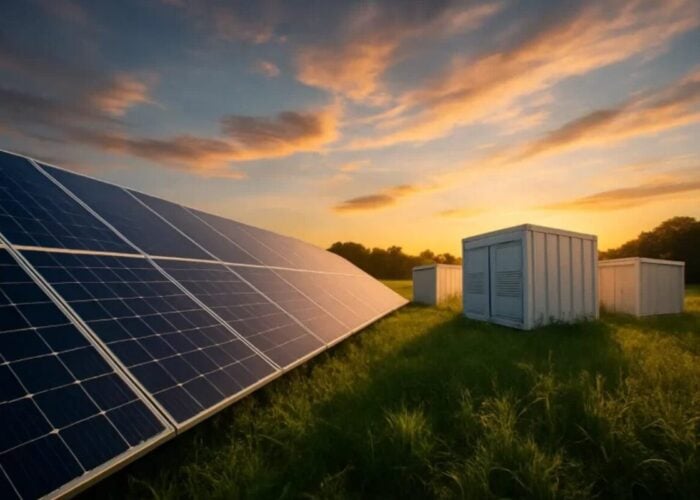
Investments into a range of technologies was another topic of discussion at the event, with the potential for the co-location of battery energy storage systems (BESS) with solar PV projects another example of a change to the investment calculus. As Priit Lepasepp, CEO of Sunly, said strikingly on a separate panel: “hybridise or die.”
However, Marta Valien, managing director and head of asset management at the Foresight Group, who spoke on another panel during the summit, argued that no single investment trend—be it technology, portfolio-level decision-making or policy and legislation—should singularly drive an investment decision. Indeed, during the event, she told PV Tech Premium that “you need to be looking at different factors”.
“You need to look at the jurisdiction [and] what kind of benefits [are in] that jurisdiction; for example in Spain we have a capacity market that will be giving out a more robust business case for investing in the technology, whereas here in the UK, it’s getting to the point where we would say it’s starting to get mature,” Valien explained.
“You have to analyse what you have in terms of resources, the legal framework you have in that jurisdiction [and] what is the appetite of the financing that you have behind [the project].”
The US, China and Europe’s position in the global solar supply chain
On the subject of the importance of legislation, the opening panel of the summit discussed how recent trends in US solar have affected the European industry. Much has been made of the challenging policy environment imposed on the solar sector by President Donald Trump, and at the beginning of the Solar Finance & Investment Europe summit, Domenico Tripodi, partner and co-head of investments at AIP Management, explained how the US is exposed to “country risk” for the first time.
Valien told PV Tech Premium that any changes in US policy constitute “macro-factors” that will “always” impact the European investment landscape, given the US’ influence over the global economy.
“These macro-factors are something that everyone is monitoring and always having an impact,” she said, drawing a parallel between the US’ sudden shift away from renewables and Russia’s invasion of Ukraine several years ago as dramatic shifts that have a significant impact on European power.
“You need to be looking at how it’s impacting on the revenue side, on the investment side [as] you have a renewable asset that’s linked to the market. You need to be paying attention to what the US is doing over there, and it may be helping the European countries.”
However, the doom and gloom associated with US policy is not necessarily indicative of struggles for European renewables. Both Valien and Tripodi’s fellow panellists suggested that uncertainty in US renewable energy investment could be a boon for Europe, as it becomes seen as a safer investment destination by default.
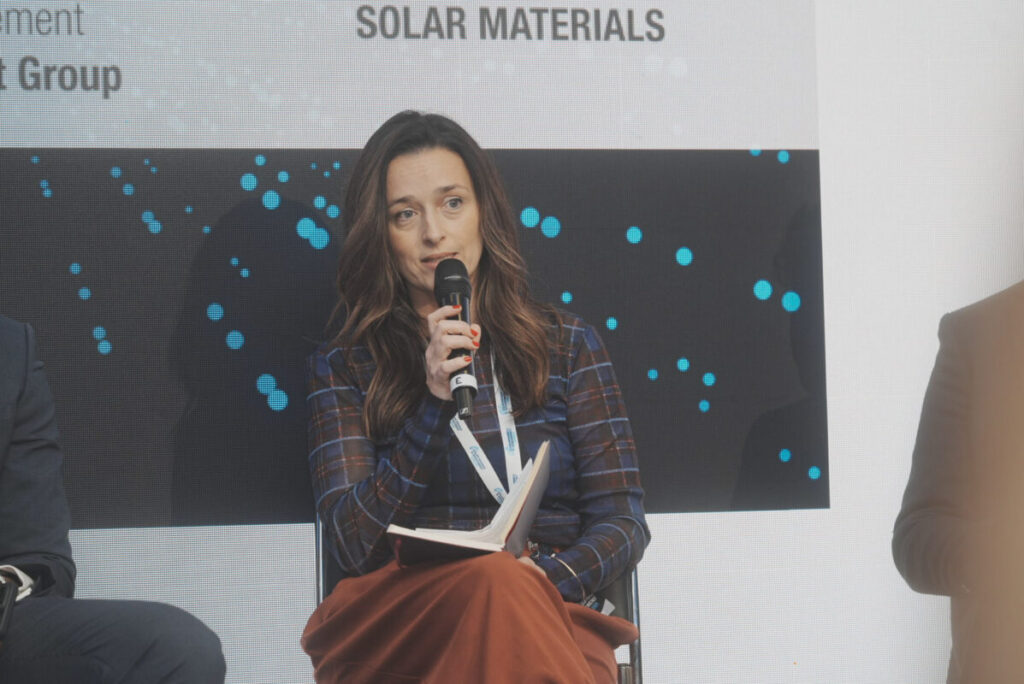
Jan-Philipp Mai, CEO of Solar Materials, also spoke PV Tech Premium during the summit about the potential for solar module recycling, and other industrial processes, to grow in Europe. He argued that the US’ emphasis on domestic production of solar modules and domestic generation of electricity from renewable energy sources could be informative for Europe.
“Of course, you have the ‘Make America Great Again’ story, which you can transfer to Europe, maybe from a different angle,” he said, acknowledging that Europe’s solar supply chains still leave the continent in a more vulnerable position than many would like.
“On the other hand, you’re still reliant on China from the solar manufacturing side; you cannot neglect that completely, so you still need partnerships, because what I think won’t come back is a big solar manufacturing industry in Europe.”
Private capital to help grid capacity challenges
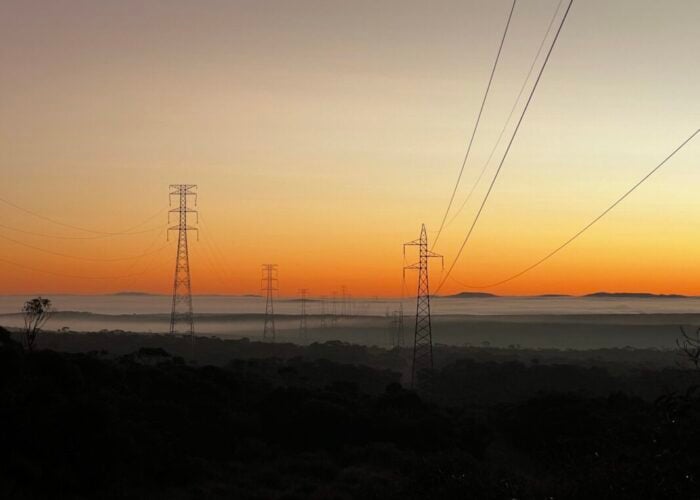
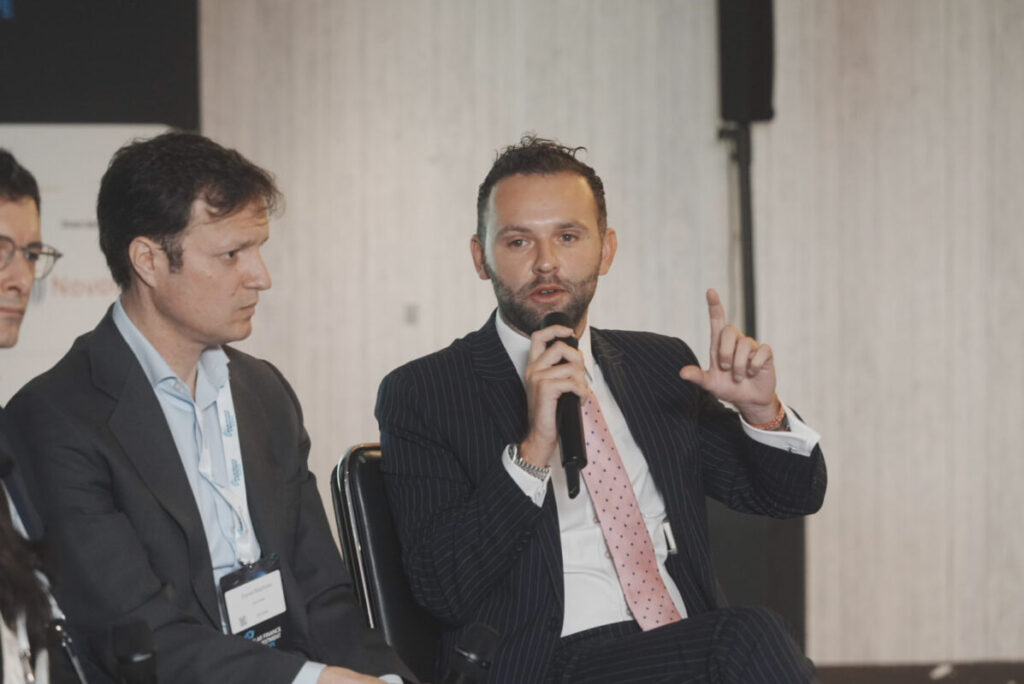
Predictably, another big topic of discussion was grid infrastructure. Speaking on a panel discussion held on the event’s first day, Larisa Bagyinka, vice president at I Squared Capital, said that €585 billion (US$696.6 billion) of new investment would be needed over the next five years to ensure Europe’s grid can accommodate the clean energy capacity currently under development, and that private capital could have a role to play in meeting this demand for investment.
“I think it’s a multi-faced solution to a complex problem,” Douglas said of the potential for private capital to help accelerate grid rollout. “I think we’ll see more collaboration between grid operators and private capital, more private networks and behind-the-meter type structure as well, to try to alleviate the grid bottleneck that’s one of the main issues facing the sector.”
Douglas also described the grid bottleneck issue as one that is “not an isolated issue”, but one that affects “countries around the world”. Last year, the Iberian blackout made headlines and exposed the vulnerabilities of the grid that supports one of the more mature solar PV markets in Europe, and Beatriz Llorente Blanco, head of growth, Iberia, at Sonnedix, told PV Tech Premium that the independent power producer (IPP) is “very focused” on grid and BESS investments in the region.
Llorente Blanco said that the availability of sun and wind in Spain and Portugal means renewables make “even more sense.” She continued: “We’ll be very focused on the grid and its constraints; we have issues with curtailment [and] we don’t have enough demand to consume the generation of the renewables, but renewables are part of the solution.”
“In Sonnedix, for example, we are working to integrate batteries with all our PV projects, to bring flexibility, grid-forming and adaptability to the needs of Red Eléctrica,” she continued. “What we have experienced, since the blackout definitely, is some more restrictive operations from Red Eléctrica that, in our view, shortly will be lifted, and that’s our expectation.”
Panellists also spoke about the benefits that smarter use of grid connections—namely the co-location of solar and storage projects to deliver both energy generation and grid-forming services at a single grid connection point, to eliminate the need for multiple grid connection points on grids that are already overwhelmed—could have for the European power sector.
“If you have just a PV project, it will be using the connection for 20% of the time, if you’re lucky, and the rest of the time, the grid connection is not used,” explained Johana Afenjar, COO at Telis Energy. “If you come back with battery storage and wind, you create a hub of generation and load shifting that helps minimise the grid usage, so that’s one thing that we did from the beginning in the UK.”
Read all of our coverage of the event, including in-depth analysis of the panel discussions mentioned in this article, here.