As Election Day inches closer, the prospect of ballot measure Amendment 1 becoming a bona fide constitutional amendment in Florida becomes even more pressing. In a press conference this week, former Florida governor and US senator Bob Graham detailed the shocking ramifications that the measure would have if it passed on 8 November.
After it was uncovered that utilities were engaging in a misleading strategy to dupe consumers into believing Amendment 1 was pro-solar, solar advocates have requested the Supreme Court to embargo the results of the vote until a decision is made.
'Deceptive' utility strategy to mislead Floridian consumers into believing Amendment 1 is pro-solar has been exposed in a leaked audio uncovered by an industry watchdog organisation.
Fair-weather solar advocate Arizona Public Service (APS), has become the first utility outside of California to surpass 1GW of solar energy capacity, reaching the milestone this summer.
Floridians may have voted in Amendment 4, a tax benefit that exempts renewable energy equipment on commercial buildings, but solar in Florida has much bigger problems to worry about.
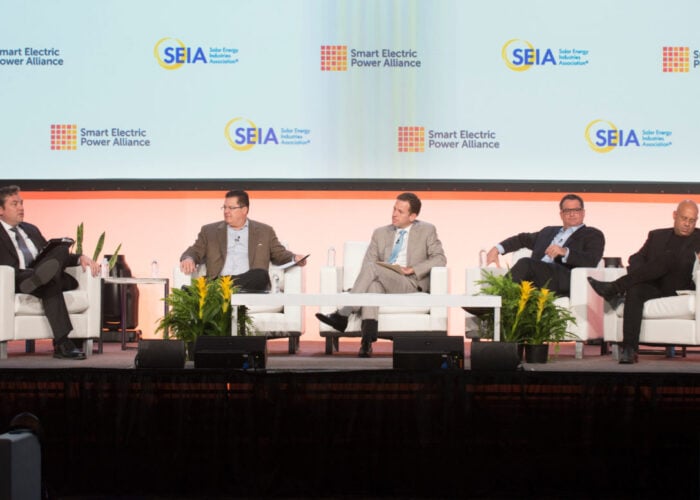
Despite US solar rapidly transitioning from an alternative energy source into a leading energy solution in recent years, barriers in regulation, communication and technology still prevent the industry from taking off into the mainstream arena, according to a panel of experts at Solar Power International (SPI) 2016.
Community solar is emerging as a promising new source of demand in the US, opening up access to solar among previously excluded groups. John Parnell reports on the prospects for a new market segment whose time seems to have come.
Energy storage in the US is being propelled forward by falling costs and increasingly favourable markets and policy. But for the full value of storage to be realised, numerous regulatory and fiscal barriers must still be surmounted, writes Matt Roberts, executive director of the Energy Storage Association.
Growing 43% year over year in 2016, the US solar industry is taking off at a pace no one could have foreseen. Naysayers may cite the industry’s slow start, hampered by high upfront costs and initial niche appeal as reasons why solar still will not experience a consumer boom. But panellists at the opening session of the 13th annual Solar Power International convention made it clear just how solar energy could exceed expectations and is poised for not only growth, but mainstream acceptance.
A member of the Alabama Public Service Commission (PSC) has sought a lease for a community solar plant on his land, that would pay US$5.6 million over a 25-year lease, despite previously voting against net metering for the state, said reports.